ICE & CEDAR

The best indoor saunas, and what each one asks of the room

Outdoors a sauna only has to survive the weather. Indoors it has to fit a doorway, a ceiling, a floor joist and a branch circuit. Of the five cabins here that publish 120V, two stay inside what a 15A circuit carries continuously.

Last verified · Ice & Cedar editorial

The verdict

For a room you can run a 240V circuit to, the HOSAUNA HY5 2-person steam cabin is the pick: it is the only cabin on this page that publishes a wood moisture content, a bench width and a seated weight limit alongside a 195°F maximum, and the only cabin here that publishes a warranty term at all. If a dedicated circuit is not on the table, go infrared and go by the computed column rather than the title — the Albott 1-person cabin makes the smallest electrical ask on the page, and the OUTEXER corner cabin is the only shape that fits a spare room by using a wall junction. Read the circuit figure on every card before you read the price; it is the number that decides whether the cabin can live where you want it.

An indoor sauna is a different purchase from an outdoor one, and not because the cabins differ much. It is because the constraints move. A barrel in the yard has to survive weather and sit on something level. A cabin in a bedroom, a basement or a tiled bathroom has to clear a doorway, fit under a ceiling, load a floor you cannot inspect, put its moisture somewhere, and draw its power from a circuit that is probably already carrying something else.

That last constraint is the one the listings are least honest about, and it is where this page does its work. eight of the nine cabins compared here publish rated watts and seven publish a voltage, but only one publishes an amperage - a figure its own wattage does not support — and a sauna heater is a continuous load, which the National Electrical Code sizes at 125% of the current it actually draws. Run that rule over each cabin’s own published figures and three of the five plug-in cabins need a 20A circuit rather than the 15A outlet in most bedrooms, while two of them advertise an outlet rating in their own titles that their own wattage does not support. Every amp and breaker figure on this page is computed by the same arithmetic we show on our electrical pages. None of it is asserted.

So this page ranks on five criteria, in this order: what the room has to supply electrically, because that is what makes a cabin possible or impossible where you want it; whether it fits through the door and under the ceiling, published rather than guessed; how hot it actually gets, read within heat type rather than across it; how much the listing publishes at all, because the blanks correlate with the things you will discover later; and only then price.

One scope note, so you can tell this page from its neighbors. Every cabin below is sited indoors by its own listing. Our infrared roundup ranks infrared cabins against each other on their own merits, and our outdoor roundup takes weather and siting as the gate. This page takes the room as the gate, which is why it is the only one of the three where a traditional stove cabin and a plug-in infrared box appear in the same ranking: indoors they compete for the same square footage.

We have not tested any of these cabins; we own none of them. Here is exactly what we do instead. Every specification below was read from the seller’s own Amazon listing on the date printed on each card, every cabin was in stock and returned a live price when it was read, and prices on this page are live rather than typed into the text.

Quick picks

Ranked on published specifications. Select a row to jump to the full write-up. We have not tested these units — here is exactly what we do instead.

#ProductHeatVoltsCircuitBest forPrice
1
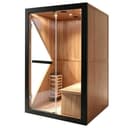
HOSAUNA HY5 2-Person Traditional Steam Sauna, 3 kW

HOSAUNA HY5 2-Person Traditional Steam Sauna, 3 kW

The most completely specified indoor cabin here and the only one that publishes a wood moisture content, a bench width and a seated weight limit. It is also real steam in a room inside your house, which is a ventilation decision as much as a purchase.

Stove240V20ABest overall
$2,699.00 · View on Amazon

Price as of October 9, 2026. #ad How we’re funded

2
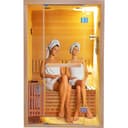
OUTEXER Traditional Steam Sauna, 2-3 Person, 3kW

OUTEXER Traditional Steam Sauna, 2-3 Person, 3kW

The only unit on this page that is a sauna in the Finnish sense — a 3kW stove, stones, and water you can throw on them. It is also the only one whose circuit is unambiguous, because 240V appliances are wired, not plugged, so nobody has to pretend an outlet will do.

Stove240V20AClearest install
$2,699.00 · View on Amazon

Price as of October 9, 2026. #ad How we’re funded

3
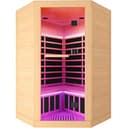
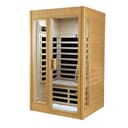
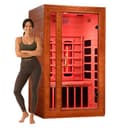
OUTEXER 2-3 Person Corner Infrared Sauna, 2100W

OUTEXER 2-3 Person Corner Infrared Sauna, 2100W

The only cabin on this page that publishes all four install numbers — wattage, voltage, amperage and exterior dimensions — which is also how you discover that its own 20A claim does not survive the code arithmetic. Ranked first for telling you enough to catch it.

Infrared120V25ABest corner fit
$1,999.00 · View on Amazon

Price as of October 9, 2026. #ad How we’re funded

4
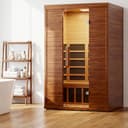
EASYHAWK 2 Person Infrared Sauna, 1500W

EASYHAWK 2 Person Infrared Sauna, 1500W

A two-person cabin that states 1,500W at 120V and adds WiFi app control. The most powerful indoor unit here — and, at 12.5A, the one that sits closest to a standard outlet's continuous limit.

Infrared120V20ABest two-seat plug-in
$1,249.99 · View on Amazon

Price as of October 9, 2026. #ad How we’re funded

5
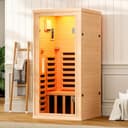
Kanlanth MST902GHC 2-Person Side-Glass Infrared Sauna, 1,500W

Kanlanth MST902GHC 2-Person Side-Glass Infrared Sauna, 1,500W

The only cabin here that publishes a built-in ceiling vent and a numbered safety cut-out, which indoors matters more than another twenty degrees. Its 1,500W on the 120V/15A outlet it names computes past what a 15A circuit carries continuously, which is the single most useful thing to know before you site it.

Infrared120V20AOnly cabin with a vent
$999.00 · View on Amazon

Price as of October 9, 2026. #ad How we’re funded

6
RESTISLAND Full Spectrum Infrared Sauna, 1 Person, 1178W

RESTISLAND Full Spectrum Infrared Sauna, 1 Person, 1178W

The most completely specified cabin here: 1,178W at 120V, full-spectrum with named 660/850nm red-light wavelengths, and actual published dimensions. Everything you need to plan the corner it goes in.

Infrared120V15ABest single seat
$1,459.99 · View on Amazon

Price as of October 9, 2026. #ad How we’re funded

7
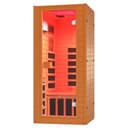
Albott Infrared Sauna, 1 Person, 1260W

Albott Infrared Sauna, 1 Person, 1260W

The most forthcoming listing in the set: 1,260W at 110V, seven carbon panels, Canadian hemlock. It states the two numbers — wattage and voltage — that decide whether it plugs into your wall, and most infrared listings state neither.

Infrared120V15ASmallest electrical ask
$999.99 · View on Amazon

$1,400.0029% off

Price as of October 9, 2026. #ad How we’re funded

8
ENSTVER Full Spectrum Infrared Sauna, 1 Person, 1240W

ENSTVER Full Spectrum Infrared Sauna, 1 Person, 1240W

The cheapest full-spectrum cabin here, and it still publishes its 1,240W draw and its Canadian hemlock construction. The honest entry point to infrared.

InfraredNot publishedNot publishedCheapest way in
$699.99 · View on Amazon

$739.995% off

Price as of October 9, 2026. #ad How we’re funded

9
Dynamic Saunas Cordoba 2-Person Full Spectrum Infrared Sauna

Dynamic Saunas Cordoba 2-Person Full Spectrum Infrared Sauna

The established name in this comparison. Dynamic Saunas is a known infrared brand and the Cordoba is full-spectrum hemlock — but the listing publishes neither wattage nor voltage, so it ranks on track record rather than on disclosure.

InfraredNot publishedNot publishedBest-known brand
#1Best overall

HOSAUNA HY5 2-Person Traditional Steam Sauna, 3 kW

The most completely specified indoor cabin here and the only one that publishes a wood moisture content, a bench width and a seated weight limit. It is also real steam in a room inside your house, which is a ventilation decision as much as a purchase.

Strengths

  • Publishes 195°F maximum and a 3,000W stove with volcanic stones — a traditional loyly cabin, not a dry box
  • Publishes its wood species (Okoume) AND a controlled 8-15% moisture content, which nothing else here states
  • Publishes a 43.3 in bench width and a 265 lb seated support figure
  • Exterior dimensions published at 47.2 x 47.2 x 74.8 in, so you can check it against a doorway
  • 7-year warranty stated — by far the longest term on this page
  • Snap-lock modular panels the listing says two adults assemble without tools

Trade-offs

  • 220-240V: this is not a cabin you plug into a bedroom outlet, and the listing says so
  • Real steam in an interior room needs ventilation and a floor that tolerates water — neither is in the box
  • Publishes no amperage, so the circuit has to be computed from the stove's rated watts
  • 74.8 in tall before you add clearance, which rules out most basements with ductwork
  • No heat-up time published, unlike the traditional cabin below it
Heat typeTraditional stove and stones
Seats (as published)2
Rated power3,000 W (3 kW)
Voltage240V
Current at rated power (computed)12.5A
Circuit required, NEC 125% (computed)20A
Maximum temperature195°F
Exterior size (as published)47.2" x 47.2" x 74.8"
WoodOkoume, 8-15% moisture content
Interior volumeNot published
Warranty84 months

Specifications as published by the manufacturer listing, read on October 9, 2026. Blank fields are specs the manufacturer does not publish.

#2Clearest install

OUTEXER Traditional Steam Sauna, 2-3 Person, 3kW

The only unit on this page that is a sauna in the Finnish sense — a 3kW stove, stones, and water you can throw on them. It is also the only one whose circuit is unambiguous, because 240V appliances are wired, not plugged, so nobody has to pretend an outlet will do.

Strengths

  • A genuine traditional room: electric stove, stones, and a bucket and ladle in the box
  • Publishes 3kW at 240V, which computes cleanly to a 20A dedicated circuit
  • Steam means humidity control, the half of the experience an infrared cabin cannot offer at all

Trade-offs

  • 240V means an electrician and a dedicated circuit before delivery day, not after
  • The wood is not named anywhere in the listing
  • No exterior dimensions and no maximum temperature published
  • Highest asking bracket on the page
Heat typeTraditional stove and stones
Seats (as published)3
Rated power3,000 W (3 kW)
Voltage240V
Current at rated power (computed)12.5A
Circuit required, NEC 125% (computed)20A
Maximum temperatureNot published
Exterior size (as published)Not published
WoodNot published
Interior volumeNot published
WarrantyNot published

Specifications as published by the manufacturer listing, read on October 2, 2026. Blank fields are specs the manufacturer does not publish.

#3Best corner fit

OUTEXER 2-3 Person Corner Infrared Sauna, 2100W

The only cabin on this page that publishes all four install numbers — wattage, voltage, amperage and exterior dimensions — which is also how you discover that its own 20A claim does not survive the code arithmetic. Ranked first for telling you enough to catch it.

Strengths

  • Publishes 2,100W, 120V, 20A and a 47.2 x 47.2 x 74.8 in cabinet — no other listing here states all four
  • Names Canadian hemlock rather than leaving the wood as 'wood'
  • Square corner footprint, so it loses a corner of a room rather than a wall

Trade-offs

  • 2,100W at 120V is 17.5A continuous, and the NEC 125% rule puts that past what a 20A branch circuit may carry — despite the title's '20A'
  • No maximum temperature published, so there is no way to compare its heat to a traditional room
  • No warranty term published
  • 'Low-EMF' is used without a figure, unlike the 0-5 mG cabin below
Heat typeFar infrared panels
Seats (as published)3
Rated power2,100 W (2.1 kW)
Voltage120V
Current at rated power (computed)17.5A
Circuit required, NEC 125% (computed)25A
Maximum temperatureNot published
Exterior size (as published)47.2" x 47.2" x 74.8"
WoodCanadian hemlock
Interior volumeNot published
WarrantyNot published

Specifications as published by the manufacturer listing, read on October 2, 2026. Blank fields are specs the manufacturer does not publish.

#4Best two-seat plug-in

EASYHAWK 2 Person Infrared Sauna, 1500W

A two-person cabin that states 1,500W at 120V and adds WiFi app control. The most powerful indoor unit here — and, at 12.5A, the one that sits closest to a standard outlet's continuous limit.

Strengths

  • Seats two and still runs on 120V
  • Publishes 1,500W / 120V outright
  • WiFi app and Bluetooth control included

Trade-offs

  • At 1,500W it draws 12.5A — close enough to a 15A outlet's continuous limit that it wants a dedicated 20A receptacle
  • Wood species is listed only as 'wooden'
  • Far-infrared panels, not full spectrum
Heat typeFar infrared panels
Seats (as published)2
Rated power1,500 W (1.5 kW)
Voltage120V
Current at rated power (computed)12.5A
Circuit required, NEC 125% (computed)20A
Maximum temperatureNot published
Exterior size (as published)Not published
WoodNot published
Interior volumeNot published
WarrantyNot published

Specifications as published by the manufacturer listing, read on July 20, 2026. Blank fields are specs the manufacturer does not publish.

#5Only cabin with a vent

Kanlanth MST902GHC 2-Person Side-Glass Infrared Sauna, 1,500W

The only cabin here that publishes a built-in ceiling vent and a numbered safety cut-out, which indoors matters more than another twenty degrees. Its 1,500W on the 120V/15A outlet it names computes past what a 15A circuit carries continuously, which is the single most useful thing to know before you site it.

Strengths

  • Sits at the bottom of the price band for a hemlock-panel cabin rather than a fabric tent
  • Publishes a built-in ceiling vent — the only cabin here that states one, and it matters indoors
  • Publishes a numbered safety shut-off at 110°C as well as a 140°F operating ceiling
  • Compact 43.2 x 38.3 x 73 in, the smallest footprint on this page
  • Side glass on two faces, which makes a small cabin tolerable rather than a box

Trade-offs

  • The listing says 120V/15A household outlet, but 1,500W at 120V is 12.5A continuous, and the NEC 125% rule puts the required capacity above a 15A circuit
  • 140°F is the lowest maximum temperature on this page
  • No warranty term published at all — the warranty bullet is a support promise, not a term
  • No interior volume, no wood moisture content, no weight published
  • Smallest footprint means two adults are genuinely close together
Heat typeFar infrared panels
Seats (as published)2
Rated power1,500 W (1.5 kW)
Voltage120V
Current at rated power (computed)12.5A
Circuit required, NEC 125% (computed)20A
Maximum temperature140°F
Exterior size (as published)43.2" x 38.3" x 73"
WoodCanadian hemlock
Interior volumeNot published
WarrantyNot published

Specifications as published by the manufacturer listing, read on October 9, 2026. Blank fields are specs the manufacturer does not publish.

#6Best single seat

RESTISLAND Full Spectrum Infrared Sauna, 1 Person, 1178W

The most completely specified cabin here: 1,178W at 120V, full-spectrum with named 660/850nm red-light wavelengths, and actual published dimensions. Everything you need to plan the corner it goes in.

Strengths

  • Publishes wattage, voltage AND exterior dimensions (31.5 x 30.3 x 67 in) — rare in this category
  • Full-spectrum heaters with stated 660/850 nm red-light wavelengths, and goggles in the box
  • Canadian hemlock and a tempered glass door, on a 120V draw that runs from a standard outlet

Trade-offs

  • A tight one-person footprint despite the full spec sheet
  • The red-light wavelength figures are the manufacturer's, not measured by us
  • Priced above the other one-person cabins here
  • Publishes a 122°F-in-15-minutes warm-up but no maximum temperature, and no warranty term
Heat typeFar infrared panels
Seats (as published)1
Rated power1,178 W (1.178 kW)
Voltage120V
Current at rated power (computed)9.8A
Circuit required, NEC 125% (computed)15A
Maximum temperatureNot published
Exterior size (as published)31.5" x 30.3" x 67"
WoodCanadian hemlock
Interior volumeNot published
WarrantyNot published

Specifications as published by the manufacturer listing, read on September 29, 2026. Blank fields are specs the manufacturer does not publish.

#7Smallest electrical ask

Albott Infrared Sauna, 1 Person, 1260W

The most forthcoming listing in the set: 1,260W at 110V, seven carbon panels, Canadian hemlock. It states the two numbers — wattage and voltage — that decide whether it plugs into your wall, and most infrared listings state neither.

Strengths

  • Publishes both wattage and voltage (1,260W / 110V) — most infrared listings give one or neither
  • Seven carbon heating panels and Canadian hemlock
  • Runs from a standard 120V household outlet (listed as 110V)

Trade-offs

  • Single-person cabin
  • Far-infrared carbon panels rather than full spectrum
  • Interior dimensions are not published
Heat typeFar infrared panels
Seats (as published)1
Rated power1,260 W (1.26 kW)
Voltage120V
Current at rated power (computed)10.5A
Circuit required, NEC 125% (computed)15A
Maximum temperatureNot published
Exterior size (as published)Not published
WoodCanadian hemlock
Interior volumeNot published
WarrantyNot published

Specifications as published by the manufacturer listing, read on July 20, 2026. Blank fields are specs the manufacturer does not publish.

#8Cheapest way in

ENSTVER Full Spectrum Infrared Sauna, 1 Person, 1240W

The cheapest full-spectrum cabin here, and it still publishes its 1,240W draw and its Canadian hemlock construction. The honest entry point to infrared.

Strengths

  • Least expensive cabin compared here
  • Publishes a 1,240W rated draw — enough to size the outlet
  • Full-spectrum panels and Canadian hemlock

Trade-offs

  • Voltage is not stated on the listing — confirm it is a standard 120V plug before you buy
  • A one-person footprint with no room to lie back
  • No dimensions published beyond a 5.4 ft height
Heat typeFar infrared panels
Seats (as published)1
Rated power1,240 W (1.24 kW)
VoltageNot published
Current at rated power (computed)Not published
Circuit required, NEC 125% (computed)Not published
Maximum temperatureNot published
Exterior size (as published)Not published
WoodCanadian hemlock
Interior volumeNot published
WarrantyNot published

Specifications as published by the manufacturer listing, read on July 20, 2026. Blank fields are specs the manufacturer does not publish.

#9Best-known brand

Dynamic Saunas Cordoba 2-Person Full Spectrum Infrared Sauna

The established name in this comparison. Dynamic Saunas is a known infrared brand and the Cordoba is full-spectrum hemlock — but the listing publishes neither wattage nor voltage, so it ranks on track record rather than on disclosure.

Strengths

  • From an established infrared-sauna brand rather than a generic seller
  • Full-spectrum heaters and Canadian hemlock
  • Two-person cabin

Trade-offs

  • Publishes neither wattage nor voltage — you cannot size the circuit from the listing
  • By far the most expensive unit here
  • Interior dimensions and volume are not published
Heat typeFar infrared panels
Seats (as published)2
Rated powerNot published
VoltageNot published
Current at rated power (computed)Not published
Circuit required, NEC 125% (computed)Not published
Maximum temperatureNot published
Exterior size (as published)Not published
WoodCanadian hemlock
Interior volumeNot published
WarrantyNot published

Specifications as published by the manufacturer listing, read on July 20, 2026. Blank fields are specs the manufacturer does not publish.

How to choose an indoor sauna

Start with the circuit, because it is the only criterion that can rule a cabin out entirely. A sauna heater runs for hours, which makes it a continuous load, and the NEC sizes continuous loads at 125% of the actual current. In practice that means a 15A circuit carries 12A of continuous load and a 20A circuit carries 16A. Of the five cabins here publishing 120V, two stay under the 15A allowance on their own numbers and three do not. The twostove cabins publish 3 kW on 220-240V, which is a dedicated circuit and an electrician in every case — no amount of reading gets around that one. Which saunas actually plug into a normal outlet works through the whole rule.

Then check the height against the ceiling, not the width against the door. four of these nine cabins publish exterior dimensions, and the heights among those run 67 to 74.8inches. That is the dimension that disqualifies rooms: a standard eight-foot ceiling is 96 inches, and ductwork or a soffit in a basement can take a foot of that. Width is less of a problem than it looks, because these arrive as flat panels and assemble in the room — but weight is a real one, and the two stove cabins are the heavy class here by a wide margin. Putting a sauna in a basement and fitting one in a small space cover the clearances properly.

Then decide on heat type, and decide it on moisture rather than on marketing. Indoors, the honest difference between a traditional stove and an infrared panel is what leaves the cabin. A stove with stones you pour water over produces steam, in a room with a ceiling, a wall finish and a floor you probably care about; one of the cabins here is the only one on the page that publishes a built-in ceiling vent, and it is an infrared unit. Infrared heats you rather than the air, produces no steam, and that is why its published maximums here (140°F) sit so far below the stove cabins (195°F). Those are not the same number measured differently. Infrared versus traditional is the long version, and sauna ventilation is the part people skip.

Then count what the listing publishes, and read the blanks as information rather than oversight. Across these nine cabins: two publish a maximum temperature, four publish exterior dimensions, one publish a warranty term, one publishes amperage, and nonepublishes an interior volume. That last blank is the most consequential one, because interior volume against heater kW is how you check whether the stove that came with the cabin is correctly sized for it — our heater sizing calculator runs that arithmetic, and not one cabin here gives you the input.

Then, and only then, compare prices. The spread here is wide enough that the cheapest cabin and the most expensive are plainly different products, and the ranking above does not follow it: the only cabin publishing a ceiling vent and a numbered safety cut-out sits near the bottom of the price band, which earns it a place above units costing considerably more, and the cabin carrying the one brand name most people would recognize publishes less than anything else here, which is why it ranks last. If budget is the binding constraint, our best infrared saunas for the money page ranks on cost per usable year instead of on sticker price, and what a home sauna really costs adds the install and the running cost the listings leave out.

The circuit arithmetic, cabin by cabin

This is the part of the decision the listings hand back to you, so here it is worked through. The rule is 125%: a load that runs for three hours or more is continuous, and its circuit is sized at 125% of the current it actually draws. A sauna session is an hour; a sauna heater reaching and then holding temperature is longer than that, every time.

CabinPublishedDrawsNeeds (125%)Circuit
HOSAUNA 2-seat3,000 W / 240V12.5A15.6A20A
OUTEXER 3-seat3,000 W / 240V12.5A15.6A20A
OUTEXER 3-seat2,100 W / 120V17.5A21.9A25A
EASYHAWK 2-seat1,500 W / 120V12.5A15.6A20A
Kanlanth 2-seat1,500 W / 120V12.5A15.6A20A
RESTISLAND 1-seat1,178 W / 120V9.8A12.3A15A
Albott 1-seat1,260 W / 120V10.5A13.1A15A
ENSTVER 1-seat1,240 W———
Dynamic Saunas 2-seatNot published———

Two things fall out of that table. The first is that the twotraditional cabins are not a plug-in decision at any point — 3 kW on 240V is a dedicated circuit, and the only question is who runs it. The second is subtler and more useful: three of the fiveplug-in cabins compute past what a 15A circuit carries continuously, which is the circuit behind most bedroom and spare-room outlets. Those cabins will run on a 15A outlet in the sense that the breaker may not trip on the first session. They are not, by the code’s own sizing rule, loads that circuit was built to carry for an hour at a time, several times a week, for years.

A dash in the last two columns is a cabin that publishes watts but no voltage, or neither. We do not fill those in by assuming a category default, which is why two of the ninecabins have no computed circuit at all. If one of those is the cabin you want, ask the seller for the voltage before you ask an electrician for a quote — and read 240V versus 120V saunas so you know what the answer commits you to.

What an indoor cabin does to the room

Moisture.A traditional stove cabin with stones you pour water over is a steam appliance, and the steam does not stay in the cabin. In a tiled bathroom with an extractor that is a non-issue; in a carpeted spare bedroom it is a slow problem that shows up in the paint. Exactly one cabin on this page publishes a built-in ceiling vent — and it is an infrared unit, which needed it least. Our ventilation guide covers what the cabin needs and what the room needs, which are different questions.

Weight. The two 240V stove cabins are the heavy class here, because a stove, a basket of stones and thick panels are heavy in a way carbon panels are not. Add two adults and a bench and a cabin of this size concentrates several hundred pounds into under 16 square feet. On a slab or a basement floor that is nothing. On a first-floor joist span it is worth asking someone about, and nobody selling these mentions it.

Heat leaving the cabin. A sauna is a heater in a room whose heat you otherwise pay to control. In winter that is a free bonus; in an air-conditioned house in summer it is a second energy bill you did not plan on, because your AC is removing what the sauna added. That is the one honest argument for siting a cabin in a garage or a basement rather than upstairs, and it is also why what an infrared cabin costs to run is a floor rather than a total.

Assembly. The top-ranked stove cabin publishes tool-free snap-lock panels and specifies two adults. Take that seriously in both directions: it means you do not need a contractor, and it means you need a second person and a clear path from the front door to the room. These do not go up a spiral staircase.

Frequently asked questions

Can I just plug an indoor sauna into a normal outlet?

Some of these, with a caveat the listings skip. five of the nine cabins here publish 120V, and a sauna heater is a continuous load - it runs for well over three hours at a time - so the NEC sizes its circuit at 125% of the current it actually draws. Run that on each cabin's own published watts and two of the five plug-in cabins stay inside what a 15A circuit carries continuously; the rest need a 20A circuit, and one computes past even that. The computed figure is on every card above. Two of these listings name an outlet rating in their own title that their own wattage does not support, which is exactly why we compute rather than quote.

Traditional or infrared, for a room inside the house?

Indoors this is an electrical and a moisture question before it is a wellness one. The two traditional stove cabins here publish 3 kW on 220-240V, which means a dedicated 240V circuit and an electrician, plus real steam in a room with a ceiling and a floor you care about. The seven infrared cabins publish 140-140°F against 195-195°F, produce no steam at all, and mostly run on a household circuit. If the room is a finished basement or a spare bedroom, infrared is the far easier install. If the room is a tiled bathroom with a drain and you want loyly, the stove cabin is the real thing and the extra work is the price of it.

What does an indoor sauna do to the room it is in?

Three things worth planning for. It raises the humidity, substantially on a steam cabin and marginally on infrared, so the room needs somewhere for that moisture to go - a window, an extractor, or a cabin with its own vent. It needs clearance above and around it, because the published height is the cabin, not the installation. And it loads the floor: a two-seat stove cabin is several hundred pounds empty before two adults get in, which is a question for a floor joist rather than a tape measure. Our guide to putting a sauna in a basement works through the moisture half, and the one on fitting a sauna in a small space works through the clearance half.

Will it fit through my door and under my ceiling?

Check the published height first, because it is the dimension that disqualifies rooms. four of the nine cabins here publish exterior dimensions, and among those the heights run from 67 to 74.8 inches. A standard eight-foot ceiling is 96 inches, so the tallest cabin here leaves roughly twenty inches - fine until you meet a basement with ductwork or a soffit. Width matters less than you would think, because these ship as flat panels and assemble in the room; the heavy ones are a two-person carry per panel, not a single crated box through a doorway.

Why is the maximum temperature so different between these?

Because they are heating different things. A traditional stove heats the air, and the two stove cabins here publish 195°F. Far infrared heats you directly and leaves the air cooler, which is why the infrared cabins here publish 140°F and why comparing the two numbers head to head is misleading. A 140°F infrared session and a 190°F stove session are not the same experience at different intensities; they are different mechanisms. two of the nine cabins here publish a maximum at all, which is better than this category usually manages.

Do any of these publish an amperage figure?

one of the nine - and the one that does prints a figure its own wattage does not support, which is the best argument on this page for computing rather than quoting. Every amp and breaker figure here is computed from the cabin's own published watts and volts using the NEC continuous-load rule, and the arithmetic is shown rather than asserted. That is also why two of these cabins show "Not published" in the circuit column: they publish watts but no voltage, or neither, and we will not infer a voltage from a product category. If you are specifying a circuit, give the computed figure to the electrician as a starting point and let them confirm it against your panel and your local code cycle.

Is an indoor cabin worth it over a sauna blanket?

A blanket is a tenth of the price, needs no circuit and stores in a closet; a cabin is a room you sit up in, at real sauna temperatures, that two people can share. The blanket is the right purchase for finding out whether heat therapy sticks for you, and the honest observation is that a lot of blankets end up in closets. If it has stuck, a cabin is the version you will actually use daily, because the friction of opening a door is lower than the friction of wrapping yourself in something. We compare the two directly on our sauna blanket versus infrared sauna page.

Why don't you score these out of ten?

Because a score implies a measurement and we have measured nothing - we own none of these cabins. Every figure above was read from the seller's own listing on the date printed on each card, and every blank is a spec the seller does not publish. The blanks on this page are unusually informative: not one of these nine cabins publishes an interior volume, which is the figure that would let you check whether the heater is correctly sized for the room it came with. We rank in prose you can argue with and show you the computed arithmetic underneath it.

Related

Sources