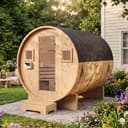
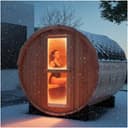
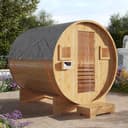
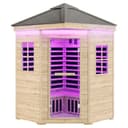
Start with heat type, because it decides whether winter works at all. A traditional stone heater is the cold-climate answer: it raises the air, the benches and a mass of stones together, so the cabin holds temperature and recovers when someone opens the door into a snowdrift. Infrared heats you and largely leaves the room alone, which is efficient and pleasant in a temperate space and much less convincing when the structure around you is at freezing. The one genuine reason to choose infrared outdoors is electrical: the Albott cabin here draws 11.9A computed against the 25A of a 6kW traditional heater, and it is the only unit in this survey that publishes an amperage outright. If your panel cannot carry a traditional heater, that is a real trade-off honestly made — but it is a different experience, not a cheaper version of the same one.
Then demand a published heater rating, because it is the only cold-climate variable you can check in advance. The sizing rule gives you roughly 50 cu.ft per kW in an insulated room, so a 6kW heater covers about 300cu.ft on paper — a figure that assumes a temperate day and a well-sealed cabin. In a cold climate treat that number as a ceiling rather than a target and lean to the larger heater when you are between two. A listing that will not print kW takes that entire calculation away from you. Every unit on this page does print it — what none of them prints is the interior volume to run it against, so the rule of thumb is as far as the listings will let anyone take you.
Then read the wood, because freeze-thaw is what ages it. A cold, wet climate does not attack a sauna with cold so much as with cycles: snow melts against the shell, soaks in, freezes overnight and expands. Cedar earns its premium here for its natural rot and moisture resistance, which is the honest case for the Backyard Discovery units. Three of the barrels on this page state no species at all beyond “wood” — that is a genuine unknown, not a neutral omission, and it is the main thing you are accepting when you save a thousand dollars. The Albott is the exception among the cheaper units: it names Finnish spruce and an asphalt shingle roof.
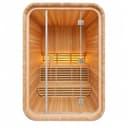
Then think about shape, roof and where it sits.A barrel’s curved roof gives snow nowhere flat to accumulate, and a cylinder wraps a given number of seats in less surface area than a box — less envelope, less heat loss. That is geometry, not a published spec, and we present it as such. A cube like the Duthss trades that for full standing headroom and a flat wall you can put against the house, which in a windy cold climate is a real advantage: siting a sauna in the lee of a building does more for your heat-up time than most upgrades. The pad underneath matters as much — ground that freezes heaves, and a base that moves in winter pushes the structure out of level.
Then treat insulation as part of the heater decision, not a separate one. The 25% penalty our sizing engine applies to uninsulated surfaces is not a rounding error in a cold climate; it is the difference between the 6kW and 8kW answers above, and between a 35A and a 45A circuit. Nobody in this category publishes a wall thickness or an R-value, so you cannot compare cabins on it directly — which means the practical levers are sealing the door properly, not skimping on the heater, and understanding how a sauna is insulated before you buy the cheapest shell you can find.
Finally, price the circuit and the trench together, because winter changes that job too. A 6kW heater draws 25A continuously; the NEC treats a sauna heater as a continuous load and sizes the circuit at 125% of that, or 31.3A, which points at a 35A dedicated breaker — though many manufacturers specify a 30A circuit, and where a unit is listed and its instructions say 30A those instructions govern under NEC 110.3(B). Step up to 8kW for a cold-climate margin and the same math gives 33.3A and a 45A breaker. Add that this is an outdoor structure, so GFCI requirements under NEC 210.8(F) apply and are genuinely debated among electricians, and that the run has to be trenched before the ground hardens. Price all of it first, and confirm with your AHJ.
What a cold climate actually costs to run
Less than the install, and less than most people expect. A 6kW heater used three times a week comes to roughly $8.84a month on mild-weather assumptions — one-hour sessions with the element energized about 60% of the time — and about $16.57 a month on winter assumptions, where the session stretches to 90 minutes for the longer warm-up and the duty cycle rises to 75% because the heater never really gets to coast. That is roughly 1.9× the mild-weather figure, on 18.83 cents/kWh, the US average — a rate that is wrong for almost everybody. Substitute your own. We state the duty cycle and the session length because a running-cost number without them is a guess wearing a decimal point.
The shape of that result is worth sitting with: saunas are expensive to install and cheap to run, and a cold climate widens the gap rather than closing it. The winter premium is a few dollars a month. The winter penalty for an undersized heater or an unsealed cabin is a sauna you stop using in the season you bought it for. Spend on the heater and the envelope, not on saving pennies per session.
Where the ranking lands, and why
The Breezestival leads because it publishes 220V/6kW, includes a waterproof tarpaulin — one of only two listings here that name a weather cover among the accessories — and does it for the lowest price of the traditional units. It is not the best-made box here and we are not claiming it is; it is the 4-6 barrel whose winter behavior you can predict before you spend the money, in the shape that sheds snow. The ZONEMEL is genuinely the better structure — Canadian red cedar, an asphalt shingle roof, steel bands compression-locked at every corner and an EPDM base holding the wood off wet ground, which is the freeze-thaw story spelled out rather than implied — and it costs roughly half again as much for a published room of 71 x 71 x 71 in. The SunSwell sits between them with stones and a thermometer included, and a thermometer is not a trivial extra in winter: it is how you know the room actually reached temperature rather than merely feeling warm after 40 minutes.
Further down, the Aoxun is the same published-6kW proposition at the same low price, with its own tarp and its overall dimensions published, the Duthss is the cube you buy when the best spot in your yard is a flat wall out of the wind — it publishes more than anything else here, down to a 975 lb shipping weight and a 5-year structure term, but it seats two, costs the most, and asks for a flat top in snow country, which is what keeps it mid-table rather than top — and the Albott is the outlier: an infrared cabin on the lightest circuit here, and the weakest choice for the deep-winter experience most people are shopping for. Six units, six different honest positions. If none of them fits because the sauna will sit far from your panel — or because you want it to work in a power cut — the answer is not on this page at all; it is a wood stove.