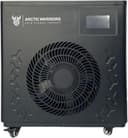
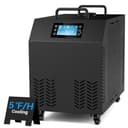
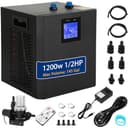
This is the chiller at the top of our chiller roundup, so a review of it is partly a review of that decision. Here is the honest version: it leads not because its listing is thorough — it is not — but because of a single structural fact about this category. Almost nobody publishes a cooling capacity, and this listing does.
Horsepower describes a compressor motor. BTU per hour describes how much heat the unit actually removes, which is the thing you are buying. Two chillers both badged “1 HP” can differ materially in real cooling capacity, and you would have no way to know. Of the 8 chillers in our registry, 3 state a BTU figure. The TURBRO is one of them, at 9,300 BTU/h.
Against that, its listing fills 3 of 10 comparable spec fields, leaving 7blank — including every electrical figure, which is the set with the most practical consequence. We have not tested this unit. We do not own it, we have not measured its pulldown and we have no way to verify the 9,300 BTU figure; what we do instead of testing is read what the manufacturer put in writing, compute what can be computed from it, and say plainly what is missing.
What the two published specs actually buy you
1 HP.In a category where 1/3 HP units dominate the cheap end, 1 HP is the size at which a chiller stops merely holding temperature and starts crashing it — and keeps working in a garage in August rather than losing ground to ambient. It is also the size most home setups actually want. The 1.5 HP alternative below is more compressor than an insulated 100-gallon tub needs, and oversizing costs you at purchase and then again on the meter.
9,300 BTU/h.This is the number that makes the page. It is the physical quantity that horsepower only approximates, and it is the only figure in this category that lets you reason about whether a unit can out-cool your tub's heat gain. The caveat is that converting BTU into “will it hold my tub” needs your water volume, your insulation and your ambient temperature — so it is a better number than a gallon ceiling and a harder one to use. Nobody in this category publishes both.
The third thing on the listing is not a spec but is genuinely part of the value: dual filters and an ozone generator in the box, plus insulated pipes, wheels and handles. Filtration is close to universal in this category rather than a differentiator — nearly every chiller we track claims it — but the ozone stage and the physical handling features are not, and if you were going to buy a separate submersible filter anyway, that is real money back.
The 7 blanks, and which of them should worry you
No voltage, amperage or rated watts.This is the one that matters. You cannot confirm from the listing whether the unit shares a circuit with anything else, you cannot compute a breaker size, and if the tub is outdoors you cannot specify the receptacle before the crate arrives. Six of the eight chillers we track publish a 120V supply; this one does not publish any of the three. Ask in writing before you book an electrician — and see cold plunge electrical requirements for what to ask for.
No gallon ceiling.Annoying rather than disqualifying, because the BTU figure is the better number and it is present. But it does mean the easy sanity check — “is my tub inside the rating?” — is unavailable on the most expensive chiller we compare, while a 1/2 HP unit at a quarter of the price publishes one.
No minimum temperature.Every other chiller on this page states a floor between 35°F and 42°F. The TURBRO states none. In practice a 1 HP unit reaching plunge temperature is not in doubt, and the published floors in this category are all colder than anyone needs — but a blank is still a blank, and it is the kind of blank that makes a return conversation harder.
No warranty term.Two other units here publish twelve months. This listing publishes nothing, which leaves you with the retailer's own return window as your only stated protection on a four-figure refrigeration appliance. That is not a reason not to buy it; it is a reason to buy it somewhere with a good returns policy and to open the crate the day it lands.
What it costs to run
We cannot tell you, and neither can any other site that is being honest with you, because no chiller in this category publishes a rated wattage — including this one. What we can do is price the electricity against an assumption we state in the open rather than bury: treat the unit as a 1 kW appliance running eight hours a day, every day, holding a tub at temperature.
On that basis it consumes about 243 kWh a month, which at the US average residential rate of 18.31 cents per kWh comes to roughly $44.55 a month. Change any of those three inputs and the answer changes: a cooler garage, an insulated tub and a lid all reduce the hours, and your own electricity rate may be half or triple the national average. The full arithmetic, with the duty-cycle assumption exposed, is on cost to run a cold plunge.
The practical point: the gap between chillers on your electricity bill is far smaller than the gap between an insulated tub with a lid and a bare one without. If running cost is what is driving this purchase, spend the next hundred dollars on a cover rather than the next compressor size.
Who it is for, plainly
Buy the TURBRO if you have a 100-to-200 gallon insulated tub, you want water care bundled rather than bolted on afterwards, and you would rather have a published cooling capacity than a published gallon ceiling. That is a real buyer and the 1 HP size is right for them.
Do not buy it if your tub is small and well insulated and lives indoors — a 1/3 or 1/2 HP unit holds that for a fraction of the money. Do not buy it if your tub is a bare stock tank in the open, where you want the larger compressor and the published ingress rating the Healcryo has. And do not buy it if you need heat as well as cold from one appliance, because this listing makes no heating claim at all.
Three alternatives worth pricing against it
All three publish more than the TURBRO does, and two of them cost less at today's live prices. That is not a gotcha — it is the trade this purchase actually is, and it is better to see it on one screen.
The comparison in one paragraph each
Healcryo 1.5 HP Pro MAX Cold Plunge Chiller is the better-documented product: 1.5 HP, a published 12,000 BTU/h, a 200-gallon ceiling, a 35°F floor, a 120V supply, a stated noise band and an IPX4 ingress rating — and cheaper than the TURBRO at today's prices. The reason it is not simply the better buy is size: 1.5 HP is more compressor than a standard insulated tub needs, which its own listing effectively concedes. Buy it for a large, bare or outdoor tub.
FADHOLE 1 HP 10,000 BTU Cold Plunge Chiller with Heater is the closest like-for-like: also 1 HP, also publishes a BTU figure (10,000), and additionally publishes a 216-gallon ceiling, a 37°F floor, a 107°F heating ceiling, a 45 dB noise figure and a twelve-month warranty. If you want a 1 HP chiller from a listing that answers more of your questions, this is it — and it is the only unit here that puts a number on both halves of contrast therapy.
Vikua 1/2 HP Ice Bath Water Chiller, 145 Gallon (110V) is the value argument, and for many readers the right one. Half the compressor, roughly a quarter of the price, and it still publishes a 145-gallon ceiling, a 41°F floor and a 110V supply. On a 100-gallon insulated tub with a lid in a conditioned space, this is enough chiller — and the money you do not spend here buys the cover and the thermometer that will do more for your setup than horsepower will.