Each pairing below is costed on the same assumptions we use everywhere on this site, imported from the same engine so the numbers here cannot drift away from the full cost breakdown: a 60-minute heat session 3 times a week at 60% duty cycle, and a 600W chiller holding temperature 6 hours a day, every day, at the EIA national average of 18.83 cents per kWh. Your rate is the one that matters; the assumption is stated so you can redo it.
Combo A — the backyard build
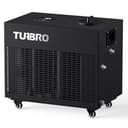
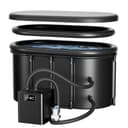
Breezestival Outdoor Barrel Sauna 4-6 Person, 6kW + Versatyle XXL Ice Bath Tub, Stainless Steel Frame + TURBRO 1 HP 9,300 BTU Cold Plunge Chiller
This is the setup most people picture, and the one that demands the most from the house. The barrel is here for a reason that has nothing to do with looks: it publishes its heater as 220V/6kW, which means you can compute the circuit — 25.0A of draw, 31.3A required after the 125% rule, so a 35A breaker — before the crate arrives. Plenty of barrels do not publish a rating at all, which makes them impossible to plan around.
The cold half is a steel-framed, insulated tub rather than an inflatable ring, because insulation is the spec that decides whether your chiller holds temperature or fights the air all day. Pair it with a chiller that publishes a BTU figure — three of the ones we compare do — and you have a setup where every important number is knowable in advance. Running cost lands around $29.45 a month — $8.84 for the sauna, $20.62 for the chiller.
The honest cost:two circuits, an electrician, a level pad for the barrel, and the largest footprint of the three. Neither the tub’s capacity nor the chiller’s amperage is published, so you will be sizing the chiller supply from the electrician’s reading of the nameplate rather than from the listing.
Combo B — the no-electrician combo
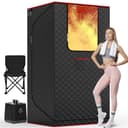
Real Relax Full Spectrum Infrared Sauna, 1 Person, 1290W + Generic Cold Plunge Tub + 1/3 HP Chiller Kit, 148 Gal
The pairing we would recommend to most people, and the one the category almost never presents. The cabin draws 1,290W at 120V — 10.8A, or 15A of breaker after the continuous-load rule, which is to say an ordinary household outlet. The cold half is a tub and a 1/3 HP chiller sold as one kit, so there is no sizing mismatch to get wrong and no second shopping trip. Neither half needs panel work.
That changes the arithmetic completely. Combo A’s real cost is not the gear, it is the two circuits; combo B’s real cost is the price on the two boxes. Running cost is about $22.52 a month on the same assumptions, and note where it goes: only $1.90 of that is the heat. The cold half costs roughly 11 times what the sauna does to run, which surprises almost everyone.
The honest cost:an infrared cabin is a different experience from a hot, humid Finnish room — two different machines sharing one word — and this one seats a single person. The kit’s 1/3 HP chiller against 148 gallons is a slow pulldown; it will hold a temperature well and reach it slowly.
Combo C — the cheapest honest trial
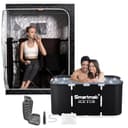
Manastin Upgraded Portable Steam Sauna, 3L/1200W + The Cold Pod Ice Bath Tub, 88 Gallon
Not a compromise so much as a different decision: spend the least possible to find out whether you will actually keep doing this. A documented steam tent that publishes its 130°F target, 15 heat levels and a 99-minute timer, plus the 88-gallon tub with the least water to cool of any we compare. The tent draws 10.0A from a wall outlet and costs about $1.77a month to run. The tub runs on ice, so its cost is not electricity — it is bags of ice, every session, forever.
The honest cost:both halves are the smallest version of themselves. 130°F of humid air is not a sauna at 180°F, and a tub you fill with ice is a chore you will eventually resent. That is fine — the point of this pairing is that it answers the question for a small fraction of what either of the other two costs to buy, and the cheapest way in is a legitimate strategy, not a booby prize.