How to choose a cold plunge
Six decisions, in the order they actually bind. Get the first one right and the rest are cheap; get it wrong and no amount of spec-reading rescues it.
Last verified · Ice & Cedar editorial
The verdict
Decide ice or refrigeration first, and default to ice.A tub and a bag of ice has no circuit, no running cost and no sizing problem, and it answers the only question that matters at this stage: whether you will still be doing this in two months. If the answer turns out to be yes, buy the chiller then — and size it from the gallons you already discovered you need, which will be fewer than you would have bought on day one. The buyers who end up with an unused tub in a garage almost all made this decision in the wrong order.
The cold plunge category is unusual in how little it publishes. Across the 17 tubs and eight chillers we compare, not one tub publishes a pulldown figure, no chiller publishes amperage, only three chillers publish a cooling capacity in BTU, and only eight of the tubs publish anything about wall insulation. That is not a research gap on our side; those rows read “Not published” on every product page here because the sellers leave them blank.
So a buying guide built on comparing specs would mostly be comparing absences. This one is built the other way round: it walks the decisions in the order they constrain each other, because the decisions are checkable even when the specs are not. The sauna half of this site has the equivalent page for heat; this is the cold one.
The six decisions, in order: ice or refrigeration; how many gallons; upright or lie-down; insulated or not; what the circuit can carry; and what goes on top. They are in that order because each one narrows the next. Choosing gallons before you have chosen ice-or-chiller is how people end up with 200 gallons and a 1/3 HP compressor.
Decision 1: ice or refrigeration
This is the only decision on the page that changes the others, so it goes first. A tub you fill with water and ice has no electrical requirement, no running cost, no sizing calculation and no compressor to fail. A chilled tub has all four, plus a thermostat that makes the cold happen whether or not you feel like it that morning — which is the real argument for it and a genuinely good one.
What tips it is honesty about adherence. Most people who buy a cold plunge stop within a few months, and the ones who stop have usually spent the most. Ice is the cheap way to find out which group you are in. Our cheapest way to cold plunge prices a session of ice against a session of refrigeration, and how much ice an ice bath actually takes puts a number on the bags.
Three signals that it is time for a chiller, rather than a sign you should have bought one on day one: you are plunging more than three times a week, you have stopped on at least one occasion because you could not face the ice run, and your tub is somewhere you can leave it set up permanently. If all three are true, refrigeration is a straightforward upgrade. If none are, a chiller is an expensive way to make the tub harder to put away.
There is a third route worth naming because it is genuinely cheaper than either: a chest freezer conversion. It goes far colder than any chiller here, costs a fraction per gallon, and asks you to handle the insulation, the sanitation and the electrical safety yourself. That last part is not a formality, and we treat it as a build rather than a purchase.
The four routes, cheapest first
Ranked on published specifications. Select a row to jump to the full write-up. We have not tested these units — here is exactly what we do instead.
| # | Product | Chiller | Gallons | Coldest | Best for | Price |
|---|---|---|---|---|---|---|
| 1 | 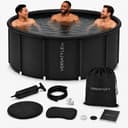 Versatyle XXL Cold Plunge and Soaking Tub, Steel Frame (GIBT-SS1) A steel-rod frame and insulated multilayer walls instead of a bare inflatable ring. That is the difference between a tub that holds temperature and one that fights your chiller — but this one is a group tub, and every gallon of it is water you pay to keep cold. | None, ice only | 300 | Not published | Route 1: tub and ice | $89.99 · View on Amazon Price as of October 9, 2026. #ad How we’re funded |
| 2 | 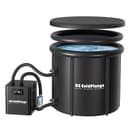 AS ColdPlunge 1/3 HP Chiller + 100 Gal Upright Tub Bundle (DY300-XL100) The only upright tub sold as a complete system here, and the only one whose shape is chosen to fit a bathroom rather than a backyard. Fewer gallons is the cheapest thing you can do about an under-sized chiller. | 1/3 HP, included | 100 | 42°F | Route 2: smallest complete system | $409.99 · View on Amazon Price as of October 9, 2026. #ad How we’re funded |
| 3 | 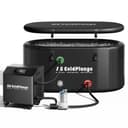 AS ColdPlunge 1 HP Chiller + 216 Gal Insulated Tub Bundle (AS1000-XXL216) The only bundle here whose chiller is rated for more water than the tub it ships with — 220-230 gallons stated against 216 in the tub. It is also the only one pairing a 1 HP compressor with a 37°F floor, which is the combination that decides whether you ever actually reach plunge temperature. | 1 HP, included | 216 | 37°F | Route 3: matched complete system | $1,149.00 · View on Amazon Price as of October 9, 2026. #ad How we’re funded |
| 4 | 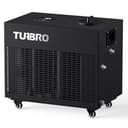 TURBRO 1 HP 9,300 BTU Cold Plunge Chiller One of only two chillers here that publishes a BTU figure, which is the number that actually predicts pulldown. That transparency, plus dual filters and an ozone generator, is why it leads. | 1 HP, separate | Not published | Not published | Route 4: chiller for a tub you own | $1,399.00 · View on Amazon Price as of October 9, 2026. #ad How we’re funded |
These are listed as routes, not as a ranking: a tub and ice, the smallest complete system, a matched complete system, and a chiller bought separately for a tub you already own. Which one is right depends entirely on Decision 1 above, which is why it comes first.
Decision 2: how many gallons
Almost everyone buys too much tub, and the reason is that gallons feel like a comfort spec when they are actually a running-cost spec. Across the 17 tubs we compare, published capacity runs from 77 to 300gallons — a factor of roughly three in the volume a compressor has to pull down and then hold.
The arithmetic is unforgiving and it repeats daily. Twice the water is roughly twice the heat to remove to get to temperature, and twice the thermal mass soaking up warmth from the room between sessions. A larger tub is more comfortable for the four minutes you are in it and more expensive for the rest of the day, every day, for as long as you own it. That is the whole case for sizing on shoulder coverage rather than legroom.
The hard constraint is the pairing. If you are buying refrigeration, gallons and horsepower have to be chosen together: what size chiller do I need works the sizing from the published ceilings, and the short version is that the 1/3 HP chillers we compare which publish a working volume state 53, 79, 79 gallons. Any setup pairing that compressor class with much more than 79 gallons is asking for work its own manufacturer does not claim elsewhere. Several bundled kits do exactly that, which is why our page on tubs that ship with a chiller ranks on the match rather than on the hardware.
One caveat worth stating, because capacity is not always trustworthy. 15 of the 17tubs we compare publish a capacity at all, and a couple of them contradict themselves between the title, the bullets and the listing’s own size field. Where that happens we record the most specific published figure and flag the conflict rather than averaging it into something tidier — because a 20% error in gallons is a 20% error in the load you just sized a compressor for.
Decision 3: upright or lie-down
Posture looks like a comfort preference and is really a space and running-cost decision. nine of the 17 tubs we compare are upright: you sit with your knees bent and your torso vertical, which puts your shoulders under water in a tub that occupies roughly the footprint of an armchair and holds noticeably less water than a lie-down tub of the same shoulder depth.
So upright buys you two things at once — floor area and fewer gallons — and costs you two: you cannot stretch out, and you cannot share it. If the plunge has to live on a balcony, in a garage corner, or in a small space, that trade is usually worth making, and our upright tub roundup ranks that half of the category on its own axes. If two people plan to use it, a two-person tub is a different purchase and the gallons go up accordingly.
A note on height, since it catches tall buyers out: in an upright tub the limiting dimension is depth against your seated torso, not your standing height. A deeper tub of the same diameter suits a tall plunger better than a wider shallow one, and only some listings publish a fit height at all. Where none is published we leave it blank rather than inferring one from the exterior dimensions.
Decision 4: insulated walls, and rigid or not
Insulation is the only spec on this page you cannot change after buying, and it is the one the category publishes least: eight of the 17tubs we compare state anything about wall insulation at all, in layers, millimeters or a bare “insulated”.
What insulation does is not make the water colder. It decides how many hours a day the compressor runs to hold the water where you set it, which is the difference between a chiller that cycles and one that never stops. That shows up on the power bill monthly rather than at checkout once, and it is why a small insulated tub can cost less to own over a few years than a bigger uninsulated one driven by the same chiller.
Rigid versus soft-walled is the related fork, and it is as much about ownership style as thermals. three of the 17 tubs we compare are rigid, hard-walled and freestanding — they cannot be punctured, hold their shape when you climb in, and are the construction most likely to publish insulation. The rest are soft-walled or frame-and-liner tubs, several sold with the word “barrel” in the title. A barrel shape and a barrel are different purchases. Soft walls fold into a bag, weigh a fraction as much, and cost a fraction as much — which loops straight back to Decision 1, because a tub that folds away is also a tub you can stop using without guilt.
If you intend to add refrigeration later, this is also where to check for a published port. Across the tubs we compare, fivepublish an actual inlet or outlet you can plumb into. “Chiller compatible” with no port means draping the supply and return hoses over the rim, which works, and which leaves the lid propped open on two hoses exactly where the cold escapes.
Decision 5: what the circuit can carry
If you chose ice, skip this section entirely — a tub has no motor. If you chose refrigeration, this is the decision most likely to produce an unwelcome surprise after delivery, because the sellers publish almost nothing about it. Of the eight chillers we compare, none publishes rated watts and none publishes an amperage figure.
We do not print figures we cannot source, so instead of quoting amps we compute circuits from published wattage where it exists and tell you what to check where it does not. Three things are worth confirming before the crate arrives: the electrical requirements for a plunge setup, whether it needs a circuit of its own, and whether there is GFCI protection on the outlet the compressor will actually use. Water and a motor in the same place is the textbook case for GFCI, and outdoor outlets have their own code requirements.
One shortcut that genuinely helps: most of the smaller chillers in this category run on ordinary 110-120V, and our 110V roundup is the subset you can plug in without an electrician. Going bigger usually means going to a dedicated circuit, and that is a cost that belongs in the purchase decision rather than in a surprise quote afterwards.
Two smaller things that live in this decision because they are also about the spot you chose. Noise: a compressor runs for hours, and how loud a cold plunge chiller is matters a great deal if that spot shares a wall with a bedroom. Drainage: you will empty this thing periodically, and where 77 to 300 gallons goes is a better question to answer before the first fill than after it.
Decision 6: what goes on top
A cover is the cheapest thing on this list and the only one that keeps paying after you have bought everything else. Once the tub is chosen, the walls are whatever they are; the lid is the last lever you have over heat gain, and heat gain is what the compressor spends its life fighting.
It also does the unglamorous half of water care: keeping leaves, dust and insects out of water you are climbing into. Filtration handles particles already in the water; a cover stops them arriving, and water treatment handles what a filter cannot catch. Not one tub-and-chiller bundle we have read includes any chemistry at all, so that is a separate trip whichever route you take.
And if cold water is only half of what you are building, the lid matters for a different reason: a contrast setup means the plunge sits idle while you are in the heat, and an open tub spends that time warming up. Of the eight chillers we compare, two publish a heating mode as well as a cooling one, which is a genuinely different way to build the same routine.
The mistakes that follow from the wrong order
Buying the chiller before knowing the gallons. The single most expensive sequencing error in this category, and the one bundled kits institutionalize. A compressor is sized to a volume; choose the volume first.
Sizing for the best-case session. People buy the tub that fits them stretched out with a friend, then chill it alone at 6am five days a week. Size for the session you will actually have most often.
Treating a published temperature floor as a guarantee. Floors across the chillers we compare run 35 to 42°F, quoted at an ambient nobody states. A 42°F floor on a warm deck in August is not a plunge temperature.
Forgetting the outlet until the crate arrives. Easily the most common avoidable cost, and the one that turns a weekend into a quote from an electrician.
Spending the cover budget on the tub. The last fifty dollars of a budget does more good on a lid than on a slightly bigger tub, because it reduces the work the compressor does forever.
We have a longer list of these in cold plunge buying mistakes, and the honest prior question — whether a cold plunge is worth it at all — is worth reading before any of the six decisions above.
Frequently asked questions
What is the first decision, if I only make one?
Ice or refrigeration, and it is not a close call in terms of consequences. Everything else on this page - gallons, posture, insulation, the circuit, the cover - follows from that one answer, because a tub you fill with ice has no electrical requirement, no running cost and no sizing problem, while a chilled tub has all three. The honest sequence is: buy a tub and a bag of ice first, find out whether you will still be doing this in two months, and only then spend on a compressor. Our page on the cheapest way to cold plunge works through what ice actually costs per session so you can compare the two properly rather than assuming the chiller is obviously better.
How many gallons should I be looking at?
Fewer than you want, and this is the decision people most often get backwards. Across the 17 tubs we compare, published capacity runs 77 to 300 gallons - roughly a factor of three. Chilling is per gallon: double the water is roughly double the work to pull down from ambient and double the thermal mass to hold against a warm afternoon, every single day, forever. A bigger tub is more comfortable for about four minutes a day and more expensive for the other one thousand four hundred and thirty-six. Size for shoulder coverage, not for legroom, unless two people genuinely plan to share it.
Should I buy a tub and chiller together or separately?
Together is simpler and gets the sizing wrong more often. six of the 17 tubs we compare ship with a chiller, and several of them pair a 1/3 HP compressor with far more water than any standalone 1/3 HP chiller claims it can hold - the ones that publish a working ceiling state 53, 79, 79 gallons. Buying separately costs more and makes you do the arithmetic; buying a kit does the arithmetic for you, sometimes badly. If you buy a kit, check the horsepower on one half of the listing against the gallons on the other before you check the price.
What temperature do I actually need to reach?
Colder than the cheap chillers will go, if you are following most published protocols. Across the chillers we compare, published temperature floors run 35 to 42°F, and that spread maps almost exactly onto compressor size. A 42°F floor is a cold bath; it is not a plunge temperature with any margin, and it is quoted under conditions no listing describes in a room whose ambient nobody states. Treat a published floor as a ceiling on performance and read our temperature guide for what the research supports rather than what the marketing implies.
Does insulation really matter, or is that an upsell?
It is the one spec you cannot retrofit, and only eight of the 17 tubs we compare publish anything about it. Insulation does not make the water colder; it decides how many hours a day the compressor has to run to keep it there, which is what shows up on your power bill every month rather than once at checkout. It is also the reason a small insulated tub can be cheaper to own than a large uninsulated one at the same chiller. After you have bought, the only remaining lever is the lid - which is why a cover is on this list at all.
What do I need to know about the electrical side before I buy?
That the sellers will not tell you. Of the eight chillers we compare, none publishes rated watts and none publishes amperage, on an appliance designed to run around the clock. What you can do before buying is check two things about the spot the compressor will live: that there is a GFCI-protected outlet within reach of it, and whether that outlet is sharing a circuit with anything else. Both of those are cheaper to find out now than after a crate arrives.
Upright or lie-down?
Upright if floor area is tight, lie-down if it is not, and the trade is clearer than most in this category. nine of the 17 tubs we compare are upright: you sit with your knees bent and your torso vertical, so the tub takes roughly the footprint of an armchair and holds less water for the same shoulder depth - which means it is cheaper to chill as well as easier to place. What you give up is stretching out and the ability to share it. A lie-down tub is the more pleasant four minutes; an upright is the one that fits in a garage corner and costs less to run.
What does nobody publish that I wish they would?
Pulldown. Not one of the 17 tubs and almost none of the chillers publishes hours-to-target from a stated ambient at a stated volume, which is the single figure that would let you compare any two setups honestly. Only three of the eight chillers publishes a cooling BTU figure, and only six publishes a working gallon ceiling. That vacuum is why this guide ranks decisions rather than products: the decisions are checkable, and most of the specs are not.
Related
- Best cold plunge tubs — the capacity-first roundup
- Best tubs with a chiller included — where kits get the sizing wrong
- Best cold plunge chillers — buying the two halves separately
- What size chiller do I need? — Decision 2, worked through
- The cheapest way to cold plunge — Decision 1, priced
- Cold plunge temperature — what the published floors have to clear
- Best cold plunge for the money — total cost, not sticker price
- Cold plunge electrical requirements — Decision 5
- Best cold plunge covers — Decision 6
- How to choose a home sauna — the same page for the heat half
Sources
- Ice & Cedar product registry — every tub and chiller we compare — Every count on this page is derived from our own registry at build time rather than written in: 17 tubs and 8 chillers, capacity 77-300 gallons, 8 tubs publishing wall insulation, 5 publishing a chiller port, 6 shipping with a chiller, and published chiller temperature floors of 35-42°F. Each underlying listing is cited individually on its own product card in the roundups linked above, with the date it was read. (accessed 2026-10-09)
- Published 1/3 HP chiller working ceilings — The 53, 79, 79-gallon sizing benchmark in Decision 2 is every standalone 1/3 HP chiller in our registry that publishes a working volume at all. 6 of the 8 chillers we compare publish one; 3 publish a cooling capacity in BTU. (accessed 2026-10-09)