ICE & CEDAR

The best infrared saunas, compared on every published spec

Indoor cabins ranked on wattage, wood and full-spectrum vs far infrared — and on the one number that separates infrared from every other sauna: it plugs into the wall.

Last verified · Ice & Cedar editorial

Infrared’s real advantage over a traditional sauna is not the temperature or the marketing around it. It is the electrical panel. A traditional 6kW electric heater draws 25A at 240V and wants a 35A dedicated circuit — which means an electrician and, often, a service the house does not have to spare. Every indoor cabin below that publishes its electricals runs on 120V and draws about 10.5A. It plugs into an outlet you already own.

So the two specifications that decide an infrared purchase are the ones most listings bury: wattage and voltage.With them we compute the current and the circuit the unit actually wants; without them the table says “Not published,” because that is the truth and it is information you should have before you spend a thousand dollars. Of the five cabins here, the listings range from one that states wattage, voltage and dimensions to one that states none of the three.

We have not run any of these units — we own none of them. Here is exactly what we do instead. Every spec is read from the manufacturer’s own Amazon listing and dated on each card; every price is live.

Quick picks

Ranked on published specifications. Select a row to jump to the full write-up. We have not tested these units — here is exactly what we do instead.

#ProductBest forPrice
1
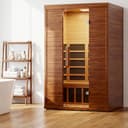
Real Relax Full Spectrum Infrared Sauna, 1 Person, 1290W

Real Relax Full Spectrum Infrared Sauna, 1 Person, 1290W

The most completely specified cabin here: 1,290W at 120V, full-spectrum with named 660/850nm red-light wavelengths, and actual published dimensions. Everything you need to plan the corner it goes in.

Best overall
$1,299.99 · View on Amazon

$1,399.997% off

Price as of July 20, 2026. #ad How we’re funded

2
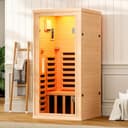
EASYHAWK 2 Person Infrared Sauna, 1500W

EASYHAWK 2 Person Infrared Sauna, 1500W

A two-person cabin that states 1,500W at 120V and adds WiFi app control. The most powerful indoor unit here — and, at 12.5A, the one that sits closest to a standard outlet's continuous limit.

Best for two
$1,099.99 · View on Amazon

$1,199.998% off

Price as of July 20, 2026. #ad How we’re funded

3
Albott Infrared Sauna, 1 Person, 1260W

Albott Infrared Sauna, 1 Person, 1260W

The most forthcoming listing in the set: 1,260W at 110V, seven carbon panels, Canadian hemlock. It states the two numbers — wattage and voltage — that decide whether it plugs into your wall, and most infrared listings state neither.

Most transparent listing
$949.99 · View on Amazon

$1,400.0032% off

Price as of July 20, 2026. #ad How we’re funded

4
ENSTVER Full Spectrum Infrared Sauna, 1 Person, 1240W

ENSTVER Full Spectrum Infrared Sauna, 1 Person, 1240W

The cheapest full-spectrum cabin here, and it still publishes its 1,240W draw and its Canadian hemlock construction. The honest entry point to infrared.

Best budget
$739.99 · View on Amazon

Price as of July 20, 2026. #ad How we’re funded

5
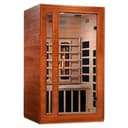
Dynamic Saunas Cordoba 2-Person Full Spectrum Infrared Sauna

Dynamic Saunas Cordoba 2-Person Full Spectrum Infrared Sauna

The established name in this comparison. Dynamic Saunas is a known infrared brand and the Cordoba is full-spectrum hemlock — but the listing publishes neither wattage nor voltage, so it ranks on track record rather than on disclosure.

Best-known brand
$3,199.99 · View on Amazon

Price as of July 20, 2026. #ad How we’re funded

#1Best overall

Real Relax Full Spectrum Infrared Sauna, 1 Person, 1290W

The most completely specified cabin here: 1,290W at 120V, full-spectrum with named 660/850nm red-light wavelengths, and actual published dimensions. Everything you need to plan the corner it goes in.

Strengths

  • Publishes wattage, voltage AND exterior dimensions (31.5 x 30.3 x 67 in) — rare in this category
  • Full-spectrum heaters with stated 660/850 nm red-light wavelengths
  • Canadian hemlock, and a 120V draw that runs from a standard outlet

Trade-offs

  • A tight one-person footprint despite the full spec sheet
  • The red-light wavelength figures are the manufacturer's, not measured by us
  • Priced above the other one-person cabins here
Seats1
WoodCanadian hemlock
Rated power1290 W
Voltage120V
Current draw (computed)10.8A
Circuit it wants (NEC 125%)15A
Exterior dimensions31.5" x 30.3" x 67"
WarrantyNot published

Specifications as published by the manufacturer listing, read on July 20, 2026. Blank fields are specs the manufacturer does not publish.

#2Best for two

EASYHAWK 2 Person Infrared Sauna, 1500W

A two-person cabin that states 1,500W at 120V and adds WiFi app control. The most powerful indoor unit here — and, at 12.5A, the one that sits closest to a standard outlet's continuous limit.

Strengths

  • Seats two and still runs on 120V
  • Publishes 1,500W / 120V outright
  • WiFi app and Bluetooth control included

Trade-offs

  • At 1,500W it draws 12.5A — close enough to a 15A outlet's continuous limit that it wants a dedicated 20A receptacle
  • Wood species is listed only as 'wooden'
  • Far-infrared panels, not full spectrum
Seats2
WoodNot published
Rated power1500 W
Voltage120V
Current draw (computed)12.5A
Circuit it wants (NEC 125%)20A
Exterior dimensionsNot published
WarrantyNot published

Specifications as published by the manufacturer listing, read on July 20, 2026. Blank fields are specs the manufacturer does not publish.

#3Most transparent listing

Albott Infrared Sauna, 1 Person, 1260W

The most forthcoming listing in the set: 1,260W at 110V, seven carbon panels, Canadian hemlock. It states the two numbers — wattage and voltage — that decide whether it plugs into your wall, and most infrared listings state neither.

Strengths

  • Publishes both wattage and voltage (1,260W / 110V) — most infrared listings give one or neither
  • Seven carbon heating panels and Canadian hemlock
  • Runs from a standard 120V household outlet (listed as 110V)

Trade-offs

  • Single-person cabin
  • Far-infrared carbon panels rather than full spectrum
  • Interior dimensions are not published
Seats1
WoodCanadian hemlock
Rated power1260 W
Voltage120V
Current draw (computed)10.5A
Circuit it wants (NEC 125%)15A
Exterior dimensionsNot published
WarrantyNot published

Specifications as published by the manufacturer listing, read on July 20, 2026. Blank fields are specs the manufacturer does not publish.

#4Best budget

ENSTVER Full Spectrum Infrared Sauna, 1 Person, 1240W

The cheapest full-spectrum cabin here, and it still publishes its 1,240W draw and its Canadian hemlock construction. The honest entry point to infrared.

Strengths

  • Least expensive cabin compared here
  • Publishes a 1,240W rated draw — enough to size the outlet
  • Full-spectrum panels and Canadian hemlock

Trade-offs

  • Voltage is not stated on the listing — confirm it is a standard 120V plug before you buy
  • A one-person footprint with no room to lie back
  • No dimensions published beyond a 5.4 ft height
Seats1
WoodCanadian hemlock
Rated power1240 W
VoltageNot published
Current draw (computed)Not published
Circuit it wants (NEC 125%)Not published
Exterior dimensionsNot published
WarrantyNot published

Specifications as published by the manufacturer listing, read on July 20, 2026. Blank fields are specs the manufacturer does not publish.

#5Best-known brand

Dynamic Saunas Cordoba 2-Person Full Spectrum Infrared Sauna

The established name in this comparison. Dynamic Saunas is a known infrared brand and the Cordoba is full-spectrum hemlock — but the listing publishes neither wattage nor voltage, so it ranks on track record rather than on disclosure.

Strengths

  • From an established infrared-sauna brand rather than a generic seller
  • Full-spectrum heaters and Canadian hemlock
  • Two-person cabin

Trade-offs

  • Publishes neither wattage nor voltage — you cannot size the circuit from the listing
  • By far the most expensive unit here
  • Interior dimensions and volume are not published
Seats2
WoodCanadian hemlock
Rated powerNot published
VoltageNot published
Current draw (computed)Not published
Circuit it wants (NEC 125%)Not published
Exterior dimensionsNot published
WarrantyNot published

Specifications as published by the manufacturer listing, read on July 20, 2026. Blank fields are specs the manufacturer does not publish.

How to choose an infrared sauna

Start with how many people, then the footprint.A “one person” cabin is a place to sit, not to recline, and a “two person” cabin usually means two people seated shoulder to shoulder. The floor space it eats is a hard constraint in a spare room or a garage corner, and only the Real Relax here publishes its exterior dimensions (31.5" x 30.3" x 67") — the rest make you ask the seller.

Then wattage, because it is heat and it is the outlet. The cabins here run from 1,240W to 1,500W. More watts means faster warm-up and a bit more reach into a larger cabin, but it also moves you up the circuit ladder: a 10.5A draw is comfortable on any 15A outlet, while the 1,500W unit’s 12.5A sits close enough to a 15A circuit’s continuous-load limit that it wants a dedicated 20A receptacle. That is still a plug, not a rewire — but it is worth knowing which outlets qualify. We work through what “dedicated” actually means here.

Full spectrum or far infraredis the next fork. Far infrared — the carbon panels in the Albott and the EASYHAWK — does the bulk of the heating in every unit on the market. Full-spectrum cabins (Real Relax, ENSTVER, Dynamic Saunas) add near- and mid-infrared emitters and usually a named red-light wavelength. It is a real hardware difference; whether it is worth the premium is a judgement call, and the specific health claims pinned to particular wavelengths are the manufacturer’s, not ours.

Wood matters less than the listings imply,but it is worth a glance. Four of these are Canadian hemlock, a low-aroma softwood that is the category default; the EASYHAWK lists only “wooden,” which is a spec gap rather than a species.

What infrared can, and can’t, claim

Infrared saunas are sold on health outcomes — detox, weight loss, recovery — more aggressively than almost anything else in this category. Be careful with that. The strongest sauna research is the Finnish cohort data, and it studied traditional saunas, so it does not transfer wholesale to a far-infrared cabin at half the temperature. The infrared-specific evidence is thinner and mostly small studies. We compare the two properly — including what the evidence does and does not say, and we unpack the Finnish data on the benefits page. Buy an infrared sauna because you will actually use a warm, low-fuss cabin that fits your room and your outlet — not because a listing promised a clinical result.

The running cost, at least, is a pleasant surprise and it is arithmetic rather than a claim. A ~1,300W cabin used four 40-minute sessions a week costs about $2.27 a month at the EIA national average of 18.83 cents/kWh, assuming the panels run about 80% of each session — a stated assumption you can change. Full cost method, at your own rate.

Frequently asked questions

Do infrared saunas need a dedicated 240V circuit?

No — that is the whole practical case for infrared. Every indoor cabin here that publishes its electricals runs on 120V and draws roughly 10-13A, so it plugs into an ordinary household outlet. Compare that with a traditional 6kW electric heater, which draws 25A at 240V and wants a 35A dedicated circuit and an electrician. The one caveat is the 1,500W unit: at 12.5A it sits close to a 15A outlet's continuous-load limit, so it is happiest on its own 20A receptacle.

Is an infrared sauna the same as a traditional sauna?

No. They share a name and almost nothing else. A traditional sauna heats the air and stones to 150-195°F and makes steam when you throw water; an infrared cabin skips the hot air and warms your body directly at around 110-135°F, with no stones and no steam. The Finnish health research everyone cites was done on traditional saunas, so it does not automatically transfer to infrared. If you want the ritual of steam and löyly, infrared is not a cheaper version of it — it is a different machine.

Full spectrum or far infrared — does it matter?

Full-spectrum cabins add near- and mid-infrared emitters (often marketed alongside red-light wavelengths) on top of the far-infrared panels that do the bulk of the heating. Three of the cabins here are full-spectrum; the two carbon-panel units are far-infrared only. The heating experience is broadly similar; the extra emitters are the main thing you are paying more for, and the health claims attached to specific wavelengths are the manufacturer's, not ours.

How much does an infrared sauna cost to run?

Very little. A ~1,300W cabin used four 40-minute sessions a week works out to roughly $2.27 a month at the US average rate of 18.83 cents/kWh, assuming the panels are energised about 80% of the session. That is a stated assumption, not a hidden one — substitute your own utility rate on the cost-to-run page, because the national average is wrong for almost everybody.

How long does an infrared sauna take to heat up?

Not published by these manufacturers in a way we can verify, and we have not measured it, so we are not going to print a number. Infrared warms you rather than the room, so it is often usable sooner than a traditional sauna even before the cabin air is fully warm — but heat-up time depends on wattage and cabin size, which is exactly why the wattage column is the one we chase hardest here.

Will one of these fit two people?

The EASYHAWK and the Dynamic Saunas Cordoba are the two-person cabins here; the Real Relax, Albott and ENSTVER are single-person. 'Two person' in this category usually means two people seated fairly close, not two people lying down, so check the seat width against the published dimensions where a listing states them — only the Real Relax does.

Related

Sources