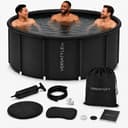
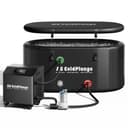
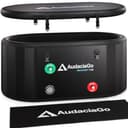
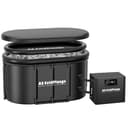
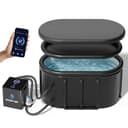
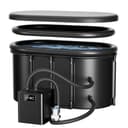
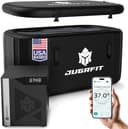
“Two person cold plunge” is a shape question that this entire category answers with a volume number. Every listing on this page leads with gallons; two of seven will tell you how big the thing is. And gallons genuinely cannot answer it: 300 gallons in a tall round column is one person standing in water to the chest, and 300 gallons in a wide shallow square is two people sitting opposite each other. Same water, same running cost, completely different purchase.
So this page ranks on the narrower plan dimension of the published footprint — the one a second set of shoulders or a second pair of knees has to fit inside — and then on whether the refrigeration is sized for the water. Occupancy claims get reported and not ranked. One listing here says it fits four people; we have not seen four people in it, nobody audits that sentence, and it is printed next to a footprint that is the only reason we believe two.
We own none of these tubs and have sat in none of them. What we do instead is read what each seller put in writing, compute the plan dimension from their own footprint, compare their own chiller claims against their own water volumes, and leave a dash where they publish nothing. Prices move daily and are read when the page is served.
How we ranked them
- A published plan dimension big enough for two — the gate. two of seven picks publish a footprint at all, and of those exactly onehas a narrow axis above 50 inches. A tub that publishes no footprint has not answered this page’s question.
- Refrigeration sized for the water, not for the box. four of these picks ship a chiller and four publish a floor temperature. The split is horsepower: the 1 HP bundle publishes 37°F, the 1/3 HP kits publish 42°F.
- A stated chiller port, not “chiller compatible”. three of seven publish an actual port, valve or connection. On a tub you intend to chill hard, the difference between a port and a hose draped over the rim is heat loss you pay for forever.
- Insulated walls. five of seven publish insulation, and it matters more with two people in the water than with one, because insulation is what buys back some of the heat the second body added.
- Posture. seven of sevenare tubs you lie in rather than sit up in. For two people simultaneously, lying down is the geometry that works — upright tubs are columns, and a column seats one.
No scores, and no price typed into a write-up. Every figure above was read from the seller’s own listing on the date printed on each card; every blank is a spec the seller does not publish.
Why gallons are the wrong unit for this question
Water volume is the most useful spec in this category for almost every other purpose. It predicts your fill cost, your chemistry dose, your running cost and how hard a chiller has to work. It is the right number for all of those. It is simply not an occupancy figure, and the category sells it as one because it is the easy thing to print.
The field here runs from 121 to 300gallons, and within that range the gallon figure tracks the chiller load almost perfectly and the usable seating almost not at all. Two of these picks publish exactly the same water volume as each other and neither publishes a footprint, so neither has told you whether it is a wide rectangle or a deep pod — and on this page’s question they are therefore indistinguishable. Meanwhile the 121-gallon system publishes its dimensions and they rule it out for two at a glance. Publishing less did not make the big tubs bigger; it just made them unfalsifiable.
If you want the posture argument in full, our tall-people ranking works the same distinction for a single body: interior length for lying down, wall height for sitting up, and gallons for neither. What size tub do I need is the upstream version of the same question.
The second body is a refrigeration problem
This is the part the category does not document at all, and it is the one most likely to disappoint you.
A person in cold water is a heat source. Two people are two heat sources, and the water warms while you are in it — faster with two than with one — then has to be pulled back down before the next session. The specs that would let you plan around that are a heat-rejection figure, an occupied-tub rating or a recovery time. Not one chiller in our registry publishes any of them, and not one of the seven tubs here publishes a time to temperature either.
What we can do is compare the manufacturers against each other. The standalone 1/3 HP chillers in our registry that publish a tub ceiling publish 53 to 79 gallons. The 1/3 HP kits on this page sit that same compressor size on 148 gallons. Those are both manufacturer claims and they contradict each other, and the published floor temperatures are the tell: every 1/3 HP kit here publishes 42°F while the 1 HP bundle publishes 37°F. 42°F is a real plunge temperature and we are not going to pretend otherwise — but it is the warm end of the useful range for an empty tub, which means a shared session starts above it and climbs. Our chiller sizing guide works the arithmetic, and best cold plunge chillers ranks the units you would add to the Versatyle.
The practical consequence: for two people, treat the published ceiling on any chiller as a one-occupant figure, insulate everything, and keep a cover on it between sessions. A cover is the cheapest horsepower you can buy.
Measuring two people, since nobody publishes a body
We publish no anthropometric data on this site, because we have measured nobody and the listings measure nobody either. What we can give you is two procedures that cost nothing and settle the question before you order.
Side by side.Stand shoulder to shoulder against a wall and measure the total width across both of you, then add enough to get your arms clear of the water without elbowing each other. Compare that to the narrower published plan dimension — the “plan min” column in the table on this page.
Facing. Each of you sits on the floor with your back flat against a wall and your knees bent the way they would be in a tub. Measure wall to kneecap. Add the two figures. That total is the plan dimension you need along one axis for a knees-interleaved sit, and it is usually the binding constraint rather than width.
Then subtract for the walls, because every dimension on this page is an exterior one and an insulated tub’s walls are not thin. We will not give you a wall-thickness figure, because no listing publishes one. If a tub publishes no footprint at all, there is nothing to compare your measurements against, and for a two-person purchase specifically that is a reason to buy something else.
Or just take turns
The unglamorous answer deserves a hearing, because for a lot of readers it is the right one. A smaller tub with the same chiller holds a colder temperature, costs less to fill, costs less to dose and costs less to run — every day, forever. Taking turns costs you a couple of degrees on the second plunge and nothing else.
What sharing buys is the thing that is genuinely hard to get any other way: doing it together, on the same schedule, as a ritual rather than a chore. That is a real reason and it is the only one we would spend the money on. If your actual use case is a contrast setup where one of you is in the heat while the other is in the water, you may not need a two-person tub at all — you need one of each, and what a contrast setup costs prices that properly. And if the budget is the binding constraint, the under-$1,000 ranking covers the single-occupant field where most of the value in this category still sits.