Do infrared saunas need to be vented?
Not to the outside, and not for moisture - there is no steam to move. What a sealed cabin benefits from is air exchange, and two of the 16 infrared cabins we compare mention air at all.
Last verified · Ice & Cedar editorial
The verdict
No duct, no outside wall penetration, and no moisture path — an infrared cabin has no stove, no stones and no water, so it produces no steam to exhaust. That is the whole reason infrared can live in a bedroom or a finished basement where a traditional cabin cannot. Two things still deserve planning. Inside the cabin, air exchange is a freshness question rather than a humidity one, and a new cabin off-gasses for its first few sessions — run it empty with the door open first. Outside the cabin, the room needs somewhere for the heat to go, because in an air-conditioned house you pay for that heat twice. Only the Kanlanth 2-person cabin publishes a built-in ceiling vent, and only one other cabin in the category names an air system at all.
This question gets asked because sauna ventilation is a real and well-documented subject — and almost all of that documentation is about traditional saunas, where it genuinely matters. Carrying the requirement across to infrared is a reasonable instinct and the wrong conclusion, for one simple reason: a traditional cabin is a humidity appliance and an infrared cabin is not.
A traditional sauna has a heater, a basket of stones and a ladle of water you throw onto them. The steam that produces is the point of the room, and it has to be able to leave — which is why a stove room wants an air inlet low near the heater and an outlet high on the far side, and why putting one in a carpeted spare bedroom is a decision about the room as much as about the sauna. An infrared cabin has panels and nothing else. No combustion, no water, no steam, nothing to exhaust. There is no duct to run and no wall to penetrate.
That does not make air irrelevant. It makes it a different question, and this page separates the three parts that usually get merged: what the cabin itself needs, what the room around it needs, and what a brand-new cabin needs for its first few sessions. Across the 16 infrared cabins we compare, two say anything whatsoever about air in their own specifications, which tells you how much of this category’s spec sheet is written about the experience of sitting inside one.
What the cabin needs: air exchange, not a vent
A sealed box with a person in it gets stale. Forty minutes in an enclosure of a few dozen cubic feet, breathing, is enough for the air to feel used even with no humidity involved. That is the real argument for air movement in an infrared cabin, and it is a comfort argument rather than a building-science one.
Most cabins address it accidentally.A glass door that does not seal, a gap at the floor, a cable entry — in practice an infrared cabin is a leaky box, and that is sufficient for air exchange at the rate one person needs. The cabins that publish a deliberate vent are doing it better rather than fixing a problem the others have.
And the figure that would let you reason about it properly is the one nobody publishes. Not one of these 16 cabins publishes an interior volume, so air changes per hour cannot be computed for any of them. We do not estimate it from exterior dimensions, which four of the cabins publish, because panel thickness and bench volume make that a guess dressed as arithmetic.
What the room needs: somewhere for the heat to go
This is the part that actually affects your bills, and it has nothing to do with ventilation in the sauna sense. An infrared cabin is a space heater installed inside a room whose temperature you otherwise pay to control. twelve of the 16 cabins we compare publish a rated power, and all of that power ends up as heat in the cabin and then, slowly, in the room.
In winter that is a straight bonus — you are heating part of the house anyway. In summer, in an air-conditioned house, it is the opposite: your AC removes the heat the sauna added, so you pay for the same energy twice. A window that opens, a ceiling fan or a bathroom extractor is enough to vent it, and the structural answer is to site the cabin outside the conditioned envelope. Putting it in a garage is the version of that decision most people reach, and what an infrared cabin costs to run explains why the published figure is a floor rather than a total indoors.
The other room-level consideration is moisture from you. You sweat inside a closed wooden box, and in a cabin with no vent that moisture goes into the wood and then into the room. It is trivial next to a steam cabin’s output and it is not zero: wipe the benches, and leave the door open after a session rather than shutting it on a damp interior. Sauna maintenance covers the routine.
What a new cabin needs: the first few sessions
Off-gassing is the one air-quality question in infrared that is genuinely worth acting on, and it is temporary. A new cabin is engineered wood, adhesive and a finish, being heated for the first time. Most owners describe a distinct smell for the first several uses, and the sensible response is mechanical rather than chemical:
Run it empty at a moderate setting, with the cabin door open and the room itself ventilated, until the smell is gone. An hour or two at a time is plenty per cycle. Do not seal yourself in with it to “break it in” faster, and do not run it at maximum on the first day.
No listing in this category publishes an emissions figure or a cure time, so any specific number of hours you read for this is invented. The honest instruction is the observational one. Cabins that publish a named wood — and several of these publish Canadian hemlock or Finnish spruce — at least tell you what you are heating; best wood for a sauna covers why the species matters, and are infrared saunas safe takes the broader question on.
What the listings actually say about air
Ranked on published specifications. Select a row to jump to the full write-up. We have not tested these units — here is exactly what we do instead.
| # | Product | Heat | Makes steam | Publishes a vent | Best for | Price |
|---|---|---|---|---|---|---|
| 1 | 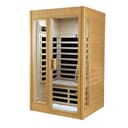 Kanlanth MST902GHC 2-Person Side-Glass Infrared Sauna, 1,500W The only cabin here that publishes a built-in ceiling vent and a numbered safety cut-out, which indoors matters more than another twenty degrees. Its 1,500W on the 120V/15A outlet it names computes past what a 15A circuit carries continuously, which is the single most useful thing to know before you site it. | Infrared | No | Yes | Only cabin with a published vent | $999.00 · View on Amazon Price as of October 10, 2026. #ad How we’re funded |
| 2 |  Generic 3-4 Person Far Infrared Sauna, 1960W The largest marketed capacity on the page and the only listing that names a ventilation system — which in a sealed infrared box is a more useful feature than a speaker. It also publishes the two numbers that reveal it has outgrown a wall outlet. | Infrared | No | Yes | Only one that names an air system | $2,399.00 · View on Amazon Price as of October 10, 2026. #ad How we’re funded |
| 3 | 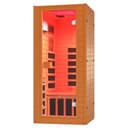 RESTISLAND Full Spectrum Infrared Sauna, 1 Person, 1178W The most completely specified cabin here: 1,178W at 120V, full-spectrum with named 660/850nm red-light wavelengths, and actual published dimensions. Everything you need to plan the corner it goes in. | Infrared | No | Not published | Most complete listing otherwise | $1,459.99 · View on Amazon Price as of October 10, 2026. #ad How we’re funded |
| 4 |  OUTEXER Traditional Steam Sauna, 2-3 Person, 3kW The only unit on this page that is a sauna in the Finnish sense — a 3kW stove, stones, and water you can throw on them. It is also the only one whose circuit is unambiguous, because 240V appliances are wired, not plugged, so nobody has to pretend an outlet will do. | Stove + steam | Yes | Not published | The cabin that genuinely needs a vent | $2,699.00 · View on Amazon Price as of October 10, 2026. #ad How we’re funded |
The first two are the only cabins in our comparison whose own specifications mention air. The third is included as the control: the most completely specified infrared cabin we compare, which still says nothing about ventilation. The fourth is a traditional steam cabin, included because it is the one that genuinely does need a plan for moisture.
Frequently asked questions
Do infrared saunas need to be vented?
Not to the outside, and not for moisture. An infrared cabin has no stove, no stones and no water, so it produces no steam - which removes the entire reason a traditional sauna needs a moisture path. What an infrared cabin does need is air EXCHANGE: a sealed wooden box with a person in it for forty minutes gets stale, and a new cabin off-gasses from its glues and finishes for the first few sessions. Most cabins handle that with a door gap and a floor gap rather than a duct. Of the 16 infrared cabins we compare, two say anything about air at all in their own listings.
Does an indoor infrared sauna need to be vented outside?
No. There is no combustion, no steam and no exhaust to route anywhere, so there is nothing a duct to the outdoors would carry. That is the single biggest install advantage infrared has over a traditional cabin indoors, and it is why an infrared cabin can go in a bedroom or a finished basement where a stove cabin cannot. The thing to plan for instead is heat: the cabin leaks warmth into the room it sits in, and in an air-conditioned house in summer that is a load your AC pays for twice.
Then why do some infrared cabins have a vent?
Because air exchange inside the cabin is a comfort and freshness question even without steam, and a small number of manufacturers have decided to address it. Exactly two of the 16 infrared cabins we compare mention air in their specifications: one publishes a built-in ceiling vent and the other names a ventilation system. That is a genuinely useful feature in a sealed box, and the fact that almost nobody else in the category mentions it is informative about how little of this spec sheet is about the experience of sitting inside.
Does the room need ventilation even if the cabin does not?
The room needs somewhere for heat to go, which is a different problem from moisture and the one people get wrong. An infrared cabin is a space heater inside a room whose temperature you otherwise control: in winter that heat is a bonus, and in an air-conditioned house in summer your AC removes everything the sauna added, so you pay for the heat twice. A window that opens, a ceiling fan or an extractor solves it. That is also the honest argument for siting a cabin in a garage or an unconditioned basement rather than upstairs.
What about off-gassing from a new cabin?
Real, temporary, and worth planning the first few sessions around. A new cabin is plywood, hemlock or spruce, glue and a finish, all being heated for the first time, and most owners describe a smell for the first several uses. The sensible routine is to run it empty at a moderate setting with the door open for an hour or two before using it, with the room itself ventilated. No listing in this category publishes an emissions figure or a cure time, so anybody quoting you a specific number of hours is guessing - the honest instruction is to run it until the smell goes.
Do infrared saunas get humid at all?
Marginally, and only from you. You sweat inside a closed box, and that moisture has to go somewhere - which in a cabin with no vent means onto the wood and then slowly into the room. It is nothing like a steam cabin's output, and it is the reason to wipe the benches down and leave the door open after a session rather than closing it on a damp interior. Not one cabin in this category publishes an interior volume, which is the figure that would let you reason about air exchange properly.
How does this compare to a traditional sauna's ventilation?
Entirely different, and the comparison is the clearest way to see why infrared is the easier indoor install. A traditional cabin burns no fuel if it is electric, but it does make real steam from water on stones, and a stove cabin indoors is a humidity appliance in a room with a ceiling and a wall finish you care about - which is a ventilation decision as much as a purchase. Every one of the eight traditional electric cabins we compare raises that question the moment it goes inside a finished room; not one infrared cabin does. Our ventilation guide covers the traditional side in full, including the inlet-and-outlet arrangement a stove room wants.
Should I pick the cabin with the vent, then?
It is a point in its favour and it is not the only number that matters. The cabin that publishes a ceiling vent also publishes 1,500 W on a 120V/15A outlet it names in its own title - and 12.5A of actual draw needs 15.6A of continuous capacity under the code's 125% rule, which is more than the 12A a 15A circuit carries. That is the more consequential thing to know before you site it. Read the circuit figure first and the vent second.
Related
- Sauna ventilation — the traditional half, where it genuinely matters
- Infrared sauna electrical requirements — the number to read before the vent
- Best infrared saunas — the whole field, ranked on disclosure
- Best indoor saunas — what each one asks of the room
- Are infrared saunas safe? — the broader version of this question
- Can you put a sauna in a basement? — where venting usually comes up
- Infrared vs traditional sauna — why only one of them makes steam
- Sauna humidity — what the number means in each kind of room
- Sauna maintenance — including drying the cabin out after a session
- What an infrared sauna costs to run — and why indoors it is a floor
Sources
- Seller listings for all 16 infrared cabins we compare (Amazon detail pages) — The ventilation claims quoted here were read from the listings themselves on the dates shown on their cards in our roundups, where each listing is linked. Of the 16 infrared cabins we compare, 2 mention air at all: one publishes a built-in ceiling vent and one names a ventilation system. None publishes an interior volume, so air-change rates are not computed anywhere on this page. No listing publishes an emissions figure or an off-gassing cure time, and none is given here. (accessed 2026-10-11)
- NEC 210.19(A)(1)(a) — minimum branch-circuit conductor ampacity — 2020 NEC. Conductors sized at noncontinuous load plus 125% of the continuous load. (accessed 2026-07-16)
- NEC 424.3(B) — fixed electric space-heating equipment — Space-heating equipment is a continuous load; conductors and overcurrent devices sized at 125% of the heating load. (accessed 2026-07-16)
- NEC 210.8(F) — GFCI protection for outdoor outlets (2023 NEC) — Applies to outdoor outlets on single-phase circuits 150V-or-less to ground and 50A-or-less. Exceptions apply; confirm with your AHJ. (accessed 2026-07-16)