Start with whether it will hold you upright at your height, not with its capacity. Gallons tell you what it costs to chill; they do not tell you whether your shoulders go under. In an upright tub the limiting dimension is depth against your seated torso, which means a deeper tub of the same diameter suits a tall plunger better than a wider shallow one. Some listings here publish a fit height — 6 ft 9 in is the most generous, and two state 6 ft 7 in — and where none is published we leave it blank rather than inferring one. If you are near the top of those numbers, treat them as the ceiling they are.
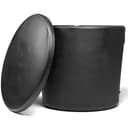
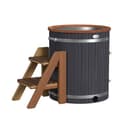
Then decide rigid or inflatable, because that is the real fork. three of the eighttubs here are rigid, hard-walled and freestanding; the rest are folding fabric tubs, several of which are sold with the word “barrel” in the title. That is not a trick exactly — they are barrel-shaped — but a barrel shape and a barrel are different purchases. Rigid walls cannot be punctured, hold their shape when you climb in, and are the only construction here that publishes insulation. Inflatable walls fold into a bag, weigh under ten pounds, and cost a fraction as much.
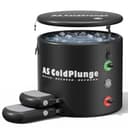
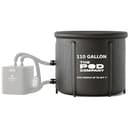
Then look for a published chiller port, and treat “chiller compatible” as marketing until you find one. This is the criterion that reorders the page. A stated port — better still, a stated thread size and shut-off valves — means you plumb a closed loop and shut the lid on it. A compatibility claim with no port means you drape the supply and return hoses over the rim, which works, but leaves the lid propped open on two hoses precisely where you were trying to keep the cold in. Only two of these eight listings clears that bar, and picking the chiller is a separate decision with its own constraints.
Then check that the capacity is a number you can actually rely on. six of the eighttubs here publish one, which sounds fine until you notice that two of them contradict themselves: one says 98 gallons in its title, 97.7 in its bullets and 116 in its own size field, and another says 135 in the title and 116 in the size field. We record the figure the listing states most specifically and flag the conflict on the card rather than averaging them into something tidier. Capacity is not trivia here — it is the input to sizing a chiller, and a 20% error in gallons is a 20% error in the load you asked it to carry.
Then weigh the footprint and the weight against each other, because they trade off in a way that catches people out. The rigid tubs win on footprint and lose on mobility: the heaviest here is 239 lb empty and ships assembled, which makes it furniture rather than equipment. The inflatables weigh eight to thirty-one pounds and fold flat. If your plunge has to disappear when guests come, or move house with you, that number matters more than any thermal spec. four of the eightpublish tub dimensions we would stand behind; for the rest, the figures in the retailer’s dimension feed look like shipping cartons, so we left them blank.
Then, and only then, compare prices. The spread on this page runs from about the cost of a decent cover to the cost of a small sauna, and the ranking above deliberately does not follow it. The cheapest tub here is a legitimate way to find out whether you will keep plunging; the most expensive is not the best documented. Both of those are useful things to know before you spend, and neither is what the prices imply.