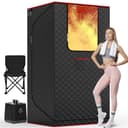
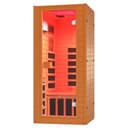
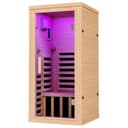
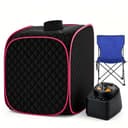
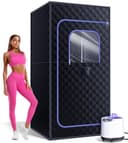
Almost every “apartment sauna” list is a size list. Size is the easy constraint. The one that actually decides what you can own is electrical, and it is unforgiving: you cannot add a circuit to a building you do not own, so whatever you buy has to live on the receptacle that is already in the wall.
That ceiling is lower than people think. A standard receptacle is on a 15A, 120V branch circuit, which looks like 1,800W of headroom. But a sauna heater or a steam generator is a continuousload — it runs at output for the whole session — and the National Electrical Code sizes a continuous load's circuit at 125% of the rated draw. Divide 1,800 by 1.25 and the real ceiling is 1,440W. That is the line this page sorts on, and it falls exactly through the middle of the category: a 1,200W tent is fine, a 1,500W tent is not.
Two products the category markets hardest at apartment buyers fall on the wrong side of it. The The Pod Company The Sauna Pod (Portable Dry Sauna, 1500W)is a genuinely good dry-heat pod, and at 1,500W it computes to 15.6A — past a 15A circuit. The Kanlanth MST902GHC 2-Person Side-Glass Infrared Sauna, 1,500W, the cheapest real cabin we compare, is also 1,500W. Neither is a bad product; both want a dedicated 20A receptacle, which in a rented unit is a conversation with a landlord rather than a purchase. We have not tested any of these units — here is exactly what we do instead, which is read what the manufacturer put in writing and do the arithmetic on it.
How we ranked them
- Does the published draw fit a 15A circuit?Pass or fail, computed from the listing's own wattage at 120V with the 125% continuous-load multiplier applied. A unit that publishes no wattage cannot pass, because you cannot check it.
- Is it reversible? Nothing fixed to a wall, nothing vented, nothing plumbed, nothing that needs a drain. Everything here clears this; the 240V stone rooms that make up most of the sauna market do not, which is why none of them appear.
- Does the listing publish an assembled size?Four of these six do. In a one-bedroom, the difference between a 31" square tent and a 36" square tent is whether it lives in the corner or in the walkway.
- How much else is in writing? Temperature ceiling, heat settings, timer range, fabric, tank size. The spec tables below include the blanks, because a blank is a finding about the manufacturer rather than a gap in our reading.
Nothing is scored. A score would imply we measured heat output, and we measured nothing — the arithmetic on this page is arithmetic, and the specs feeding it are the sellers' own.
Steam, dry heat or a blanket: pick the one your building tolerates
The form factor decision in an apartment is mostly a moisture decision. A steam tent is the cheapest route to real heat and the most satisfying at the price, but a 3-litre tank means roughly three litres of water leaving the generator and entering your room over a session. In a house with a bathroom fan that is nothing. In a studio with one window, it is a condensation problem you need a plan for — run it near the window, open it afterwards, and never on a carpet you have not protected.
Dry infrared sidesteps that entirely, which is the honest case for paying four to fifteen times more for a blanket or a one-person cabin. No water, no steam, nothing to wipe down, and no smell in a shared hallway. The trade-off is the experience: infrared heats you rather than the air around you, so your breathing never gets hot and the ritual feels different. If that distinction matters to you, read it before you spend, not after.
The blanket is the odd one out and deserves a straight description. It is not a small sauna; it is a heated wrap with your head outside it. For an apartment it has one advantage nothing else can match — it has no assembled footprint, so it stores in a cupboard and the room goes back to being a room. The blanket-versus-cabin comparison is the page to read if that is where you are leaning.
The two things an apartment listing never tells you
Noise.Not one listing in this category publishes a sound level, and a steam generator is not silent — it is a kettle with a pump. In a detached house that is irrelevant. Through an apartment wall at six in the morning it may not be. There is no published figure to rank on, so we have not invented one; treat it as an unknown you will discover in week one.
Floor loading. Also unpublished, and also mostly fine: a one-person cabin plus an occupant is well inside normal residential floor loading. Where this category genuinely collides with an upper-floor apartment is water. A 100-gallon plunge tub is roughly 830 pounds of water in a four-foot circle, which is why our small-space cold plunge guide treats a balcony or a ground-floor bathroom as the only sane siting. If you want both halves of contrast therapy in a rented unit, the heat side is the easy half.
What this costs to run
Very little, and much less than the cabinet price suggests. A 1,200W tent run for 30 minutes consumes 0.6 kWh — at the US average residential rate that is pennies per session, and the wattage figures in the tables below are the inputs if you want to price it against your own bill. Our cost-to-run page does the arithmetic properly, including the duty-cycle assumption that most calculators hide.
The real cost in an apartment is not electricity, it is the purchase decision. Everything here is live-priced from the Amazon listing rather than quoted from memory, and the spread on this page is wide: the cheapest pick and the most expensive one are an order of magnitude apart for products that all plug into the same socket. That is worth sitting with before you buy the expensive one.
Who should skip this page
If you own your unit, or your building already has a 20A receptacle in the room you want to use, the 15A ceiling stops being the binding constraint and a much better set of options opens up. Start with the one-person roundup for cabins, or best indoor saunas if you want the full indoor comparison including the 240V steam rooms.
And if what you want is the sauna experience rather than the appliance, price a gym membership honestly against the cabinet cost. A one-person infrared cabin here is four figures. That is a lot of drop-in sessions, and the thing most home-sauna buyers underestimate is not the money, it is whether the habit survives month three. The cheapest honest test of that is a fold-away tent.