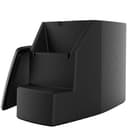
We have not plunged in an Ice Barrel 300. We do not own one, we do not own any of the tubs on this site, and what we do instead of testing is read every listing in the category against the same checklist and report who answers and who does not. On that checklist the Ice Barrel 300 does unusually well — and the places it goes blank are the same places the entire category goes blank, which is worth knowing before you read its silence as a defect unique to it.
The short version: it publishes 77 gallons, fully insulated rigid walls and built-in chiller ports, and it publishes no R-value, no pulldown figure, no amperage and no warranty term. The first three are what you are buying. The last four are what the whole market refuses to tell anyone.
What the three published specs actually buy you
Rigid, insulated walls
This is the spec that decides whether a chiller wins. A chiller does not have a fixed job; it has a race against heat leaking back in through the walls, the lid and the surface. An uninsulated inflatable in a 90°F garage can absorb heat faster than a 1/3 HP compressor removes it, at which point the water simply never gets to temperature and the unit runs continuously trying. Insulated rigid walls change the arithmetic from "can it win" to "how often does it need to cycle".
The Ice Barrel 300's listing states the insulation outright, which puts it in a small minority. What it does not state — and what nothing in this category states — is an R-value, so there is no way to compare its insulation against another insulated tub or to compute a payback. The claim is real and the magnitude is unknown. Our cold plunge cover roundup runs into exactly the same wall from the other direction: not one cover publishes a thermal figure either.
77 gallons, published
Capacity is the one number that drives every downstream cost, and this is the smallest rigid volume in our registry. Less water means less to chill, less to treat and a lower monthly bill — and it means a 1/3 HP chiller is a sane pairing rather than wishful thinking. It also means a tight fit: 77 gallons in an upright barrel is a seated plunge with your knees up, not a soak. If you are over about six feet, read the 300 vs 500 comparison before you commit; height is the one axis where the pricier barrel genuinely wins.
A note on what capacity does NOT tell you. No cold plunge listing in our registry publishes a pulldown figure — hours to reach a target temperature from a stated ambient — so the gallons number plus a chiller's BTU rating is as close to a performance estimate as this market allows. We size chillers against gallons on the chiller sizing guide, and we are explicit there that it is arithmetic, not a measurement.
Built-in chiller ports
The quiet one, and arguably the most valuable. A port is an inlet and an outlet molded into the tub wall. Without them, "chiller compatible" means you drape two hoses over the rim, which works but leaves the lid unable to seal and puts two hoses across the lip you climb over. The difference between a port and a hose is the difference between a fixture and a rig.
Note the asymmetry here: the Ice Barrel 500 — the more expensive barrel from the same maker, in the same construction — publishes no chiller ports at all. Whether it has them and the listing is silent, or it does not have them, is not something the listing will tell you.
The four blanks, and which of them should worry you
No R-value. Universal in this category. Worth shrugging at, because there is nothing to compare against.
No pulldown figure.Also universal, and the single most useful missing number in the whole market. Nobody will tell you how long their tub-and-chiller pairing takes to get 77 gallons from 70 to 45°F, because the answer depends on their chiller and their ambient and is unflattering in a garage in July.
No amperage.Irrelevant for the barrel itself — it is a plastic tub with no electrical load — but very relevant for the chiller you will bolt to it, and no chiller listing in our registry publishes it either. We cover what that means for your panel on cold plunge electrical requirements.
No warranty term.This one is a real mark against a premium-priced, US-made product. A rigid recycled-LLDPE shell should outlive a fabric tub by years, and the maker declining to put a number of years on it is a gap worth asking customer service about before you buy — in writing.
What it costs to keep cold
The barrel itself consumes nothing. Your running cost is the chiller, water treatment and water changes, and only the first is computable.
No chiller in our registry publishes rated watts, so we cannot derive a figure from the hardware. What we can do is state an assumption out loud and price it: a 1 kW chiller cycling 8 hours a day, every day, at the US average residential rate of 18.31 cents/kWh, draws about 243 kWh a month and costs roughly $44.55 a month. On 77 insulated gallons the real duty cycle is probably lower than eight hours in a conditioned space and higher in an uninsulated garage in summer, so treat that as a middle of the range rather than a quote.
Water treatment adds a few dollars a month — the chemistry options, and the fact that most of them will not name their active ingredient, are covered in the water treatment roundup. The listing states a four-week water-change interval, which on 77 gallons is a smaller refill bill than most of this category asks for. The full arithmetic across tub sizes is on what a cold plunge costs to run.
Who it is for, plainly
Buy it if you want a permanent upright plunge that lives in one place, holds temperature between sessions, and connects to a chiller through real ports. That is a specific setup, and for that setup there is very little else in the market publishing the same three facts.
Do not buy it if you plunge with bagged ice and drain afterwards, if you need to pack the tub away between uses, if you are tall enough that a 77-gallon upright will not cover your shoulders, or if the chiller budget does not exist yet. In each of those cases you are paying a premium for capabilities that stay idle. The cheapest way to cold plunge is the honest page to read instead.
Three alternatives worth pricing against it
All three were confirmed live the day this page was written. They are not ranked against each other — they are three different answers to "what if the Ice Barrel 300 is not the right shape for me".
How to read those three
The Ice Barrel 500 Freestanding Cold Plunge is the same rigid build in a taller shell, and its listing publishes less: no capacity, no insulation claim, no ports. Choose it for height, with your eyes open.
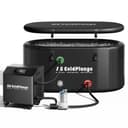
The AS ColdPlunge 1 HP Chiller + 216 Gal Insulated Tub Bundle (AS1000-XXL216)solves the other problem — it arrives as a tub and a 1 HP chiller together, with a published 37°F floor and a chiller actually rated for more water than the tub holds. The cost is 216 gallons of water to keep cold instead of 77, every month, forever.
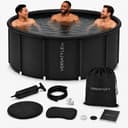
The Versatyle XXL Cold Plunge and Soaking Tub, Steel Frame (GIBT-SS1) is the value case taken to its limit: insulated multilayer walls and a steel-rod frame for a fraction of the price. It publishes no chiller port, and at over 300 gallons filled it is more water than any chiller on our pages will crash in a day. Fill it partway, or use it as an ice tub.
If none of those fit, the wider sets are the upright tub roundup and complete tub-plus-chiller systems. The TURBRO 1 HP 9,300 BTU Cold Plunge Chiller is the chiller we would plumb into these ports first, for the simple reason that it is one of only two in our registry that publishes a cooling BTU figure at all.