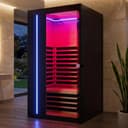
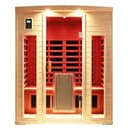
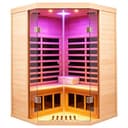
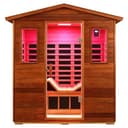
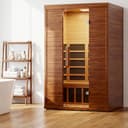
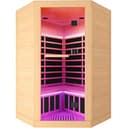
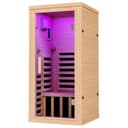
"Low EMF" is the most common phrase in infrared sauna marketing and one of the least informative. EMF is measured in milligauss, so a low-EMF claim either carries a milligauss figure or it carries nothing. Of the seven cabins below — all of them live and in stock when we read them — 4 publish a stated range of 0-5 mG and 3 publish the words alone.
That is the ranking criterion, and we are applying it before the list rather than after: a claim you can hold a meter to beats a claim you cannot, every time, regardless of how the cabin looks in the photos. We have not measured any of these units. We own none of them, we do not own a gaussmeter, and what we do instead of testing is read what the manufacturer was willing to commit to in writing and report the gaps.
Two honest caveats before the table. First, every 0-5 mG figure here is the seller's own, measured by them, at a distance they do not state. None of it is third-party certified, and there is no US safety standard for sauna EMF for it to be certified against. Second, the figure says nothing about whether the cabin is a good sauna. So the second sort below is the spec that decides whether you can install it at all: whether the listing publishes enough to compute the circuit. Where it does, we show the amperage and the breaker the code requires, using the arithmetic explained on the infrared electrical page.
How we ranked them
Four criteria, applied in this order. They are deliberately blunt, because the listings are too thin to support anything subtler.
- Does the EMF claim carry a figure?A stated range is falsifiable; the word "low" is not. This is the whole premise of the search, so it sorts first.
- Can you compute the circuit? A cabin that publishes wattage and voltage lets you find out whether it trips your breaker before you buy it. One that publishes neither is asking you to find out afterwards.
- Does the capacity claim survive the power rating?A 1,520W cabin marketed for three people is being generous with the word "fits". We rank the honest readings higher.
- What else is in writing? Wood species, exterior dimensions, maximum temperature, warranty term. Four fields; most of these listings fill in one or two.
Nothing here is scored, because a score would imply we measured something. The order is an argument, and the spec tables underneath each pick are the evidence for it — including the blanks, which are findings about the manufacturer rather than gaps in our reading.
What the milligauss number actually means
A milligauss is one thousandth of a gauss, a unit of magnetic flux density. Household wiring, a refrigerator and a laptop charger all produce a field in the low single-digit milligauss range at arm's length, and all of them fall off sharply with distance. That is why a seller's figure is close to meaningless without a stated measurement distance, and not one listing here states one.
It is also why a cabin has a structural advantage over a sauna blanket: the panel sits a foot or more from where you sit, while a blanket's heating element is pressed against you. If EMF exposure is genuinely the thing driving your purchase, that geometry is a bigger lever than any number in a product title. We walk through the same trade-off from the other direction in sauna blanket vs infrared sauna.
There is no FCC, UL or FDA limit for sauna EMF in the United States. The benchmarks quoted in this category — usually something near 3 mG, sometimes 1 mG — come from building-biology guidance, which is an advisory tradition rather than a regulator. A seller quoting "0-5 mG" is therefore making a claim against no standard at all. It is still worth more than the adjective, because you can check it.
How to check the claim yourself
This is the rare spec in the home recovery market that a buyer can verify in ten minutes for the price of a towel. A consumer gaussmeter is inexpensive, and the procedure is simple: run the cabin up to temperature with the panels at full output, then measure at the position your body actually occupies — seated, back against the bench, hands in your lap — not with the probe against the heater face. Take a reading at the head, the torso and the calves, because the panels are not evenly distributed and your calves usually sit closest to one.
Record the numbers inside the return window. A seller who states 0-5 mG and delivers a cabin reading well outside that range has given you a concrete, documented basis for a return, which is precisely what the sellers who only say "low" have made impossible. That asymmetry is the practical reason to pay the same money for the cabin that published a figure.
The electrical reality nobody puts in the title
Infrared cabins are sold as the plug-in alternative to a traditional room, and at one-person sizes that is true. It stops being true somewhere around 1,500W. A resistive heater is a continuous load, so the National Electrical Code sizes its circuit at 125% of the rated draw — which means a 1,500W cabin on 120V needs 15.6A of circuit capacity and a 15A outlet cannot carry it.
Run that arithmetic across this page and the picture is consistent. The 1,260W Albott computes to 10.5A and sits comfortably on a standard circuit. The 1,500W EASYHAWK and the 1,710W cabin both want a dedicated 20A receptacle. The 2,100W OUTEXER corner cabin computes to 17.5A, which at 125% is past what a 20A branch circuit may carry continuously — and its own title says "20A". That contradiction is visible only because OUTEXER published enough numbers to catch it, which is a point in its favor even as it costs the cabin a rank.
Three of the seven publish no voltage, so there is no arithmetic to do. If you buy one of those, budget for an electrician to read the nameplate on delivery. We cover the general case, including what to ask for, in sauna electrical requirements, and the cabins that genuinely do run off a wall socket are collected in which saunas plug into a normal outlet.
Who should skip this page
If the EMF question is not what brought you here, it should not drive your shortlist. The cabins that publish a milligauss range are not automatically better saunas; they are better-documented listings, which is a different and narrower virtue. A buyer optimizing for heat, wood and build quality is better served by the main infrared roundup, and a buyer optimizing for price by the value roundup.
And if what you actually want is the heat of a Finnish room rather than radiant panels, EMF is close to a non-question: a stone heater's field comes from the element and the supply cable, both of them several feet from the bench. Infrared vs traditional sauna is the comparison to read before you commit to panels at all.