Infrared sauna electrical requirements
A sauna is a continuous load, so the code sizes its circuit at 125% of actual draw. Of the seven cabins here publishing watts and 120V, five need more than a 15A circuit carries continuously.
Last verified · Ice & Cedar editorial
The verdict
Specify a dedicated 20A, 120V circuit for almost any indoor infrared cabin — and read the computed figure rather than the outlet rating in the product title. A sauna runs for hours, which makes it a continuous load the NEC sizes at 125% of actual current, so a 15A circuit carries only 12A and a 20A circuit 16A. Of the seven cabins we compare that publish both a wattage and 120V, two stay inside the 15A allowance and five do not, and two computes past 20A as well. The larger 240V cabins are a separate conversation: at twice the voltage the same wattage draws half the current, so they are wired rather than plugged. We publish the load and the breaker size; wire gauge is your electrician’s call.
Infrared is sold as the easy install, and relative to a traditional stove it is: no steam, no moisture path, nothing to vent, and mostly a plug rather than a junction box. That is all true. What gets lost in it is that “it plugs in” and “your circuit can carry it” are two different claims, and this category routinely makes the first while implying the second.
The rule is one line long. A load that runs for three hours or more is continuous, and the National Electrical Code sizes continuous loads at 125% of the current they actually draw. Run that on a branch circuit and a 15A circuit carries 12A of continuous load and a 20A circuit carries 16A. A sauna session is an hour; a cabin reaching and then holding temperature is longer than that, every time.
Apply that to the cabins themselves and the picture is not the one the listings paint. Of the sixteen infrared cabins we compare, twelve publish a rated power and eight publish a voltage, so eight have a computable circuit at all. Among those, five of the seven 120V cabins need more than a 15A circuit carries continuously. four of them publish an amperage of their own, and one of those published figures is lower than the cabin's own wattage requires. That is the entire reason this page computes rather than quotes.
Every infrared cabin we compare, with its circuit computed
Published figures in the first two numeric columns; everything to the right of them computed from those figures by the rule above. A dash is a cabin that publishes watts but no voltage, or neither — we do not infer a voltage from a product category, which is why eight of these sixteen cabins have no computed circuit.
| Cabin | Watts | Volts | Draws | Needs (125%) | Circuit |
|---|---|---|---|---|---|
| Albott 4-seat | 2,850 | 240V | 11.9A | 14.8A | 15A |
| RESTISLAND 1-seat | 1,178 | 120V | 9.8A | 12.3A | 15A |
| EASYHAWK 2-seat | 1,500 | 120V | 12.5A | 15.6A | 20A |
| Albott 1-seat | 1,260 | 120V | 10.5A | 13.1A | 15A |
| ENSTVER 1-seat | 1,240 | — | — | — | — |
| Dynamic Saunas 2-seat | — | — | — | — | — |
| LTCCDSS 4-seat | — | — | — | — | — |
| SALUSHEAT 3-seat | 1,950 | — | — | — | — |
| OUTEXER 2-seat | — | — | — | — | — |
| KUNSANA 2-seat | — | — | — | — | — |
| OUTEXER 3-seat | 2,100 | 120V | 17.5A | 21.9A | 25A |
| Generic 3-seat | 2,130 | — | — | — | — |
| SALUSHEAT 3-seat | 1,800 | — | — | — | — |
| Generic 3-seat | 1,810 | 120V | 15.1A | 18.9A | 20A |
| Generic 4-seat | 1,960 | 120V | 16.3A | 20.4A | 25A |
| Kanlanth 2-seat | 1,500 | 120V | 12.5A | 15.6A | 20A |
The useful reading of that table is the gap between the “draws” and “needs” columns, because that gap is the whole code rule and it is what product titles leave out. A cabin drawing 12.5A is advertised as a 15A-outlet appliance all over this category; it needs 15.6A of continuous capacity, which is a 20A circuit.
What to specify, in order
1. A dedicated circuit, for the arithmetic rather than the rule. A cabin using 12 to 17 amps continuously is consuming most of a branch circuit by itself. Whatever shares that run — and in a bedroom it is usually several outlets, in a garage it is the door opener and the second fridge — is what trips the breaker. Asking for a dedicated run while an electrician is already on site is inexpensive; the dedicated-circuit page covers how the requirement is actually worded.
2. 20A rather than 15A, unless the cabin is genuinely small. two of the sevencomputable 120V cabins here stay inside a 15A circuit’s continuous allowance, and they are the one-person units. Everything with two or more seats is a 20A specification on its own published numbers. Which saunas plug into a normal outlet is the consumer-facing version of this page.
3. Then ask about GFCI, by location rather than in general. Requirements for outlets have broadened in recent code cycles and they turn on where the outlet is — outdoors, in a garage, within reach of water. That is a question for your inspector, not for a spec sheet; our GFCI page explains the shape of the rule and why we defer the answer.
4. And ask about a permit before the work, not after. New circuits are typically the trigger rather than the appliance, and the answer is jurisdictional. Whether you need a permit for a home sauna covers what tends to be inspected and what tends not to be.
5. Skip the extension cord entirely.A continuous load near the top of a circuit’s capacity, through a cord of unknown gauge and unknown length, is the one shortcut in this whole subject with a bad failure mode. Extension cords for a sauna or cold plunge is a page about why not.
Cabins by what they ask of the panel
Ranked on published specifications. Select a row to jump to the full write-up. We have not tested these units — here is exactly what we do instead.
| # | Product | Watts | Volts | Circuit | Best for | Price |
|---|---|---|---|---|---|---|
| 1 | 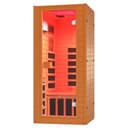 RESTISLAND Full Spectrum Infrared Sauna, 1 Person, 1178W The most completely specified cabin here: 1,178W at 120V, full-spectrum with named 660/850nm red-light wavelengths, and actual published dimensions. Everything you need to plan the corner it goes in. | 1,178 W | 120V | 15A | Smallest electrical ask | $1,459.99 · View on Amazon Price as of October 10, 2026. #ad How we’re funded |
| 2 | 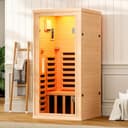 Albott Infrared Sauna, 1 Person, 1260W The most forthcoming listing in the set: 1,260W at 110V, seven carbon panels, Canadian hemlock. It states the two numbers — wattage and voltage — that decide whether it plugs into your wall, and most infrared listings state neither. | 1,260 W | 120V | 15A | Fits a 15A circuit | |
| 3 | 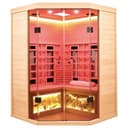 Generic 2-3 Person Ceramic Infrared Sauna, 1810W The only cabin here that publishes wattage AND voltage together, which is the pair that lets the circuit be computed rather than guessed — 1,810W at 120V lands on a 20A circuit, the one unit on this page that genuinely does. | 1,810 W | 120V | 20A | Computes to a real 20A | $1,577.00 · View on Amazon Price as of October 10, 2026. #ad How we’re funded |
| 4 | 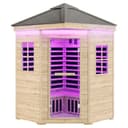 Albott Outdoor Infrared Sauna 4 Person, 2850W The only unit in this entire comparison that publishes its amperage: 2850W, 240V, 20A. Everyone else makes you do the math. | 2,850 W | 240V | 15A | Only one publishing amperage |
Four cabins chosen for what their own numbers say about the circuit, not for heat output or price. The full rankings are on our infrared roundup and indoor roundup, where every card carries the same computed figure.
Frequently asked questions
What are the electrical requirements for an infrared sauna?
Most infrared cabins are 120V appliances drawing between 1,178 and 2,850 watts, and that range crosses the line that matters. A sauna is a continuous load - it runs for well over three hours at a time if you use it properly - so the NEC sizes its circuit at 125% of the current it actually draws. That means a 15A circuit carries 12A continuously and a 20A circuit carries 16A. Of the seven cabins we compare that publish both watts and 120V, two stay inside the 15A allowance and five do not.
Do infrared saunas need a dedicated circuit?
In practice yes, and for a reason that is about the maths rather than about the code's wording. A cabin drawing 12 to 17 amps continuously is using most or all of a household branch circuit on its own, so anything else on that run - a space heater, a freezer, a hair dryer, a shop vac - is what trips the breaker. five of the seven plug-in cabins here already compute past what a 15A circuit carries continuously before anything else is plugged in. A dedicated 20A circuit for the sauna is the right specification for almost every indoor install, and it is a cheap thing to ask for while an electrician is already there.
Can I plug an infrared sauna into a normal wall outlet?
Physically yes, and that is exactly what makes this question dangerous to answer with a yes. The plug fits; the question is what is behind the outlet. two of the seven computable plug-in cabins here stay inside what a 15A circuit carries continuously, five need a 20A circuit on their own published numbers, and two computes past even that. A cabin that needs more than its circuit carries continuously will usually run - the breaker may not trip on the first session - but it is not a load that circuit was designed to carry for an hour at a time, several times a week, for years.
How do I work out the amps myself?
Watts divided by volts gives the current; multiply by 1.25 for the continuous-load requirement; then take the next standard breaker size at or above that figure. A 1,500 W cabin at 120V draws 12.5A, requires 15.6A of continuous capacity and therefore needs a 20A circuit, not the 15A outlet its title may name. That is the whole calculation, and it is why we compute rather than quote: only four of the sixteen infrared cabins we compare publishes an amperage, and one of the figures that are published do not survive the arithmetic.
Do any infrared saunas need 240V?
A few of the larger ones, and they are a different install rather than a bigger one. one of the cabins we compare publish 240V, and at that voltage the same wattage draws half the current - which is why a nearly 3 kW four-person cabin can compute to a smaller breaker than a 2.1 kW three-person cabin on 120V. The trade is that 240V is wired rather than plugged, so an electrician is not optional. Our 240V versus 120V page works through what each answer commits you to.
Do infrared saunas use a lot of electricity?
Less than people expect, because the draw is modest and the session is short. A 1,500 W cabin run for an hour uses 1.5 kWh at most, and in practice less, since the panels cycle once the cabin is up to temperature. The honest comparison is against a traditional sauna: a 6 kW stove is four times the draw and needs a 240V circuit to carry it. That is the real efficiency argument for infrared, and our cost-to-run page computes the figure from published wattage at a rate you can substitute for your own.
What about GFCI protection and permits?
Both are local questions with real answers, and we deliberately do not give a universal one. GFCI requirements for outlets have broadened in recent code cycles and they turn on where the outlet is - outdoors, in a garage, near water - which is a conversation with your inspector rather than a rule we can state for your address. Permits vary the same way and tend to be required for new circuits rather than for plugging in an appliance. Both have their own pages here, and both are worth asking about before an electrician quotes rather than after.
Why don't you publish a wire gauge?
Because conductor sizing depends on things that are not on any product listing: the length of the run, the ambient temperature, how many conductors share the raceway, the insulation type, and the code cycle your jurisdiction is on. Publishing a gauge would be the one number on this site most likely to be wrong for your specific install and most consequential if it were. We publish the computed load and the breaker size the load requires, which is exactly what an electrician needs from you, and we stop there on purpose.
Related
- Sauna electrical requirements — the traditional half, with code citations
- 240V vs 120V saunas — what the voltage commits you to
- Does a sauna need a dedicated circuit?
- Does a sauna need a disconnect?
- Which saunas plug into a normal outlet?
- Do infrared saunas use a lot of electricity?
- Do infrared saunas need to be vented?
- What an infrared sauna costs to run
- Extension cord for a sauna or cold plunge — why not
- Best infrared saunas — every card carries the computed circuit
Sources
- Seller listings for all 16 infrared cabins we compare (Amazon detail pages) — Every wattage and voltage in the table above was read from the listings themselves on the dates shown on their cards in our roundups, where each listing is linked. 12 of 16 publish a rated power, 8 publish a voltage and 4 publish an amperage, so every amp, continuous-load and breaker figure here is computed from published watts and volts rather than quoted. Wire gauge is deliberately not published: conductor sizing depends on run length, ambient temperature, conduit fill and the code cycle in force, none of which appear on a product listing. (accessed 2026-10-11)
- NEC 210.19(A)(1)(a) — minimum branch-circuit conductor ampacity — 2020 NEC. Conductors sized at noncontinuous load plus 125% of the continuous load. (accessed 2026-07-16)
- NEC 424.3(B) — fixed electric space-heating equipment — Space-heating equipment is a continuous load; conductors and overcurrent devices sized at 125% of the heating load. (accessed 2026-07-16)
- NEC 210.8(F) — GFCI protection for outdoor outlets (2023 NEC) — Applies to outdoor outlets on single-phase circuits 150V-or-less to ground and 50A-or-less. Exceptions apply; confirm with your AHJ. (accessed 2026-07-16)