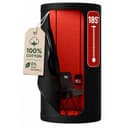
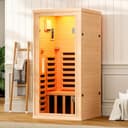
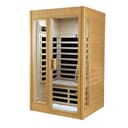
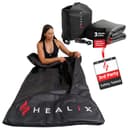
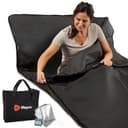
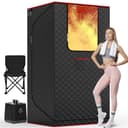
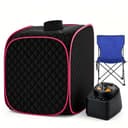
“Best sauna under $1,000” is a price question that hides a category question, and getting the category wrong is how people end up with a closet ornament. Under this line there are three genuinely different machines, and their published maximum temperatures are not comparable with each other. A steam tent is a fabric enclosure plus an electric steam generator. An infrared blanket is a zipped wrap that heats you rather than any air at all. A one-person infrared cabin is a wooden box with a bench and a door. Only one unit in this whole bracket heats air to the temperature a Finnish sauna runs at, and it is none of those three.
That is why this page does not simply sort by price. It ranks on four criteria, in this order: whether the unit reaches a temperature worth the session, read within its own format rather than across formats; how much the listing publishes, because at this end of the market the blanks are the risk; where it has to live, since a blanket needs no floor and a cabin needs a permanent corner; and only then price. Across these eight picks, six publish a rated power, six publish a maximum temperature and fourpublish an assembled size — so the comparison is built on what sellers actually state.
The price line itself is checked rather than claimed. There is no price typed anywhere into this page’s copy. Every figure is read from our live price layer when the page is served, with the date attached, and each pick is tested against the $1,000 line at that moment — so a unit that has drifted above it gets labelled rather than quietly left in a list that says “under”. The table lower down this page is that check, in full.
One scope note. If your constraint is the cheapest route to any heat rather than the best use of a thousand dollars, our portable sauna roundup ranks the tents against each other on their own terms and our blanket roundup does the same for blankets. If you want to know what the next bracket up buys you, our best infrared saunas for the money page ranks on cost per usable year rather than on a sticker ceiling.
We have not tested any of these; we own none of them. Here is exactly what we do instead. Every specification below was read from the seller’s own Amazon listing on the date printed on each card.
How to spend under $1,000 well
Decide the format before the product, because the formats are not substitutes. The question that sorts this bracket is not “which is best” but “where will this live and will I use it”. A blanket lives in a cupboard and needs a sofa; a tent needs a square metre of floor for the duration of the session; a cabin needs a permanent corner and never moves again. People who buy on price alone usually buy the wrong format and then conclude the whole category does not work for them. Blanket versus cabin and blanket versus tent are the two comparisons worth reading first.
Read the assembled height, not the assembled footprint. This is the single most under-read number in the budget bracket. Two of the tents here publish their dimensions, and the difference between them is the difference between standing up in a 71-inch enclosure and sitting on a stool in a 40.5-inch one with your head out of a neck hole. Both are sold as portable saunas. Only one of them is a room. four of the eight picks publish an assembled size at all, and a listing that will not state one is withholding exactly this.
Treat a published maximum temperature as format-specific, not as a score. A 140°F steam tent and a 185°F dry-air pod are not the same experience at different intensities, and an infrared blanket’s 176°F is a surface temperature against your skin rather than an air temperature in a room. Comparing those three numbers directly is the most common mistake in this bracket. Infrared versus traditional and what temperature an infrared sauna should run at set out why.
Expect the electrical question to be easy, and check it anyway. Everything in this bracket plugs into a wall. The highest rated power here is 1,500 W, which is about 15.6A of continuous capacity once the code’s 125% rule is applied — fine on a 20A circuit, tight on a 15A one that is also carrying a space heater or a freezer. Which saunas plug into a normal outlet is the full version, and it is the page that explains why the next price bracket up needs an electrician.
And weigh the running cost, because at this end it is genuinely trivial. A thousand-watt tent run four times a week for half an hour is a rounding error on a power bill, which is the real financial argument for starting here rather than at four thousand dollars. What a blanket costs to run computes the per-session figure from published wattage at a rate you can substitute, and is a home sauna worth it puts it against what a studio charges.