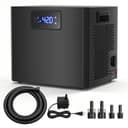
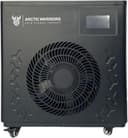
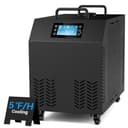
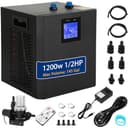
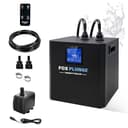
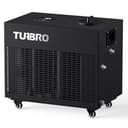
First, the circuit.This is the largest single difference between two chillers that look similarly priced. A unit that publishes a 120V or 115V plug goes in the wall and works that afternoon. A unit that needs 240V needs a licensed electrician to run a new circuit, which is a few hundred dollars and a scheduling delay before you have cold water at all. Worse than either is a listing that publishes no voltage, because then you are buying the install blind — two of the chillers we compare do exactly that. Our 110V chiller roundup exists specifically because this cost is so often invisible until delivery, and the cold plunge electrical requirements page covers what an electrician will want to know.
Second, the gallon ceiling. A chiller is not rated in degrees, it is rated in how much water it can hold against heat leaking in from the room. Published ceilings on this page run from 53 gallons up to 216, which is a four-fold spread, and the units at the bottom of that range are the cheap ones. Buy one for a 150-gallon tub and it will run continuously, cost you more every month than the money you saved, and still never reach your set point on a hot day. Our tub roundup publishes capacity for every tub we compare for exactly this reason — the pairing is the purchase, not either half on its own.
Third, the warranty. A compressor is a mechanical part with a finite life, and this is the one category on our site where the warranty column is almost entirely empty. Only 3 of 8chillers publish a term. A stated 12 months is not generous, but against silence it is the difference between a product and a shipment — and it is free to weight, because it costs you nothing to prefer the unit that published one.
Fourth, the second appliance.This is the only one of the four that can make a more expensive chiller the cheaper buy. If you want contrast therapy rather than cold alone, a chiller that also heats replaces a second purchase, a second plumbing loop and a second thing to find space for. The FADHOLE 1 HP publishes both functions, 10,000 BTU of cooling and a 216-gallon ceiling, which makes it the value pick for anyone building toward a contrast setup at home. If you only want cold water, skip it — you would be paying for half a machine you never switch on.
What is NOT on this list is cooling power for its own sake. A bigger compressor pulls water down faster, and pulldown speed is the spec this category markets hardest and publishes least — only 3 of 8 chillers state a BTU figure at all, and none publishes a tested pulldown curve. For a home setup that holds temperature under an insulated cover between daily sessions, raw speed is close to irrelevant: you are paying for a sprint you never run. That is the main reason the value ordering on this page differs so much from the capability ordering on the main roundup.