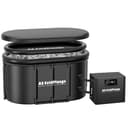
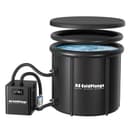
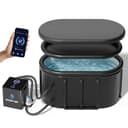
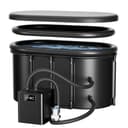
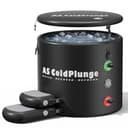
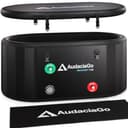
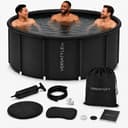
The query behind this page assumes a thousand dollars buys a tub. It does not have to, and that is the single most useful fact in the bracket: a complete tub-and-chiller kit lands comfortably inside the line. So the real decision at this budget is not which vessel. It is whether you want refrigeration or a vessel, because under $1,000 you are not getting a good version of both.
An unchilled tub is an ice bath. That is a legitimate way to plunge and it is how most people start, but it means buying bags of ice for the rest of the tub’s life and accepting a temperature you did not choose. A kit ends both of those. What it does not do is end them quickly: every kit under this line ships a 1/3 HP compressor against 100–148 gallons, and the standalone 1/3 HP chillers we compare that publish a gallon ceiling state 53, 79, 79 gallons. Every kit here is over-tubbed against its own compressor class, and none of them says so.
We own none of these and have measured none of them. What we do instead is read what the seller put in writing, leave the page blank where the listing is blank, and argue the ranking out loud. Prices move daily and are pulled live — the $1,000 claim on this page is checked against the live figure further down rather than typed into the copy.
How we ranked them
- Does the money buy cooling — the gate. four of these eight picks include a refrigeration unit and four do not. A kit takes the top four places not because the hardware is better than the bare tubs but because it answers a question the bare tubs leave open and expensive.
- Among the kits: gallons against horsepower. All of them are 1/3 HP. None publishes a cooling capacity in BTU. So the only lever left is how much water the compressor is asked to hold, which is why the 100-gallon bundle outranks a 148-gallon one that costs more.
- A published port. four of eightpicks publish an actual inlet and outlet rather than a bare “chiller compatible” claim. One of them names the thread size and ships shut-off valves, which is the most specific plumbing spec anywhere in this bracket.
- Among the bare tubs: published capacity, then published insulation. Those two specs decide what a chiller you buy later has to fight. eight of eight publish a capacity; four publish wall insulation.
- Everything else. Fit height, a cover in the box, a warranty term, a model number. three of these listings state a warranty at all, and the ones that do are the kits.
No scores. A score implies a measurement, and we have measured nothing here — every figure above was read from the seller’s own listing on the date printed on each card, and every blank is a spec the seller does not publish.
The arithmetic the kit listings leave out
This is the one piece of maths worth doing before you spend anything in this bracket, and no listing does it for you.
Four standalone 1/3 HP chillers sit in our registry. 3 of them publish a maximum tub volume, and those figures are 53, 79, 79gallons — stated by the manufacturer, for an insulated tub, in an unstated ambient. Now look at what the kits in this bracket pair that same compressor class with: 148, 100, 148, 148 gallons. The smallest kit here is already above the lowest published ceiling, and the largest is roughly 1.9 times the highest.
That does not make them useless. It makes them slow, and it makes the fill level a real setting rather than a detail. Filling a 148-gallon tub to the volume you actually immerse in — not to the brim — is free, instant, and the most effective thing you can do to a budget kit. Our chiller sizing guide works the relationship through properly, and the page on a plunge that will not get cold is mostly a list of this one mistake.
What the extra money buys above this line
Worth knowing what you are declining, because the next tier is not just a bigger version of this one. Above $1,000 the category starts publishing three things that are absent here: a 1 HP compressor, a 37°F floor instead of the 42°F floor these kits state, and rigid hard walls that hold their own shape and their own insulation. The rigid barrels and the 1 HP bundles are covered on best vertical cold plunge tubs and best cold plunge tubs with a chiller.
The honest framing is that this bracket is a working cold plunge and the tier above is a fastone. If you plunge four mornings a week and the tub sits in a room that is roughly room temperature, slow is invisible — the chiller holds overnight and you never watch it work. If it lives in a garage that hits 95°F, or you want it cold on demand after a session you did not plan, the compressor size stops being an abstraction.
Who should buy a bare tub instead
Three readers, and it is worth checking whether you are one of them. The first already owns a chiller, in which case the whole kit premium is wasted and the only question is which tub publishes a port — four of eight here do. The second is plunging with ice on purpose: if the ritual is bags of ice on a Saturday, insulation and ports are doing nothing for you and the cheapest route in is the right one.
The third is testing whether the habit sticks. This is the most common and the least discussed. A hundred-dollar tub answers the habit question for a hundred dollars, and the answer is worth knowing before you spend ten times that — our beginner’s guide is written for exactly that first month, and the buying-mistakes page lists what people regret in order.
The budget line nobody includes in the budget
A thousand dollars of tub is not a thousand dollars of setup, and two line items get left out often enough to be worth naming. The first is a thermometer. Every published guideline about cold water is stated in degrees, so without one you are estimating rather than following anything — and 3 of these eight picks publish a temperature figure of any kind. It costs about $20.
The second is water care. A chilled tub holds the same water for weeks, which is the entire point and also the problem. Every kit here ships some filtration and none of it sanitizes; the water treatment roundup covers what the chemistry side actually publishes, and a cover does more for a budget kit’s running cost than anything else you can bolt on, because the cheapest cold is the cold you do not lose.
Who should skip this page
If value rather than a hard ceiling is what you are after, the ceiling is the wrong filter — best cold plunge for the money ranks the whole field on what each unit publishes per dollar, including the units above this line. If you are tall, the tall-user page ranks on the posture-appropriate dimension rather than on gallons, and one tub in this bracket publishes the tallest stated fit in the registry.
And if the chiller is the part you actually care about, buy it first and separately. Best cold plunge chillers ranks the standalone units on published cooling capacity, and the 110V subset is the one that plugs into a receptacle you already have. Heat as well as cold is a different purchase again — see the chillers that also heat.