The verdict
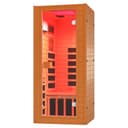
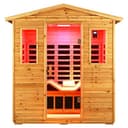
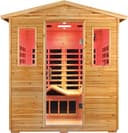
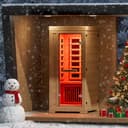
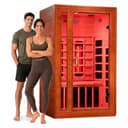
The RESTISLAND 1-person full-spectrum cabinis the pick, and it is for one person who wants to plan the install before it arrives: it is the only cabin here that publishes its wattage, its voltage, its exterior dimensions and the 660/850 nm wavelengths of its red-light emitters on the same listing. If you need three seats, the SALUSHEAT 3-person outdoor cabinstates 1,950 W and a 20A circuit, which is more than most outdoor listings manage; if you need four, the LTCCDSS is the only cabin in the group that tells you how much patio it covers. The budget pick is the ENSTVER 1-person cabin— the cheapest full-spectrum cabin we track, and it still publishes the 1,240 W draw you need to size an outlet, which is the minimum a cheap cabin should tell you.
“Full spectrum” is the only infrared spec that is sold as a grade and written as an adjective. It means the cabin emits in the near, mid and far infrared bands rather than far infrared alone — and nothing on a retail listing requires a seller to show that it does. So the phrase turns up on cabins that name their emitters and on cabins that publish nothing at all, at both ends of the price range. That is the problem this page is built to solve.
The ranking criteria, in order: whether the listing names the wavelengths it emits, because that is the only published number that speaks to the claim at all; whether it publishes a rated power, because that is what you size a circuit from; whether it publishes an exterior footprint, because a cabin that will not state its dimensions is withholding the spec most likely to disappoint you; and then seats. Across these five cabins, three publish a rated power, one publishes a voltage, two publish a footprint and one names a wavelength.
The finding worth carrying away is that full spectrum is not what prices this category. The cheapest cabin in the group is full-spectrum and so is the dearest; the dearest publishes neither a wattage nor a voltage and ranks last here on that basis, while the cheapest publishes its draw. What you pay for in this pool is seats, cabinet construction and whether a brand has a history — not the spectrum claim. four of the five cabins that name a wood name Canadian hemlock, so even the cabinet is less differentiated than the price spread implies.
Two scope notes. If your question is the broader one — which infrared cabin, full-spectrum or not — our best infrared saunas roundup ranks the whole pool, and best infrared saunas for the money ranks it on cost per usable year instead. If what you actually want is the red-light half of the claim rather than the heat, best saunas with red light therapy is the page for that, and infrared sauna vs red light therapy explains why they are not the same purchase.
We have not tested any of these; we own none of them. Here is exactly what we do instead. Every specification below was read from the seller’s own Amazon listing on the date printed on each card, and every price comes from our live price layer at the moment the page is served.
How to read a full-spectrum claim
Look for a wavelength, in nanometres.Red-light and near-infrared emitters are normally specified at 660 nm and 850 nm, and a listing that names them has told you something checkable about its hardware. A listing that says “full spectrum” and stops has told you a category. One cabin in this group names the numbers; the rest do not, and we have ranked accordingly rather than assuming the silence means absence.
Then look for watts and volts together, because one without the other is not a plan. three of these listings publish a rated power and one publishes a voltage. The outdoor three-person cabin states a 20A circuit while withholding the voltage, which tells you the breaker but not the receptacle. The computed row on each card above shows the NEC 125% figure wherever both numbers exist and says so plainly where they do not. Which saunas plug into a normal outlet is the longer version of that question.
Treat the absent maximum temperature as the category norm, not an oversight. Not oneof these cabins publishes a maximum temperature, which matters more in infrared than in a stove sauna: an infrared cabin is not trying to heat air to 190 °F and comparing it to one that is will mislead you. What temperature an infrared sauna should run at sets out the band these units actually work in.
And weigh the EMF question separately. Full spectrum and low EMF are different claims about different things, and sellers use them interchangeably. Our low-EMF roundup ranks the cabins that put a milligauss range on the claim against the ones that publish the adjective, which is the same test applied to a different word.