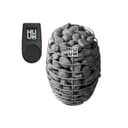
Almost every sauna heater listing sells you a kilowatt number and leaves the expensive part — the circuit — as an exercise for the reader and their electrician. The HUUM Drop does not. Its listing publishes amperage, breaker size and wire gauge for every rating in the line, which makes it the most electrically complete heater listing in our entire registry and the only one you can get a firm quote against before the box arrives.
That is the whole case for this heater, and it is a better case than it sounds. A 6 kW heater produces 6 kW whatever the badge says; the variable cost between two 6 kW heaters is the install, and the install is where sauna budgets go wrong. Of the nine electric heaters we track, threepublish an amperage at all — and all three of them are Drop bundles. No other electric heater in our registry publishes one, let alone the breaker and the cable with it.
We do not own this heater and we have not fired it. What we do instead is read what the manufacturer put in writing, compute the code arithmetic from their own published watts, leave the page blank where the listing is blank, and say so when a listing contradicts itself. Prices move daily and are pulled live — nothing below quotes a figure we typed in by hand.
What the listing publishes that nothing else does
Three numbers, and together they are the review. For the 6 kW: 25A at 240V, a 30 A breaker and 10 AWG wire. For the 9 kW: 37.5A, a 50 A breaker and 8 AWG wire. Nothing else in our registry publishes the second and third of those at all.
Here is why that matters more than it reads. Applying the code’s 125% continuous-load rule to HUUM’s own rated wattage, the way our electrical page does for every heater on this site, gives 31.3A for the 6 kW and 46.9A for the 9 kW. Those are the figures that force a 30 A breaker instead of a 25 A one and a 50 A instead of a 40 A — and HUUM has already done that arithmetic and printed the answer. Most listings publish the raw amperage, if that, and leave a buyer to discover the 25% uplift from their electrician at quoting time.
The practical consequence is that you can price this heater properly before you own it. Cable gauge drives the cost of a long run from the panel to a garden sauna more than the breaker does, and 8 AWG over 10 AWG across fifty feet is a real line item. Being able to put that in a quote request is worth more to most buyers than any feature on the heater itself.
The blank that bothers us
No stone capacity.On an exposed-stone heater, where the elements sit in direct contact with the rock and the rock does more of the radiating, stone mass is close to the defining spec — it is what buffers the heat and what decides how the room feels a minute after a ladle of water hits it. HUUM publishes a figure for its own wood stoves. It publishes nothing here.
Across the 15 heaters we track, onepublish a stone mass. So the Drop is in good company, statistically — but it is the brand’s flagship electric stove, the exposed stones are the design story on the listing, and the number is absent. It is the inverse of the electrical picture: the most documented listing we have read is silent on the one mechanical spec its own design depends on. Our sauna rocks guide covers what mass does and how to judge a fill by eye instead.
The warranty inversion on the WiFi bundle
This is the strangest thing on the three listings and we are reporting it rather than resolving it. The 6 kW Local bundle states 60 months. The 6 kW WiFi bundle — same heater, same published electricals, same published room range, higher price — states 36 months.
We have no explanation and we are not going to invent one. It may be that the controller carries a different term from the heater and the bundle inherits the shorter of the two; it may be an error in the listing copy. What we can say is what each page says today, on the read date on each card. If the warranty is the thing deciding your purchase, ask HUUM directly before you pay the premium — and note that the premium buys scheduling, not cover.
What it costs to run
Computed, not quoted. At 18.31cents per kWh — the US average residential figure, which is wrong for almost everyone — a 6 kW Drop used 3 times a week for 90 minutes comes to roughly $11 a month, or about $0.82 a session. The 9 kW on the same habit is roughly $16 a month.
Both numbers rest on an assumption we are stating rather than hiding: the element is energized 50% of the session, because a stove heater draws rated power while the room climbs and then cycles to hold. HUUM publishes no duty cycle, and neither does any other heater manufacturer. If your room is well insulated the real figure is lower; if it is a glass-fronted garden cabin in February it is higher. Our cost-to-run page takes your own rate and your own habit as inputs instead of printing one national number.
Which Drop to buy
Sizing it honestly
HUUM publishes a room range for both ratings, which puts it in the minority: 12 of the 15 heaters we track publish a maximum room volume at all. The 6 kW states 177–353 cu.ft and the 9 kW states 282–530 cu.ft.
Two things to do with those figures. First, measure your room in cubic feet rather than guessing from the seat count, because glass and uninsulated surfaces both cost real heat — our heater size calculator applies the usual penalties and shows its work. Second, resist sizing up “to be safe”. An oversized heater in a small room overshoots, cycles hard, and costs you a bigger breaker and heavier cable for the privilege. The sizing guide works through where the rule of thumb breaks.
What we would buy instead, and when
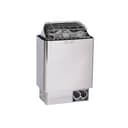
If you want a documented electric stove for less, the Harvia KIP80B publishes a room range and ships with built-in controls, so there is no separate wall unit to wire — a genuinely simpler install even though it needs a larger circuit at 8 kW. It does not publish a breaker or a wire gauge, which is the Drop’s whole advantage, and our HUUM against Harvia comparison goes through both spec sheets properly.
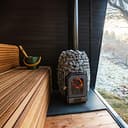
If the circuit is the obstacle, the answer is not a smaller electric heater — it is wood. HUUM’s own HIVE Wood needs a flue instead of an electrician, publishes the stone mass the Drop leaves blank, and costs nothing per session. Drop against HIVE is the head-to-head, and electric versus wood is the general case.
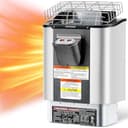
If the budget is the obstacle, a generic 9 kW heater with a digital controller costs a fraction of the Drop and produces the same kilowatts. You give up the published circuit information, the stainless body, the sensors in the box and most of the warranty, and you accept a brand that may not exist when a part fails. Best sauna heaters ranks the whole field on kW, published room volume and the circuit each one computes to.
Availability, honestly
Worth saying because it affects whether this review is actionable. On the date above, all three Drop bundles were confirmed purchasable, but only the 9 kW was in stock in any quantity — both 6 kW bundles reported a handful of units. The 6 kW is the rating most buyers want and it is the one that sells out. If it is unavailable when you read this, the honest advice is to wait for it rather than to size up to the 9 kW and pay for a 50 A circuit you do not need.