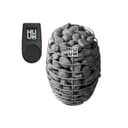
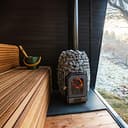
HUUM is one of the few sauna brands people shop by name, and the two lines it sells for a home sauna are not variants of each other. They are different appliances with different installs, different running costs and different failure modes, sharing a design language and a factory in Estonia.
What makes this comparison unusually tractable is that the two listings publish almost perfectly disjoint sets of specs. The Drop tells you the amperage, the breaker size and the wire gauge for every kW rating it is sold in — information no other heater listing in our registry provides — and never says how much stone is in the box. The HIVE Wood tells you it holds 199 lb of rounded olivine and never mentions electricity, because it uses none. So the comparison is not “which spec sheet is better”; it is “which set of unknowns can you live with”.
We own neither and have fired neither. What we do instead is read what HUUM publishes, run its electrical figures through the same code arithmetic we apply to every heater on this site, and say plainly where the two disagree.
The first fork: a circuit or a chimney
Everything else on this page is downstream of one question. An electric Drop needs a dedicated 240 V circuit run from your panel to the sauna. A HIVE Wood needs a code-compliant chimney, clearances to combustibles and somewhere for ash to go. Both are real construction costs and neither is in the price of the box.
Which is cheaper depends entirely on your site, and the answer flips more often than people expect. A sauna in a basement, a few feet from the panel, makes the electric install trivial and the chimney a penetration through every floor above it. A sauna at the bottom of the garden makes the chimney straightforward and the circuit a trench. Our electric vs wood heater guide works through the trade in full, and the outdoor foundation page covers what else an outbuilding commits you to.
What is not site-dependent: the Drop has a thermostat and the HIVE has a fire. One of those holds a set temperature while you are in the room and the other asks you to feed it. If that sounds like a chore, the Drop is your heater. If it sounds like the point, it is the HIVE.
HUUM publishes the circuit. We checked its arithmetic.
The Drop listing is the most electrically complete heater listing in our whole registry. For each of the four ratings it is sold in, HUUM states the kilowatts, the amperage at 240 V single phase, the circuit breaker size and the wire gauge:
- 4.5 kW — 18.8 A, 30 A breaker, 10 AWG, 106–247 cu.ft
- 6.0 kW — 25 A, 30 A breaker, 10 AWG, 177–353 cu.ft
- 7.5 kW — 31.25 A, 40 A breaker, 8 AWG, 247–424 cu.ft
- 9.0 kW — 37.5 A, 50 A breaker, 8 AWG, 282–530 cu.ft
Every page on this site sizes a sauna circuit the same way: a fixed electric heater is a continuous load, so conductors and overcurrent devices get sized at 125% of the load. Run HUUM's own amperage through that rule and three of the four ratings agree with HUUM exactly. The 9 kW computes to 46.88 A continuous and a 50 A breaker, which is what HUUM states.
The 6 kW does not. HUUM states a 30 A breaker; 125% of its own published 25 A is 31.25 A, and the smallest standard breaker at or above that is 35 A. We are not calling HUUM wrong: a listed appliance is installed per its own instructions, exceptions exist, and your inspector has the final say. We are saying that this is the one line on the listing worth putting in front of your electrician before the wire is pulled, because if they size to the code rule rather than the listing you are buying a heavier circuit than the box implies.
Stone mass: published on the wood stove, blank on the Drop
Stone is the thing that makes a sauna feel like a sauna. Mass stores heat, releases it slowly, and turns a ladle of water into steam instead of a hiss. HUUM markets this directly: both lines are built so the heat source sits in direct contact with the stones, and more exposed stone is explicitly why the company says its heat is longer and milder.
Which makes it odd that only one of these two listings puts a number on it. The HIVE Wood 13 publishes 199 lbof rounded olivine, included. The Drop publishes that stones are in the box and nothing more. So on the single spec HUUM's own marketing says is the reason to buy a HUUM, the electric line asks you to take it on trust and the wood line does not.
It is not a reason to avoid the Drop — a wall-hung electric heater physically cannot hold the mass a floor-standing firebox does, and nobody expects it to. It is a reason to be skeptical of any comparison that treats the two as interchangeable. If soft steam is what you are after, read our page on sauna rocks and what happens when you pour water on them.
The WiFi bundle costs more and states less warranty
The two 6 kW bundles on this page are the same heater. Same output, same 25 A draw, same wire gauge, same body, same stones. The difference is the controller: the UKU Local is a wall panel, and the UKU WiFi adds the HUUM app, which sets start and end times and a target temperature and tells you when the room is ready.
The WiFi bundle costs more, which is expected. What is not expected is the warranty line. The Local bundle's listing states a 60-monthlimited warranty excluding elements; the WiFi bundle's listing states 36 months. Those are HUUM's own words on its own two product pages, read on the same day. We cannot tell you why, and the listing does not explain it — but you should know before you pay the upgrade.
Worth noting too that HUUM makes the argument against its own upgrade: the Local controller is described as the right choice where there is no network connection, which is exactly the situation a garden sauna is usually in. Remote pre-heating is genuinely useful if your sauna is indoors on house WiFi and you want it hot when you get home. In a shed at the end of the yard with two bars of signal, it is a feature you will use once.
Sizing: read the published ranges, not a rule of thumb
All four units here publish a room range in cubic feet, and the ranges overlap on purpose. The 6 kW Drop covers 177-353 cu.ft; the HIVE Wood 13 covers 212-459 cu.ft; the 9 kW Drop covers 282-530 cu.ft.
A range rather than a single figure is the honest way to publish this, because the same cubic footage is a different heating job depending on insulation, glass area and whether the room is indoors. Sit at the bottom of a band for a well-insulated indoor room with a small window; sit at the top for a glass-fronted outdoor cabin in a cold climate. Our heater sizing page does the arithmetic from your own measurements, and the insulation guide covers what moves you up or down the band.
One practical consequence: the gap between the 6 kW and the 9 kW Drop is not just output. It is a 30 A circuit and 10 AWG wire against a 50 A circuit and 8 AWG, which on a long run to an outbuilding is a meaningful difference in copper. If your room is near the top of the 6 kW band, insulating better is usually cheaper than stepping up the heater and the circuit together.
The HUUM line at a glance
The same four units, side by side on the specs that separate them rather than the ones they share.
Who should buy neither
A HUUM is a premium stove and there is no version of this page where it is the budget answer. If the heater is the whole budget, our full heater roundup ranks the cheaper electric options on the same published specs, and HUUM vs Harvia puts the HIVE Wood directly against the Finnish stoves that compete with it, including the Harvia M3 — which publishes the same 212–459 cu.ft range from a very different firebox.
And if you are not building a room at all, a heater is the wrong purchase. Complete outdoor cabins arrive with a heater matched and included, and barrel saunas are the format most HUUM stoves end up in.