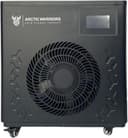
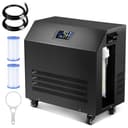
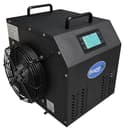
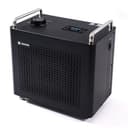
A chiller that also heats is the most appealing idea in home recovery and the least documented product in it. The pitch writes itself — one appliance, one circuit, one footprint, cold in July and warm in January — and the category has responded by putting “heating and cooling” in the title of every listing and a number behind it on almost none.
So that is the axis this page ranks on. Not whether a unit claims heat, because they all do, but whether the listing commits to a ceiling in degrees, a cooling capacity you can size with, a gallon figure, and a wattage. Of the 6 heat-and-cool units we could confirm were purchasable, 5 publish a hot ceiling, 2 publish a BTU figure, 3 publish a gallon ceiling, and 1 publishes rated power. No single unit publishes all four.
We own none of these and have measured none of them. What we do instead is read what the manufacturer put in writing, leave the page blank where the listing is blank, and argue the ranking out loud. Prices move daily and are pulled live — nothing here quotes a figure we typed in by hand.
How we ranked them
- A hot ceiling, in degrees — the gate.A protocol built on a 104°F soak needs a unit that says 104°F. 5 of 6 name one. The unit that does not is ranked last on this page despite publishing something no other listing here does.
- Published cooling capacity. The cold half is the hard half, and BTU/h is the spec that predicts it. Only 2 listings here state one, and they take the top two places for it.
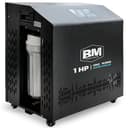
- How much else is in writing. Those two units come from the same brand and make near-identical claims, so the tie breaks on documentation and fit: the 1.0 HP publishes a supply voltage, an ingress rating, an ambient-temperature limit and a winter drain port, and its 120-gallon ceiling matches the tub most readers own.
- A gallon ceiling, then rated power. 3 of 6 tell you what size tub they suit; 1 tells you what it draws. Running cost matters more here than on a plunge-only chiller, because a contrast habit works the appliance in both directions.
- Everything else. Noise band, filtration, warranty, and whether there is a model number at all. Two of these listings are effectively brandless, which matters the day a part fails.
No scores and no claimed test results. Nobody here publishes a reheat time and we are not going to invent one, because a time-to-temperature figure with no ambient condition attached is not a measurement — it is a number in a marketing bullet.
The spec nobody in this category will print
There are two completely different machines sold under the words “heating and cooling”, and the listings do not distinguish between them.
The first is a reversible heat pump: the same refrigeration circuit that pulls heat out of the water runs backwards and puts heat in. It is efficient, because it moves heat rather than making it, and the hot side costs a fraction of what the cold side does. The second is a resistance elementplumbed into the loop — essentially a kettle in a box. It works, it is cheap to build, and it draws its full rated wattage the entire time it runs.
Not one listing in this survey says which one it is. The closest anything comes is the two units that publish a separate heating capacity and cooling capacity, which at least implies two different figures for two different processes. If running cost matters to you, that absence is the single biggest gap in this category — and it is why the only unit that publishes a wattage keeps a place on this page despite having the smallest compressor on it. Our cost-to-run page does the arithmetic once you have a wattage; without one there is nothing to compute.
What “contrast therapy from one appliance” actually means
It is worth being precise about this, because the marketing is not. A heat-and-cool chiller does notlet you alternate hot and cold within a session. It lets you choose, per day or per season, what temperature the tub sits at. Swinging a 100-gallon volume from 50°F to 104°F is a large amount of energy moved through a small appliance, and none of these listings publishes how long it takes.
True alternation needs two vessels, or a tub and a sauna. Our guide to setting up contrast therapy at home covers the layouts that make that work, and the protocol page covers the timings. What this format genuinely buys you is seasonality: a cold tub from May to September and a warm one from November to March, from one purchase, without owning something that sits idle half the year. Several listings here describe exactly that use case themselves, and it is the honest one.
Why the hot ceilings cluster between 104 and 108°F
Five of the six units here name a ceiling, and four of those five land between 104 and 108°F. That is not a coincidence. 104°F is the conventional maximum for a residential hot tub, and consumer products that heat water for people to sit in are built around that convention. A unit advertising 115°F would be advertising something no manufacturer wants to be responsible for — which is worth remembering when you see the one outlier here claiming 120°F.
The practical read is that the hot end of this category is effectively settled and the spread across it is noise. What is notsettled is the cold end: the floors in this survey run from 35°F on the units that publish one to no stated floor at all on the units that do not. If you care about a specific plunge temperature, the cold spec is where the real variation lives, and our temperature guide covers which band is actually worth targeting.
Warm water changes the water care problem
This is the part of the heat-and-cool pitch that nobody mentions. Cold water is a hostile environment for most of what grows in a tub; warm water is a friendly one. Running a plunge at soak temperature for a season puts it squarely in the regime a hot tub owner has to manage, and the vessel you are doing it in is probably an insulated plunge pod with no ozone, no automated chemistry and a cover designed to keep cold in rather than debris out.
Every unit ranked here includes some combination of filtration and an ozone stage, and on a warm tub those stop being nice extras. Budget for test strips and a treatment routine from day one — our water treatment roundup covers what the chemistry side actually publishes, and the filters and pumps roundup covers the hardware side, including the inline filter that keeps hair out of whichever of these you buy.
Who should skip this page
If you only ever want cold water, do not pay for the heat side. The units that drop the heating function publish more of everything else at a lower price, and best cold plunge chillers ranks that set on cooling capacity alone. If price leads, best cold plunge chiller for the money is the page you want.
And if what you are really after is hot and cold in the same session, the answer is a sauna next to a plunge, not one appliance doing both. Our sauna and cold plunge combos page covers the one-box version of that, and the bundled tub-and-chiller systems are worth pricing if you have not bought the tub yet either.