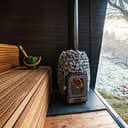
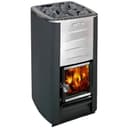
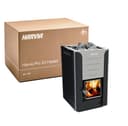
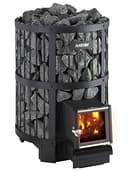
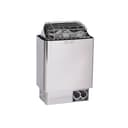
HUUM and Harvia are the two Finnish names a home sauna builder actually has to choose between, and the choice is narrower than the brand loyalty around it suggests. The stove each brand sells into a standard home room — the HUUM HIVE Wood 13 and the Harvia M3 — publish the same room range: 212-459 cu.ft. One is 13 kW, the other 16.5 kW, and they land in the same place because output and room rating are not the same question.
So this page resolves on the rows underneath that one. Stone capacity, warranty term, price band and — if your room is bigger than either stove covers — what else each brand has on the shelf. We have not fired either of these stoves. We own neither, and what we do instead is read what each maker commits to in writing and report where one says more than the other.
Where the two stoves actually differ
Stone mass is the real difference
HUUM publishes 199 lb of rounded olivine for the HIVE Wood 13. Harvia includes stones with the M3 and does not state how many. That gap is the single most consequential thing on this page, because the stone bed is the thermal battery of a traditional sauna: it absorbs the fire's output, holds it, and releases it as steam when water hits it. A heavy bed takes longer to come up and then gives you several throws of even, soft loyly. A light bed heats faster and spikes, then sags while the stones recover.
Neither behavior is wrong — they are preferences, and if you heat the room for 45 minutes before a 20-minute session, both get you there. But it is the clearest reason the HUUM costs what it costs, and it is the one variable HUUM lets you check on the listing. If you want to see how the rest of the category treats stone disclosure, our sauna rocks guide covers which stone types survive repeated thermal cycling and which crack.
Output is not the ranking you think it is
The M3 is 16.5 kW and the HIVE is 13 kW, and they are rated to the same room. Read that as a reminder that a wood stove's published output describes the fire, not the room: firebox volume, air control and the mass sitting on top of it all change how much of that output reaches the bench. The rough electric-side ratio of about 1 kW per 50 cu.ft does not transfer cleanly to wood, which is exactly why both makers publish a volume range instead and why the range is the number to size against.
Warranty, and what it is worth
HUUM states 3 years residential on the HIVE Wood 13; Harvia states 2 years on the M3 and nothing at all on the Legend 240 SL or the Pro 20. On a steel firebox that will see hundreds of thermal cycles that extra year is a real, if modest, difference. The larger point is the pattern: across this page, HUUM publishes a figure in every row and Harvia publishes one in some.
Price band
Qualitatively, the M3 is the least expensive stove on this page by a wide margin and the HIVE Wood 13 sits near the top of it, close to the two-room Harvia Legend. That is the trade in one line: the HUUM premium buys disclosure, stone mass and a year of warranty, not more room coverage. Current prices for all five are in the table above, read live rather than typed by us.
If your room is bigger than 459 cubic feet
This is where the brand comparison stops being a comparison. HUUM has one wood stove in our registry; Harvia has three, and two of them go well past where the HIVE stops. The Pro 20 publishes 283-706 cu.ft at 24 kW, sized for six to eight people, with a cast-iron glass hatch. The Legend 240 SL publishes 353-848 cu.ftand will heat two adjacent rooms from a single fire through rear and upper connection openings — the only stove on this page that will.
Both carry the wood category's usual asterisks. The Pro 20's chimney kit is a separate purchase and a real install, and neither publishes a stone capacity or a warranty term. Oversizing is also a genuine mistake rather than a safe margin: 24 kW in a 250 cu.ft room is a stove you will spend every session damping down.
The chimney is the hidden cost, the way the breaker is on electric
The honest case for wood is that it needs no circuit at all. No dedicated 40A run, no panel capacity question, no electrician — which on a backyard build far from the house is often the difference between a project and a fantasy. We put numbers on that side of it in sauna electrical requirements.
What replaces it is a chimney: the flue, the roof or wall penetration, the clearances to combustibles, and in most jurisdictions a permit and an inspection. That is not a smaller job than a circuit, it is a differently shaped one, and it is why the same buyer who wants a wood stove in a backyard barrel usually wants an electric heater indoors. The whole trade is laid out in electric vs wood sauna heater, and the permit guide covers what inspectors tend to ask for.
What if you would rather not deal with a fire at all
Harvia has the answer that HUUM does not, in our registry at least: the KIP80B, an 8 kW electric stove with built-in controls, rated to Up to 425 cu.ft. That is a slightly smaller room than the two stoves at the top of this page cover, and it comes with the electric category's own tax — a dedicated 45A circuit at 240V under the continuous-load rule. What you get for it is a thermostat instead of a damper and a 30-minute preheat you can start from the house.
If that is the direction you are leaning, the Harvia KIP 6kW vs 8kW comparison is the next page to read — the breaker, not the room, usually decides that one — and the full electric heater roundup puts the Harvias against the budget alternatives.