Do saunas need electricity?
A wood-fired sauna does not - it is the only genuinely off-grid route to real sauna heat. Every other kind does. Here is which is which, and what you trade for the freedom.
Last verified · Ice & Cedar editorial
The verdict
A wood-burning sauna needs no electrical circuit at all — the heat comes from a fire in a steel firebox, and the only things that might want power are a light and, in some builds, a fan. For a cabin, a remote site or a yard you do not want to trench, that makes wood the one real answer. Everything else needs power: all 6 electric heaters we compare are 240V units needing a dedicated circuit, and every infrared cabin, blanket and steam tent is an electrical appliance with no non-electric mode. If you want low electrical commitment rather than none, a 120V infrared cabin is the middle ground.
People arrive at this question from two very different places. Some are building somewhere there is no power to speak of — a cabin, a remote corner of a property, a yard where running a circuit means trenching across a lawn. Others just want to know whether a sauna is a plug-in appliance or an electrical project. The answer serves both, and it is unusually clean: exactly one kind of sauna needs no electricity, and it is the oldest one.
A wood-burning sauna heater is a steel firebox with a grate, a flue and a bed of stones on top. You light a fire in it. There are no elements, no control board, no thermostat and no circuit — which is why the spec sheets for the wood stoves we compare have no voltage, no amperage and no breaker size on them at all. That absence is the entire point of the category.
Everything else in sauna is electrical, and not marginally so. Every traditional electric heater we compare is a 240V unit: a 6kW heater draws 25A continuously and wants a 35A circuit, and a 9kW one draws 38A and wants 50A. That is a licensed electrician, a new run from the panel, and on an outdoor build quite possibly a trench. Our dedicated circuit guide works through the arithmetic, and it is the cost a wood stove lets you delete.
Which saunas need power, and how much
- Wood-burning heaters and stoves— no circuit at all. The only genuinely off-grid route to real sauna heat.
- Traditional electric heaters— a dedicated 240V circuit, sized at 125% of a continuous load. All 6 we compare are 240V.
- Infrared cabins— always electrical, but mostly modest. Most one- and two-person cabins we compare run on a standard 120V outlet.
- Sauna blankets— electrical, and the lowest draw of anything here. A normal outlet, no planning.
- Portable steam tents and hot-air pods— electrical; a 120V plug-in appliance with a boiler or a heater in it.
Put plainly: if the heat is made by burning something, you need no circuit. If the heat is made by a wire getting hot, you do. There is no hybrid and no battery-powered option worth taking seriously — sauna heat is simply too many kilowatt-hours to store.
What a wood stove asks for instead
A flue, and the clearances that come with it. This is the real work that replaces the electrical work. A wood stove needs a chimney with correct penetration and a hearth with correct clearances to combustible surfaces, and getting either wrong is a fire risk rather than an inconvenience. It is not harder than wiring a 240V circuit, but it is not nothing, and it is the part to do properly or have done. Our outdoor foundation guide and permit guide are both worth reading before a wood build, because the inspection questions change rather than disappear.
Attention, every single session.An electric heater is a switch and a wait. A wood fire is a fire: you lay it, light it, feed it, and manage the temperature by how you manage the fuel. Many people consider that the better experience and would not swap it. Others discover after two months that they wanted heat, not a ritual. Be honest with yourself about which you are — our electric versus wood comparison lays out that trade without romanticising it.
A longer heat-up, and a wood supply. Wood heats more slowly than a well-sized electric heater and cannot be put on a timer, so a wood sauna is a planned event rather than a spontaneous one. You also need somewhere dry to keep seasoned wood. Neither is a dealbreaker; both are the kind of thing that decides whether a sauna gets used four times a week or four times a year, which matters far more than any spec.
And the right stove for the room’s volume. This is where the wood stoves we compare are unusually well documented: most publish a rated room range in cubic feet, which is precisely the number you size against. A stove rated for a bigger room than you have will run you out of the sauna; one rated too small will never get there. Our heater sizing guide applies the same logic to both heat sources.
The off-grid option: wood stoves we compare
Ranked on published specifications. Select a row to jump to the full write-up. We have not tested these units — here is exactly what we do instead.
| # | Product | Rated | Room max | Best for | Price |
|---|---|---|---|---|---|
| 1 | 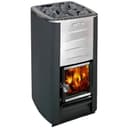 Harvia M3 Woodburning Sauna Heater, 16.5kW The default first wood stove: an established Finnish heater for a normal-sized room, and the specs it doesn't need are the point — no volts, no amps, no circuit. It publishes a 212-459 cu.ft room range and a 2-year warranty, which is more than most of the electric side of this market manages. | 16.5 kW | 459 ft³ | Best first wood stove | $1,100.00 · View on Amazon Price as of October 4, 2026. #ad How we’re funded |
| 2 | 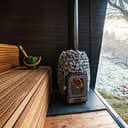 HUUM HIVE Wood 13 Sauna Stove, 13kW The best-documented stove here and the softest heat. Its 199 lb of stone is a large thermal mass that gives a gentler, longer loyly than a light firebox, and it publishes what the others leave out: the same 212-459 cu.ft room range as the Harvia M3, a stated stone capacity, and a longer 3-year warranty. | 13 kW | 459 ft³ | Fullest spec sheet, longest warranty | $2,530.00 · View on Amazon Price as of October 4, 2026. #ad How we’re funded |
| 3 | 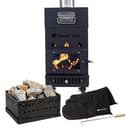 SweatTent Wood Burning Sauna Stove Kit Not a room heater but a portable tent stove, and the most complete kit here: it ships with the rock basket, heat-resistant gloves and fire poker most stoves make you buy separately. Stainless steel and built to travel. It publishes no kW or room range, so match it to your tent by the maker's guidance rather than a number. | Not published | Not published | Best for a tent or backyard build | $799.00 · View on Amazon Price as of October 4, 2026. #ad How we’re funded |
| 4 | 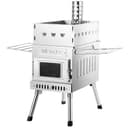 WillowyBe Outdoor Sauna Hot Tent Rocket Stove The cheapest way into wood heat, and honest about what it is: a foldable rocket-style tent stove with an adjustable air damper and a spark arrestor, aimed at sauna tents and camping. No published output or room rating, so it's a match-to-your-tent purchase — but at this price it's the low-risk way to find out whether a wood fire is the experience you want. | Not published | Not published | Lowest-cost route to a wood fire | $284.95 · View on Amazon Price as of October 4, 2026. #ad How we’re funded |
None of the 6 wood heaters we compare publishes a voltage, an amperage or a circuit requirement, because none of them has one. Their spec sheets are about room volume, stones and steel instead.
The middle ground, if you have some power
Most people asking this question do not actually have zero electricity — they have a normal household outlet and no appetite for a 240V circuit. That is a different question with a better answer: a one- or two-person infrared cabin, a sauna blanket or a portable steam tent all run from a standard outlet with no electrician involved. You are not getting traditional 185°F dry heat from any of them, and we would rather say so than sell the word, but you are getting a usable sauna habit for the cost of a plug.
Our guide to which saunas plug into a normal outlet is the right next page if that describes you, and the one-person roundup is where every unit shares exactly that property. If you genuinely have no power at the site, skip all of it and read the wood-burning heater roundup instead — it is the only category on this site that does not care whether your panel has a spare slot.
Frequently asked questions
Do saunas need electricity?
Not all of them. A wood-burning sauna needs no electrical circuit at all - the heat comes from burning wood in a steel firebox, and the only things that might want power are a light and, in some builds, a fan. That makes wood the single genuinely off-grid route to real sauna heat, and it is why wood stoves are the standard answer for cabins, remote builds and anywhere running a new circuit is impractical. Everything else does need power: electric heaters, every infrared cabin, sauna blankets and portable steam tents are all electrical appliances with no non-electric mode.
Do barrel saunas need electricity?
It depends entirely on which heater goes in it, which is the thing to understand about barrel saunas: the barrel is a shell, and the heater is a separate decision. Fit a traditional electric heater and you need a dedicated 240V circuit and an electrician. Fit a wood stove into the same barrel and you need a flue, a hearth clearance and a wood supply, and no electrical work at all. Plenty of barrels are sold either way. If your reason for wanting a barrel is that it can go at the bottom of a garden with no trenching, the wood version is the one that actually delivers that.
Do outdoor saunas need electricity?
Only if their heater does. An outdoor sauna is where the question matters most, because running a circuit out to a yard or a deck is the expensive, disruptive part of an outdoor build - trenching, weather-rated enclosures, and on many circuits GFCI protection under the 2023 NEC outdoor-outlet rules. A wood-fired outdoor sauna skips all of it. That is a genuine cost advantage, and it is the main reason wood remains popular outdoors long after it stopped being the default indoors.
Do infrared saunas need electricity?
Yes, always, with no exception - an infrared cabin is panels of electrical heating elements and nothing else. There is no wood-fired equivalent, because the entire mechanism is electrical emission. The good news is that the circuit is usually modest: most of the one- and two-person cabins we compare run on a standard 120V outlet rather than a dedicated 240V circuit, which is a completely different proposition from a traditional heater. If what you want is low electrical commitment rather than no electricity, infrared is the realistic answer.
How much electricity does a traditional sauna heater need?
Enough that it is never a casual addition. A 6kW heater at 240V draws 25A continuously for the length of a session, which under the NEC 125% continuous-load rule calls for a 35A circuit; a 9kW heater is 38A and a 50A circuit. All 6 electric heaters we compare are 240V units. That is the scale of electrical work a wood stove lets you avoid entirely, and it is also why the running-cost question is answered so differently for the two heat sources.
Does a wood sauna need any power at all?
The heater does not. The room sometimes benefits from it. A light is the common one - a sauna lit only by a firebox door is atmospheric and not especially practical - and some builds use a small fan as part of their ventilation scheme. Neither is a requirement, and both are a world away from a dedicated 240V circuit: a single lighting circuit or even a battery lantern covers it. So the honest answer is that a wood sauna needs no electricity to make heat, and you may still want a wire out there for comfort.
Related
- Best wood-burning sauna heaters - the no-circuit category
- Electric vs wood sauna heater - the full trade-off
- Which saunas plug into a normal outlet - the low-commitment middle ground
- Does a sauna need a dedicated circuit - the electrical route in full
- Does a sauna need a disconnect - another thing wood avoids
- Outdoor sauna foundation - what a wood build sits on
- Best barrel saunas - the shell that takes either heater
- How long do sauna heaters last - where wood has the structural advantage
Sources
- NEC 210.19(A)(1)(a) — minimum branch-circuit conductor ampacity — 2020 NEC. Conductors sized at noncontinuous load plus 125% of the continuous load. (accessed 2026-07-16)
- NEC 424.3(B) — fixed electric space-heating equipment — Space-heating equipment is a continuous load; conductors and overcurrent devices sized at 125% of the heating load. (accessed 2026-07-16)
- NEC 210.8(F) — GFCI protection for outdoor outlets (2023 NEC) — Applies to outdoor outlets on single-phase circuits 150V-or-less to ground and 50A-or-less. Exceptions apply; confirm with your AHJ. (accessed 2026-07-16)
- Manufacturer listings for all four wood stoves (Amazon detail pages) — Room ranges, kW ratings and construction above were read from each stove's own listing on the date shown on its product card, where each listing is linked. Amperage and breaker figures for electric heaters are computed from published kW and voltage using the NEC continuous-load rule cited here. Flue, clearance and hearth requirements are a matter for your local code and a competent installer; we publish no clearance figures. (accessed 2026-10-05)