Does a sauna need a disconnect?
A hardwired heater needs a means of disconnection. Whether that is the breaker you already have or a local switch beside the door depends on your install - and on your inspector.
Last verified · Ice & Cedar editorial
The verdict
If your sauna heater is hardwired, a means of disconnection is part of the install — that is the general principle for fixed electrical equipment and the reason this comes up at inspection. Whether the panel breaker serves as that means, or a local switch is required because the panel is not within sight of the heater, is a determination for your licensed electrician and your local authority having jurisdiction. If your sauna plugs into a receptacle, the plug is the disconnecting means and the question does not arise — which covers every infrared cabin, blanket and portable unit we compare.
This question almost always arrives late: the cabin is built, the heater is on the wall, and someone — an electrician, an inspector, a forum post — mentions a disconnect. It is worth understanding before that point, because it can change the wiring plan and the quote.
Start with what a disconnect is for. It is not a control and it is not a safety device in the sense a GFCI is. A disconnecting means exists so that whoever services a piece of fixed equipment can positively isolate it and be certain it cannot be re-energised while they are working on it. That purpose is the key to the whole question, because it explains why the answer depends on where things are rather than on what the heater is rated at. If the person servicing the heater can see the breaker they just opened, the breaker does the job. If they cannot, it is a far weaker guarantee.
We are going to decline to tell you what your install needs, and it is worth saying why. Requirements for disconnecting means depend on how the equipment is classified, where it is located, the sight line between it and the panel, and which code cycle your jurisdiction has adopted. Across this whole section our rule is to publish a number only where we can trace it to primary code text, and otherwise to state the principle and refer you to a licensed electrician — the same reason we publish no wire gauge tables anywhere on this site. A confident article number that is correct for one jurisdiction and wrong for yours is worse than no number at all.
What the question actually turns on
1. Hardwired or plugged in.This is the first fork and it settles most cases. A plug-connected appliance has its disconnecting means built in — the plug — and nobody needs to install anything. A hardwired heater has no such thing, which is why the question only ever concerns traditional electric heaters and the larger cabins. Our plug-in sauna guide lists which units fall on the easy side of this line.
2. Whether the panel is within sight. This is the factor that most often decides whether a local switch gets added. A panel in the same room as the sauna, or in clear line of sight of it, is a very different situation from a panel in a basement at the other end of the house. The further apart they are, the more likely your electrician specifies a local disconnecting means near the equipment.
3. Indoors or outdoors.An outdoor sauna raises the stakes on both of the above — it is usually further from the panel, and it brings weather-rated enclosures and outdoor GFCI rules into the same conversation. The 2023 NEC outdoor-outlet GFCI provisions we cite below are the clearest example of how an outdoor install picks up requirements an identical indoor one does not. Our permit guide covers the inspection side of an outdoor build.
4. The size of the load, indirectly. The disconnect question is not decided by amperage, but amperage is what puts you in the hardwired category in the first place. A 6kW heater at 240V computes to 25A continuous and a 35A circuit; a 9kW heater is 38A and a 50A circuit. Nothing at that scale plugs into a wall, which is exactly why every heater in the table below is in scope and every infrared cabin is not. Our dedicated circuit guide works through that arithmetic in full.
5. What your controller is, and is not.Do not let a control panel stand in for a disconnect in your own head. A thermostat, a timer, a digital panel or an external controller mounted outside the hot room are all control devices — they switch the elements as part of normal operation. A disconnecting means is a separate concept with a separate purpose. Ask your electrician to name what they are using, explicitly, rather than assuming the switch you can see counts.
6. Your local inspector, last and decisively. Code is adopted and amended locally, and the authority having jurisdiction has the final word on your install. The productive version of this conversation is to raise it before the walls close up: ask your electrician what they intend to use as the disconnecting means, and whether your AHJ has a view. That is a five-minute question before rough-in and an expensive one afterwards.
The heaters this applies to: hardwired 240V
Ranked on published specifications. Select a row to jump to the full write-up. We have not tested these units — here is exactly what we do instead.
| # | Product | Rated | Controls | Best for | Price |
|---|---|---|---|---|---|
| 1 | 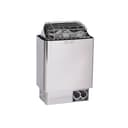 Harvia KIP80B, 8kW The default Finnish heater for a mid-size room. Built-in controls keep the install simple, and Harvia publishes the room range — which most brands do not. | 8 kW | Built-in | Hardwired: disconnect question applies | $1,269.00 · View on Amazon Price as of October 4, 2026. #ad How we’re funded |
| 2 | 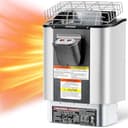 Mxmoonant 9kW 220V Digital Sauna Heater 9kW and 425 cu.ft published — the same room rating as the 8kW Harvia at a fraction of the price, with digital control. | 9 kW | Digital | Largest draw, biggest circuit | $599.99 · View on Amazon Price as of October 4, 2026. #ad How we’re funded |
| 3 | 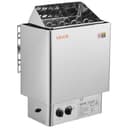 VEVOR 6kW 240V Sauna Heater A fraction of the Harvia price with a published fit range of 176.5-317.8 cu.ft. The cheapest honest route to 6kW. | 6 kW | Not published | Smallest 240V heater we compare | $185.90 · View on Amazon Price as of October 4, 2026. #ad How we’re funded |
All 6electric heaters we compare are 240V hardwired units, so the disconnect question applies to every one of them. Their published control types vary — built-in, dials, digital — and none of those is a disconnecting means.
How to raise it with your electrician
Give them three facts and one question. The facts: the heater’s rated kW and voltage, where the sauna is going, and where your panel is relative to it. The question: “what are you using as the disconnecting means for this heater, and does our AHJ want it local?” That phrasing gets you a straight answer because it uses the term they use, and it surfaces the sight-line issue without you having to diagnose it.
If the answer is a local disconnect, it is a small line item on a job that already involves a new circuit — not a reason to reconsider the build. If you are still at the shopping stage and would rather avoid the whole category of question, that is a real argument for a plug-in unit: an infrared cabin on a 120V receptacle involves no hardwiring, no disconnect and no inspection on this point. The trade is heat type and ceiling temperature, which our infrared versus traditional guide lays out honestly.
Frequently asked questions
Does a sauna need a disconnect?
If the heater is hardwired, it needs a means of disconnection - that much is a general principle for fixed electrical equipment, and it is why the question comes up at inspection. What it does NOT settle is what that means has to be in your specific install. Depending on the equipment, the location and the code cycle your jurisdiction enforces, the breaker in the panel may serve as the disconnecting means, or a local switch may be required where the panel is not within sight of the heater. That determination belongs to a licensed electrician and your local authority having jurisdiction, and we are not going to make it for you from a web page.
Can the breaker be the disconnect for a sauna?
Often, yes - and the usual deciding factor is whether the panel is within sight of the equipment. The reason the rule exists is maintenance safety: whoever services the heater needs to be certain it cannot be energised while they have their hands in it, which is straightforward if they can see the breaker they just opened and much less so if the panel is in a basement two floors away. If your panel is in the same room or in clear line of sight, your electrician may well use it. If it is not, expect a local disconnecting means to be part of the quote.
Do plug-in saunas need a disconnect?
No, and this is the clean half of the answer. An appliance that plugs into a receptacle already has its disconnecting means: the plug. Pull it out and the unit is isolated, visibly, by anyone standing next to it. That covers essentially every infrared cabin, sauna blanket and portable steam tent we compare, which is one of the underrated advantages of a plug-in sauna - no hardwiring, no disconnect, no inspection on that point. Our guide to which saunas plug into a normal outlet covers which units those are.
Is the sauna's own control panel a disconnect?
Treat it as no. A heater's thermostat, timer or digital control panel is a control device - it switches the heating elements as part of normal operation - and a control is not the same thing as a disconnecting means that isolates the equipment for service. An external controller mounted outside the hot room is not automatically one either, even though it has an off position. Do not assume the panel satisfies the requirement because it has a switch on it; ask your electrician what, specifically, they are using as the disconnecting means.
Do outdoor saunas need a disconnect?
Outdoor installs attract more scrutiny, not less, and for good reasons that go beyond the disconnect itself. An outdoor sauna is typically further from the panel, which makes the sight-line question more likely to matter. It also brings in weather-rated enclosures and, on many circuits, GFCI protection under the 2023 NEC outdoor-outlet rules. None of that is something to work out from a listing. If the sauna is going in a yard or on a deck, budget for the electrician conversation up front rather than discovering it at inspection.
Why will you not just tell me the code article?
Because disconnecting-means requirements turn on equipment classification, location and the code cycle your jurisdiction has actually adopted, and we have not verified a specific article for sauna heaters against primary code text. Our rule across this whole section is the same: publish a figure only where we can trace it to primary text, and otherwise state the principle and defer. We would rather give you an accurate account of what the question depends on than a confident article number that is right for somebody else's install and wrong for yours.
Related
- Does a sauna need a dedicated circuit - the load arithmetic
- Sauna electrical requirements - the full reference
- 240V vs 120V saunas - which side of the hardwired line you are on
- Do you need a permit for a home sauna - the inspection side
- Extension cords - why a plug-in sauna still wants the wall
- Which saunas plug into a normal outlet - the units with no disconnect question
- Best sauna heaters - every hardwired unit we compare
- How long do sauna heaters last - what the warranty column shows
Sources
- NEC 210.19(A)(1)(a) — minimum branch-circuit conductor ampacity — 2020 NEC. Conductors sized at noncontinuous load plus 125% of the continuous load. (accessed 2026-07-16)
- NEC 424.3(B) — fixed electric space-heating equipment — Space-heating equipment is a continuous load; conductors and overcurrent devices sized at 125% of the heating load. (accessed 2026-07-16)
- NEC 210.8(F) — GFCI protection for outdoor outlets (2023 NEC) — Applies to outdoor outlets on single-phase circuits 150V-or-less to ground and 50A-or-less. Exceptions apply; confirm with your AHJ. (accessed 2026-07-16)
- Ice & Cedar electrical policy - what we will and will not publish — This page states the purpose and the deciding factors of a disconnecting means qualitatively and does not cite a code article for sauna heaters, because we have not verified one against primary code text. Amperage and breaker figures above are computed from published kW and voltage using the NEC 125% continuous-load rule cited here. Requirements for your install are a matter for a licensed electrician and your local authority having jurisdiction. (accessed 2026-10-05)