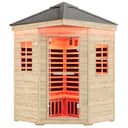
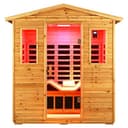
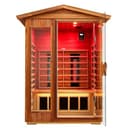
Every other page we have written about this category ranks it on something the reader can check before buying — power draw and siting, or how it survives a real winter. This page asks the one question that reorders the field: what does it cost per seat?
The answer is not subtle. The stove barrels publish 6 seats and the small outdoor infrared cabins publish 2, and because the two formats overlap heavily on sticker price, the per-seat figures across this survey spread by roughly a factor of two. The unit with the lowest price tag in the whole category is, on this measure, the most expensive one in it. That is worth knowing before you shop, because every retailer in the category sorts by price.
We own none of these and have heated none of them. What we do instead is read what the manufacturer put in writing, compute the circuit arithmetic from their own published watts, divide the live price by the seat count they publish, and leave a dash where they publish nothing. Prices move daily and are read when the page is served — we quote brackets in prose and let the table do the numbers.
How we ranked them
- Cost per published seat — the gate. Computed at request time from the live price and the seat count the manufacturer publishes. eight of eight picks publish a seat count, which is the one spec this category reliably states.
- Which money. Purchase price, install cost and running cost do not rank the field the same way. A 6 kW stove computes to a 35A circuit; a 2,850 W cabin computes to 15A. Both figures are arithmetic from published watts, not claims.
- What the listing publishes at all. Inside the same-price barrel tier this is the only tiebreak left, and it splits them cleanly: one publishes a footprint and the others do not.
- The experience you actually get. one of eightpicks publishes a maximum temperature at all — 195°F, on a stove unit. Not one infrared cabin here states one. Value comparisons between the two formats are only honest once you know they are not substitutes.
- Everything else. Named wood species, exterior dimensions, a warranty term, a model number. Not one of these listings states a warranty, which is the single most consistent blank in the category.
No scores, and no price typed into a write-up. Every figure above was read from the seller’s own listing on the date printed on each card; every blank is a spec the seller does not publish; every circuit number is computed by us from their watts.
The three barrels at one price
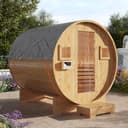
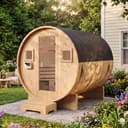
This is the single most useful thing we found and it is not in any listing. threebarrels in this survey — threedifferent brand names — publish the same 6 kW at 240V, the same 4–6 person capacity and no wood species at all, and on the read date they sat at the same live price. Two of them serve the identical primary product photograph. None of the three names a manufacturer.
We are not going to assert that they are the same unit, because no listing says so and we have not opened a crate. What we can say is that nothing published about them distinguishes them on heat, capacity or price — so the only basis for choosing one is what each listing is prepared to commit to in writing. On that test exactly one of them publishes exterior dimensions, and in a category where the thing that actually goes wrong is getting a crate down a side return, that is not a small difference. It is the whole difference.
The corollary is that paying more insidethat tier buys you nothing you can verify. Paying more to leave it — for named Canadian red cedar and a published temperature — buys you two things you can.
Where the money actually goes after the purchase
Two costs follow the unit home, and the sticker price predicts neither.
The circuit. Every stove unit here publishes 240V and none plugs into a household outlet. A published 6 kW at 240V draws 25.0A, which the code’s continuous-load rule turns into 31.3A and a 35A breaker. The 2,850 W outdoor infrared cabin computes to a 15A breaker and publishes a 20A requirement on its own listing. For a sauna at the end of a garden, the cable gauge over that run can matter more than the breaker does, and our electrical page covers what to ask for. Outdoor equipment also brings a GFCI requirement into play, which is a permit conversation in many jurisdictions.
The heat. At 18.31cents per kWh — the US average, which is wrong for nearly everyone — 3 one-hour sessions a week comes to roughly $7 a month on a 6 kW stove and about $5 on a 2,850 W cabin. Those rest on duty cycles we are stating rather than hiding: 50% for the stove, which draws hard while the room climbs and then cycles, and 80% for the cabin, which runs closer to continuously because it never gets anywhere near a stove’s temperature. No manufacturer publishes a duty cycle. Our cost-to-run page takes your rate and your habit as inputs instead.
Put those together and the value picture inverts again for a solo user. A six-seat barrel is excellent value per seat and poor value per session if only one person ever sits in it, because you heat the whole volume either way. Per-seat value is the right opening question; it is not the last one.
Infrared versus stove is not a price decision
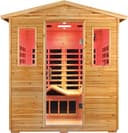
It is worth being blunt about this, because the price overlap invites exactly the wrong comparison. four of these picks are stove units that heat a room you then sit in, and fourare infrared cabins that heat you directly. The one unit here that publishes a maximum temperature is a stove barrel, at 195°F. Not one infrared cabin here publishes a maximum temperature at all, and the format’s honest operating band is far below a traditional room’s.
So the per-seat table is a fair comparison withineach format and a loaded one across them. If you want Finnish heat and the option of water on stones, the infrared cabins are not cheaper — they are a different product that happens to cost similar money. Infrared against traditional is the full argument, and barrel against infrared is the outdoor-specific version of it.
The footprint nobody checks until the pallet arrives
two of these eightlistings publish exterior dimensions. That matters more in this category than in any other we cover, because an outdoor sauna is the largest object most readers will ever have delivered, it arrives on a pallet, and the failure mode is not a bad heater — it is a gate.
Measure the narrowest point on the route from the curb to the pad before you buy, not after. Then measure the pad: a barrel needs a level, load-bearing base and the foundation page covers what counts as one. If your access is tight, the small-space guide is the page to read before this one, and a flat-walled cube sites against a fence in a way a barrel cannot.
Who should skip this page
If you are buying for one or two people and value per seat is therefore irrelevant, rank on the things that do affect you: best two-person saunas covers the small end properly, and best outdoor infrared saunas ranks the cabin half of this field on its own terms rather than against barrels it is not competing with.
If the climate is the binding constraint, the cold-climate ranking re-orders this same pool on heat type, wood and verifiable headroom. If the barrel form factor is what you came for, best barrel saunas is the dedicated page. And if the heater rather than the shell is the thing you care about, buying a kit and a stove separately is a real route — kit against custom build weighs it, and best sauna heaters ranks the stoves on their own published room volumes.