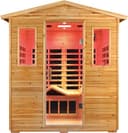
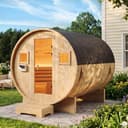
Start with the circuit, because it is the one thing you cannot change after the fact. A family-size traditional barrel runs a 6kW heater, which draws 25A at 240V and, under the NEC’s 125% continuous-load rule, wants a 35A dedicated circuit. That is not a receptacle you already have; it is a run from the panel, and on an older or smaller service it can trigger an upgrade that dwarfs the sauna. Price that circuit first, because it quietly decides which half of this page you are shopping from — and if the answer is “my panel is tight,” the outdoor infrared cabins move to the top of your list.
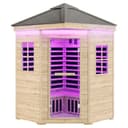
Then decide traditional or infrared, because it decides the experience.Traditional is hot air and stones you can throw water on for löyly, which is what most people picture when they say “sauna,” and it is the only heat here that makes steam. Infrared is a milder, dry radiant heat with no stones — pleasant, low-fuss, and far lighter on the panel. The evidence cannot currently tell you one is healthier than the other, so choose on the experience you want and the circuit you have, not on a health claim. We compare the two side by side.
Then read the seat count as a ceiling, not a promise.A “4-6 person” barrel seats four in real comfort and six with shoulders touching; a “4 person” infrared cabin seats four people sitting, not reclining. Buy for the number that will actually use it most weeks, not the maximum on the box — a room built for six and used by two is a bigger heater, a bigger circuit and a bigger bill for nothing. Where a listing publishes exterior dimensions, plan around those; note how few in this category do, which is itself the finding.
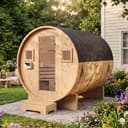
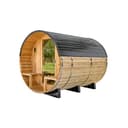
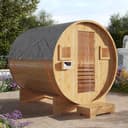
Then weigh the wood and the documentation together. Cedar resists rot and moisture and stays cooler to the touch, which is why the Backyard Discovery Paxton commands a premium — but that same listing publishes no heater rating, so you cannot size its circuit before you buy, and that is a genuine mark against it despite the better materials. The generic 6kW barrels are plainer wood but publish the 220V/6kW heater outright, which at this size is worth more than it looks. Where a listing is silent on wattage, voltage or dimensions, treat that silence as a cost you have not priced yet.
Finally, plan the pad and the delivery before the box ships.A family-size barrel or cabin is heavy and arrives on a pallet; it needs a level, load-bearing base — cradles on gravel, pavers or a slab — ready before it lands. That base spec comes from the manufacturer’s own installation manual and varies by model and by your ground, so we will not publish a number we have not verified for a specific unit. What we will say plainly: the foundation and the circuit are the two costs that turn a listed price into a real one.
Family size sharpens every trade-off
The pattern that runs through the whole sauna category runs hardest here: the listings are generous about seat count and wood and evasive about watts. At two seats you could sometimes sidestep the problem with a 120V indoor infrared cabin and no electrician. At four to six seats that escape hatch closes — a room this size needs real heat, which means either a 6kW traditional heater on a 240V circuit or an outdoor infrared cabin that still wants 240V but far fewer amps. There is no wall-outlet option that seats a family, so the circuit decision is unavoidable, and the honest ranking puts the units that tell you the most about it above the ones that tell you the least.
That is why the Breezestival leads on a page full of bigger names: it is a genuine 4-6 seater that publishes its 220V/6kW heater, so you can price the electrical before you commit, and it does it for well under the cedar brands. The cedar Paxton is the better box — genuine cedar, an established maker, a porch and a Wi-Fi panel — and it loses points for a heater rating it will not print. The Albott sits between them on a different axis entirely: it is the only unit here that states its amperage, and its infrared heat asks the least of your panel, at the cost of the steam a barrel gives you. Three honest positions, three different buyers.