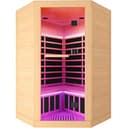
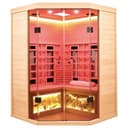
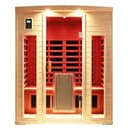
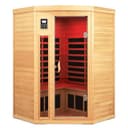
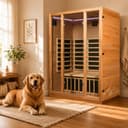
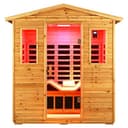
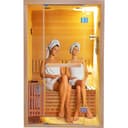
Start with the circuit, because at this size it decides the shortlist and you cannot change it after the crate arrives. The rule is simple and it is not ours: a sauna is a continuous load, so the NEC requires the branch circuit and breaker to be sized at 125% of the draw. Run the published numbers through it and the category splits cleanly. The 1,810W ceramic cabin draws 15.1A and wants a 20A circuit — fine on a dedicated 20A line. The 2,100W OUTEXER draws 17.5A, needs 21.88A of capacity and lands on 25A. The 1,960W cabin does the same. Since no household receptacle is rated 25A, both of those are hardwire or dedicated-circuit installs dressed up as plug-in appliances. Which saunas run without an electrician is the page to read before this one if your panel is already full.
Then decide whether you want humidity, because only one unit here can give you any. Infrared warms your body with radiant panels at a low air temperature: dry, mild, quick to start, and the reason five of these seven exist. A traditional room heats air and stones to sauna temperatures and lets you pour water for steam — the experience most people picture when they say the word, and the one the Finnish research studied. The evidence cannot currently tell you one is healthier than the other, so choose on the experience you want and the service you have, not on a health claim. We compare the two heat types side by side.
Then read the seat count as a ceiling, not a promise. Four of these seven are marketed “2-3 person” and one as “3-4 person”, which in practice means the upper number is achievable and not comfortable. Most are corner cabins: the third seat comes from an L-shaped bench in a corner, not from extra floor area. That is a genuinely efficient way to seat three in a spare room, but it is not the same as a three-person bench, and nobody on this page pretends otherwise in writing because almost nobody publishes an interior dimension at all.
Then weigh what each listing is willing to put in writing. This is the axis the ranking actually turns on. One unit publishes wattage, voltage, amperage and an exterior size — 47.2 x 47.2 x 74.8 in, the only cabinet dimension on the page. One publishes an EMF range as a number, 0-5 mG, where everyone else writes the words “low EMF” and stops. One publishes a wattage and a voltage together, which is the minimum pair that makes a circuit knowable. And three carry no brand name whatsoever. Not one of the seven publishes a maximum temperature or a warranty term.
Finally, treat wood and features as tie-breakers, not reasons. Canadian hemlock is named on four of the seven and is the sensible default for an indoor cabin; two listings never name their wood at all, which on a two-thousand-dollar cabinet is the omission that should bother you most. Ceramic emitters run hotter and more locally than carbon panels, a real hardware difference rather than a better one. Bluetooth speakers, chromotherapy lights and reading lamps are pleasant and cost the manufacturer very little — when a listing leads on them and omits the voltage, read the ordering as the message.
What the arithmetic says about this whole category
Lay the seven side by side and a pattern falls out that no individual listing would admit to. Rated power on the indoor cabins runs from 1,800W to 2,130W — a narrow band, because they are all heating a similar corner box. Put that band through the 125% continuous-load rule and the honest conclusion is that most of this category needs a dedicated circuit, while almost all of it is sold with the vocabulary of an appliance you plug in. The two listings that print “20A” in their own titles are not lying about the instantaneous draw; they are quietly declining to mention that a forty-minute session is a continuous load and the code treats it differently.
The second pattern is about disclosure, and it cuts against price. The cheapest unit here publishes a wattage and a voltage. The most expensive publishes a wattage and a voltage. The two that publish the least sit in the middle of the range. There is no correlation between what you pay and what you are told, which is why this page ranks on disclosure rather than on price: a listing specific enough to be caught out — as the OUTEXER corner is, by its own numbers — is more useful than one that gave you nothing to check. Three of the seven will not even tell you who made them.
The third is what nobody publishes. No maximum temperature, anywhere on the page — so there is no way to compare any of these cabins to a traditional room on the one axis that defines the experience. No warranty term, anywhere. One exterior dimension in seven. Those three blanks are not research gaps on our side; they are the current state of a category that has decided seat count and speaker brands sell better than numbers. Where our tables say “Not published”, that is the finding.