ICE & CEDAR

The best cold plunge chillers that plug into a normal outlet

No electrician, no dedicated circuit — four chillers that run on a standard 110–120V wall socket, ranked on how hard they can actually pull.

Last verified · Ice & Cedar editorial

A cold plunge chiller that plugs into a normal 110–120V wall outlet needs no electrician and no dedicated circuit — but that convenience has a ceiling. Standard-outlet chillers top out around 1/2 horsepower, because a household circuit can only feed so much, so they hold a small insulated tub cold rather than crashing a big one. Below are four that genuinely plug in, ranked on how hard they pull.

This is a deliberate cut of the full chiller comparison: the units here all publish a 110–120V rating, which is the one spec that decides whether you can skip the electrician. A chiller that does not publish its voltage cannot honestly be called plug-in, so it is not on this list — a blank there is not an oversight, it is the reason for the omission.

We have not run any of these units. Here is what we do instead.

Quick picks

Ranked on published specifications. Select a row to jump to the full write-up. We have not tested these units — here is exactly what we do instead.

#ProductBest forPrice
1
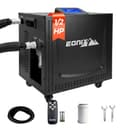
EONIX 1/2 HP Cold Plunge Chiller

EONIX 1/2 HP Cold Plunge Chiller

A 110V half-horse unit that plugs into an existing garage outlet. The honest entry point if you are not ready to pay an electrician.

Best overall plug-in
$369.99 · View on Amazon

Price as of August 5, 2026. #ad How we’re funded

2
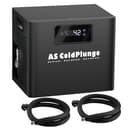
AS ColdPlunge 1/3 HP Ice Bath Water Chiller (110V)

AS ColdPlunge 1/3 HP Ice Bath Water Chiller (110V)

The best-equipped 1/3 HP plug-in here: a built-in filter, a submersible pump and insulated hoses out of the box. The compressor is still small, so the completeness is the reason to pick it, not the speed.

Best-equipped kit
$399.00 · View on Amazon

Price as of August 5, 2026. #ad How we’re funded

3
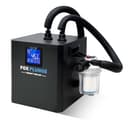
EONIX 1/3 HP Cold Plunge Chiller (110V)

EONIX 1/3 HP Cold Plunge Chiller (110V)

The cheapest way off the ice habit that still plugs into a normal outlet. A 1/3 HP compressor is small on purpose — treat it as a temperature holder for a small insulated tub, not a fast puller.

Cheapest way off ice
$279.99 · View on Amazon

Price as of August 5, 2026. #ad How we’re funded

4
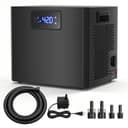
AQOVOR 1/3 HP Cold Plunge Chiller (115V)

AQOVOR 1/3 HP Cold Plunge Chiller (115V)

A no-frills 1/3 HP unit on a standard 115V plug. The listing publishes little beyond horsepower and voltage, so buy it for the plug and the price, not the spec sheet.

Simplest option
$379.99 · View on Amazon

$399.995% off

Price as of August 5, 2026. #ad How we’re funded

#1Best overall plug-in

EONIX 1/2 HP Cold Plunge Chiller

A 110V half-horse unit that plugs into an existing garage outlet. The honest entry point if you are not ready to pay an electrician.

At 1/2 HP this is the largest compressor you can run without an electrician, which makes it the fastest puller on this list. It is still a plug-in unit, so on a large or uninsulated tub it will hold temperature rather than crash it — but on a typical ~100-gallon insulated setup, it is the one that keeps up.

Strengths

  • 110V — runs from a standard outlet, no electrician needed
  • Built-in filter and pump; insulated hoses included
  • Least expensive path to a chilled tub here

Trade-offs

  • 1/2 HP will pull down slowly on a large or uninsulated tub
  • Amperage is not published, so you cannot confirm circuit headroom from the listing
Plugs into a standard outletYes — 110–120V
Voltage120V
Compressor1/2 HP
Cooling capacityNot published
Minimum temperatureNot published
Maximum volumeNot published
AmperageNot published
Rated wattsNot published
Filtration includedYes
WarrantyNot published

Specifications as published by the manufacturer listing, read on July 16, 2026. Blank fields are specs the manufacturer does not publish.

#2Best-equipped kit

AS ColdPlunge 1/3 HP Ice Bath Water Chiller (110V)

The best-equipped 1/3 HP plug-in here: a built-in filter, a submersible pump and insulated hoses out of the box. The compressor is still small, so the completeness is the reason to pick it, not the speed.

The submersible pump and insulated hoses matter more than they sound: they are the parts a bare chiller makes you buy separately, and getting them in the box is why this is the one to hand someone who wants to plug in and go.

Strengths

  • Runs on a standard 110V outlet — no electrician needed
  • Built-in filter, submersible pump and insulated hoses included
  • The most fully equipped 1/3 HP unit compared here

Trade-offs

  • 1/3 HP against anything but a small insulated tub is a slow pulldown
  • No published BTU, temperature floor or amperage
Plugs into a standard outletYes — 110–120V
Voltage120V
Compressor1/3 HP
Cooling capacityNot published
Minimum temperatureNot published
Maximum volumeNot published
AmperageNot published
Rated wattsNot published
Filtration includedYes
WarrantyNot published

Specifications as published by the manufacturer listing, read on August 5, 2026. Blank fields are specs the manufacturer does not publish.

#3Cheapest way off ice

EONIX 1/3 HP Cold Plunge Chiller (110V)

The cheapest way off the ice habit that still plugs into a normal outlet. A 1/3 HP compressor is small on purpose — treat it as a temperature holder for a small insulated tub, not a fast puller.

The only 1/3 HP unit here that publishes a temperature floor (42°F), and the lowest-priced of the four plug-ins compared here. Buy it to stop hauling ice on a small insulated tub, not to make a big tub cold on demand.

Strengths

  • Runs on a standard 110V outlet — no electrician, no dedicated circuit
  • Publishes a 42°F cooling floor, which many listings omit
  • Built-in filter and pump; insulated hoses included
  • Least expensive chiller compared here

Trade-offs

  • 1/3 HP is a small compressor — expect a slow pulldown, and a losing race on a hot or uninsulated tub
  • Amperage and rated watts are not published, so you cannot confirm outlet headroom from the listing
Plugs into a standard outletYes — 110–120V
Voltage120V
Compressor1/3 HP
Cooling capacityNot published
Minimum temperature42°F
Maximum volumeNot published
AmperageNot published
Rated wattsNot published
Filtration includedYes
WarrantyNot published

Specifications as published by the manufacturer listing, read on August 5, 2026. Blank fields are specs the manufacturer does not publish.

#4Simplest option

AQOVOR 1/3 HP Cold Plunge Chiller (115V)

A no-frills 1/3 HP unit on a standard 115V plug. The listing publishes little beyond horsepower and voltage, so buy it for the plug and the price, not the spec sheet.

The listing tells you the horsepower and the plug and almost nothing else. That is a real strike against it — but if the plug and the price are all you are optimizing for, it is an honest budget option, provided you size it to a small insulated tub.

Strengths

  • Runs on a standard 115V outlet — no new circuit
  • Simple, inexpensive 1/3 HP unit

Trade-offs

  • The listing publishes essentially nothing beyond HP and voltage — no BTU, temperature floor, filtration or amperage
  • 1/3 HP pulls down slowly; size it against a small insulated tub
Plugs into a standard outletYes — 110–120V
Voltage120V
Compressor1/3 HP
Cooling capacityNot published
Minimum temperatureNot published
Maximum volumeNot published
AmperageNot published
Rated wattsNot published
Filtration includedNot published
WarrantyNot published

Specifications as published by the manufacturer listing, read on August 5, 2026. Blank fields are specs the manufacturer does not publish.

Why the plug-in chillers stop at 1/2 HP

A standard US household outlet is a 110–120V circuit rated for 15 or 20 amps, and that is the whole constraint. A 1/2 HP chiller fits inside it comfortably; a 1 HP unit generally does not, which is why almost every 1 HP and larger chiller is built for 240V or asks for a dedicated circuit. The plug is not a feature the manufacturer adds — it is a limit the compressor size lives inside.

That is also why every unit on this page is 1/3 or 1/2 HP. If you want the raw pulldown of a 1 HP compressor, you are choosing the electrician, and you should read whether a cold plunge needs a dedicated circuit and the full electrical requirements before you buy the tub, not after.

How to make a 1/3 HP plug-in actually keep up

The most common expensive mistake here is pairing a small plug-in chiller with a large uninsulated tub and concluding the chiller is broken. It is not broken. It is losing a race against heat gain, and on a standard outlet it has no bigger gear to shift into.

The two variables you control at purchase are water volume and insulation. A 1/3 HP unit against a small insulated tub is a sensible pairing; the same unit against 200+ uninsulated gallons in an August garage will never reach your set point. A cover is the one lever on heat gain you can still pull after the tub arrives, and on a plug-in setup it does more relative work than on a 1 HP unit — because the chiller has less headroom to spare. If yours is struggling, the diagnostic checklist for a plunge that will not get cold starts with the heat load, not the compressor.

Frequently asked questions

Can a cold plunge chiller plug into a normal outlet?

Yes — the smaller ones. Every chiller on this page runs on a standard 110–120V household outlet, which is the same plug your kettle uses. The catch is size: standard-outlet units top out around 1/2 horsepower, because a 15- or 20-amp household circuit can only feed so much. Once you want 1 HP or more, you are usually into 240V or a dedicated circuit, which is where an electrician re-enters the picture.

What size chiller can run on 110V?

Up to about 1/2 HP on a standard outlet, and 1/3 HP is the common plug-in size. The EONIX 1/2 HP here is the largest compressor that still runs on a wall socket, which is why it pulls down fastest of the four. The 1/3 HP units are smaller again — genuinely plug-and-go, but sized to hold a small insulated tub cold rather than to crash a large one.

Do plug-in cold plunge chillers need a dedicated circuit?

Not by design — that is the entire reason to buy one. But none of the four here publish an amperage figure, which is itself the finding: you cannot confirm from the listing how much of your circuit the unit will use. The practical rule is to give it an outlet that is not already sharing a heavy load, and if a breaker trips, that is the circuit telling you it was closer to the limit than the listing let on.

How cold does a 1/3 HP plug-in chiller get?

Cold enough on a small, insulated tub; not on a big, uninsulated one. A 1/3 HP compressor removes heat slowly, so it wins a race against a well-insulated 80–110 gallon tub and loses one against 200+ uninsulated gallons in a hot garage. The EONIX 1/3 HP is the only unit here that publishes a floor at all — 42°F — and even that assumes the tub is helping rather than fighting it.

Is a plug-in chiller worth it compared to just using ice?

If you plunge more than a couple of times a week, yes. Bagged ice is a recurring cost and an errand, forever; a chiller is a one-time cost plus a modest amount of electricity, and it ends the errand. A plug-in unit is simply the version of that trade you can make without paying an electrician first, which is what makes it the cheapest honest way in.

Should I buy a plug-in chiller or pay an electrician for a bigger one?

Decide it on the tub, not the chiller. A small insulated tub you keep cold on a schedule is a plug-in job. A large or uninsulated tub, or wanting the water cold on demand rather than on a timer, is what pushes you toward a 1 HP+ unit and the dedicated circuit it needs. The circuit is the expensive, last-minute surprise — price it before you buy the tub, not after.

Related

Sources