What temperature should an infrared sauna be?
Roughly 110-140°F - far cooler than a traditional room, because the heat is reaching you directly rather than through the air. The awkward part is that almost no cabin will tell you its own ceiling.
Last verified · Ice & Cedar editorial
The verdict
Set an infrared cabin in the 110–140°F bandand judge the session by how you feel rather than by the panel reading — infrared heats you by radiation, so the air does not need to reach the 150–195°F a traditional room runs at. Start near the bottom of your unit’s range and extend the session before you raise the temperature. The complication is disclosure: of the 11 infrared cabins we compare, 0 publish a maximum temperature, while 5 blankets publish a full range. If you want a number you can actually set, the hardware that states one is listed below.
This question usually gets answered with a single figure, which is part of why it keeps getting asked. The useful answer has two halves: the band infrared units are built to work in, and the fact that most of them will not tell you where their own ceiling is. The second half changes what you should do about the first.
Start with why the number is lower than you expect. A traditional sauna heats the entire volume of air in the room, and that hot air is what heats you — so the air has to get genuinely hot, which is why traditional rooms run at 150–195°F and why the temperature-and-duration guide for traditional setups talks in those terms. An infrared panel does something different: it emits radiant heat that warms your body directly, the way sun on your face warms you on a cold day. The air in the cabin is largely a bystander. So an infrared cabin at 130°F can ask as much of you as a traditional room at a far higher reading, and comparing the two on air temperature is comparing the wrong number. Our infrared versus traditional guide works through the rest of that difference.
What to look for before you set a number
First, find out whether your unit has a range at all. This is the step most buyers skip, and the one that decides whether the rest of this page is advice or theory. Some infrared cabins expose a target temperature on a digital panel. Some expose heat levels — one through nine, say — with no temperatures attached to them. Blankets usually expose an actual temperature. If your unit only has levels, no number on this page is directly settable and you are calibrating by feel, which is fine as long as you know that is what you are doing.
Second, treat the absence of a published maximum as information. Not one of the 11infrared cabins we compare publishes a maximum temperature. That is not a gap in our research — every specification on this site is read from the manufacturer’s own listing, and this one is simply never there. It means you cannot compare two cabins on heat before buying, and it means a cabin advertised as running “as hot as a traditional sauna” has committed to nothing. A seller who publishes a figure is giving you something to hold them to.
Third, do not transplant a blanket number into a cabin. The blankets publish ranges reaching 176°F, and that figure is the temperature of a heating surface wrapped against your body behind a towel — not the air temperature of a room you sit in. Both numbers are honest; they are measuring different things. Setting a cabin by a blanket’s ceiling, or vice versa, is the one way to get this wrong in a direction that matters.
Fourth, settle the session before the setting. The thing you are actually trying to produce is a sustained physiological response, not a reading. A 25-minute session at a moderate setting does more of that than eight minutes at the ceiling followed by getting out, and it is far easier to repeat four times a week. So pick the duration you intend to keep, then find the lowest setting that makes it feel like work. How often you use it moves the needle more than where you set the dial.
Fifth, hydrate and ventilate to the session, not the number. Infrared sessions are long and dry, and the lower air temperature makes them deceptively easy to extend. Our hydration guide applies in full even though the reading is lower than a traditional room, and it is worth reading before you start lengthening sessions. If you ever feel unwell, end the session — that instruction does not have a temperature attached to it.
The units that will actually tell you a temperature
Ranked on published specifications. Select a row to jump to the full write-up. We have not tested these units — here is exactly what we do instead.
| # | Product | Best for | Price |
|---|---|---|---|
| 1 | 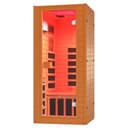 RESTISLAND Full Spectrum Infrared Sauna, 1 Person, 1178W The most completely specified cabin here: 1,178W at 120V, full-spectrum with named 660/850nm red-light wavelengths, and actual published dimensions. Everything you need to plan the corner it goes in. | The only cabin that states a figure | $1,459.99 · View on Amazon Price as of October 4, 2026. #ad How we’re funded |
| 2 | 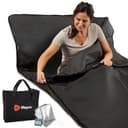 LifePro RejuvaWrap Infrared Sauna Blanket The most completely documented listing in the category: temperature range, heat settings, timer, blanket size and warm-up time are all published. Nothing else here states four of those, let alone five. | Best if you want a dial with numbers | $399.99 · View on Amazon Price as of October 4, 2026. #ad How we’re funded |
| 3 | 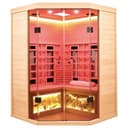 Generic 2-3 Person Ceramic Infrared Sauna, 1810W The only cabin here that publishes wattage AND voltage together, which is the pair that lets the circuit be computed rather than guessed — 1,810W at 120V lands on a 20A circuit, the one unit on this page that genuinely does. | Best documented three-person cabin | $1,679.00 · View on Amazon Price as of October 4, 2026. #ad How we’re funded |
Published temperature information, unit by unit
Every figure below was read from that product’s own listing on the date shown on its card in the roundups. The cabin column being entirely blank is the finding of this page, not an omission in it.
| Unit | Temperature published |
|---|---|
| Infrared cabins | |
| RESTISLAND Full Spectrum Infrared Sauna, 1 Person, 1178W | Not published |
| EASYHAWK 2 Person Infrared Sauna, 1500W | Not published |
| Albott Infrared Sauna, 1 Person, 1260W | Not published |
| ENSTVER Full Spectrum Infrared Sauna, 1 Person, 1240W | Not published |
| Dynamic Saunas Cordoba 2-Person Full Spectrum Infrared Sauna | Not published |
| OUTEXER 2-3 Person Corner Infrared Sauna, 2100W | Not published |
| Generic 3 Person Infrared Sauna, 2130W, 0-5 mG | Not published |
| SALUSHEAT 2-3 Person Corner Infrared Sauna, 1800W | Not published |
| Generic 2-3 Person Ceramic Infrared Sauna, 1810W | Not published |
| Generic 3-4 Person Far Infrared Sauna, 1960W | Not published |
| OUTEXER Traditional Steam Sauna, 2-3 Person, 3kW | Not published |
| Infrared blankets | |
| LifePro RejuvaWrap Infrared Sauna Blanket | 95-176°F |
| SetteWell XL Infrared Sauna Blanket | 77-176°F |
| Healix Zero EMF Infrared Sauna Blanket | 77-176°F |
| Lunix LX17 Infrared Sauna Blanket | 77-176°F |
| RRGFB Carbon Crystal Infrared Sauna Blanket | From 86°F |
| Deep Modality Pro M3 Infrared Sauna Blanket (Mineral Edition) | 77-176°F |
| Portable units | |
| Manastin Upgraded Portable Steam Sauna, 3L/1200W | Up to 130°F |
| FniOk Portable Steam Sauna, 2.6L/1000W | Up to 140°F |
| The Pod Company The Sauna Pod (Portable Dry Sauna, 1500W) | Up to 185°F |
Where to start, and how to move
For a first session, set the cabin toward the bottom of whatever range it offers and plan on 15 to 20 minutes. If your unit only has levels rather than temperatures, use the second or third of them. The goal of the first few sessions is not a number at all — it is finding out how your body responds to radiant heat, which for most people is noticeably different from the hot-air sauna they have been in at a gym.
From there, extend before you escalate. Add five minutes at a time until you reach the session length you actually want to keep up, and only then consider raising the setting. That ordering matters: a longer session at a moderate temperature is more sustainable, more repeatable and easier to fit around a week than a short one at the ceiling. If you reach a session length you are happy with and never raise the temperature at all, nothing is wrong.
The one number worth knowing from the hardware side is the preheat. The single cabin we compare that publishes any temperature figure states 122°F in 15 minutes, which tells you an infrared cabin is a preheat-then-use appliance rather than an instant one — worth building into the routine, because standing in a cold cabin waiting for it is how a habit dies. For contrast, the dry hot-air pod we compare publishes a single figure of 185°F, which is a real traditional-sauna temperature in a portable shell and a useful reminder that “portable” and “mild” are not the same claim.
Frequently asked questions
What temperature should an infrared sauna be?
Lower than you probably expect. Infrared cabins are designed to work in roughly the 110-140°F band, not the 150-195°F a traditional room runs at, because the heat reaches you by radiation rather than by heating all the air around you - so the air temperature is not doing the work and does not need to be as high. The practical advice is to start near the bottom of your unit's range for your first few sessions and move up only if you want to, and to judge the session by how you feel rather than by the number on the panel. If you are new to it, a shorter session at a lower setting beats a longer one you have to cut short.
Why do infrared saunas run cooler than traditional ones?
Because they are doing a different job. A traditional heater warms the entire volume of air in the room, plus a bed of rocks, and your body is heated by that hot air - so the air has to get genuinely hot for the session to work. An infrared panel emits radiant heat that warms your body directly, the way sunlight warms your skin on a cold day, and the surrounding air is largely incidental. That means an infrared cabin at 130°F can feel as demanding as a traditional room at a far higher reading. Comparing the two on air temperature alone is comparing the wrong number.
Is a hotter infrared sauna better?
No, and chasing the number is the most common beginner mistake in this category. The output you care about is your own response - sweating, raised heart rate, the session feeling like work - and on an infrared unit you reach that at a lower air temperature than a traditional room needs. Turning the panel to its ceiling mostly shortens how long you can tolerate sitting there, which is the opposite of useful if the session is the point. Set it where you can comfortably complete the session you intended, then extend the session before you raise the temperature.
How long does an infrared sauna take to reach temperature?
Longer than a blanket and less predictably than a traditional heater, and almost no listing will tell you. The one cabin we compare that publishes any warm-up figure at all states 122°F in 15 minutes - a single data point in a whole category, and a useful one, because it tells you an infrared cabin is a 15-to-20-minute preheat rather than an instant appliance. Blankets are faster because the heating element is wrapped directly around you. If a preheat time matters to your routine, our guide on how long a sauna takes to heat covers the traditional side of the question.
Why do so few infrared saunas publish a maximum temperature?
We do not know, and the pattern is stark enough to be worth stating plainly: of the 11 infrared cabins we compare, 0 publish a maximum temperature. Not one. Meanwhile 5 infrared blankets publish a full range, usually 77-176°F, and the dry hot-air pod publishes a single clear figure. So it is not that the number is hard to state - it is that the cabin sellers do not state it. Our working read is that an air-temperature figure invites exactly the comparison with traditional saunas that infrared loses, and the listings are quieter for leaving it out.
Does the blanket temperature range mean the same thing?
Not quite, and the difference is worth understanding before you compare the numbers. A blanket's stated range is the temperature of the heating surface wrapped against your body, not the air temperature of a room you are sitting in. That is why blanket ranges reach 176°F - a figure that would be extreme as a cabin air temperature but is a contact surface you are insulated from by a towel and a layer of fabric. Treat a blanket number and a cabin number as two different measurements that happen to share a unit, and never set a blanket to its ceiling on the basis that a cabin runs cooler.
Related
- Sauna temperature and duration - the traditional-room numbers
- Infrared vs traditional sauna - why the readings are not comparable
- Infrared sauna benefits - what the claims do and do not support
- How long to heat a sauna - preheat times, traditional and otherwise
- How to use a sauna - the session, start to finish
- Best infrared saunas - ranked on the specs the listings do publish
- Best infrared saunas with red light therapy - the wavelength cross-cut
- Best sauna blankets - the units that publish a full temperature range
Sources
- Ice & Cedar product registry - infrared cabins, blankets and portable units — Every temperature figure on this page was read from the manufacturer's own Amazon listing on the date printed on that product's card in our roundups, and each listing is linked per product there. The 110-140°F band described above is the range this hardware is built and marketed to operate in, read off those same listings' heat levels and published figures - it is not a medical recommendation and not a measurement of our own. We own none of these units. (accessed 2026-10-05)