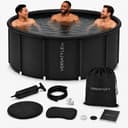
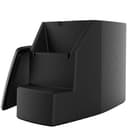
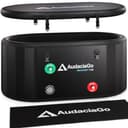
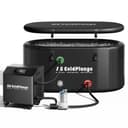
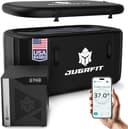
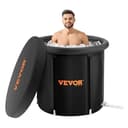
“Will it fit me” is two different questions in this category, and which one applies to you is decided by the tub's posture rather than its size:
- Recumbent tubs— the oval and rectangular ones you lie down in — are constrained by interior length. If it is shorter than you, your knees come up out of the water and your plunge is from the ribs down.
- Upright tubs— barrels and buckets you sit in — are constrained by wall height, because that sets how far the water can come up your torso once you are in it and displacing some of it.
Gallons answer neither question. A 216-gallon tub that is wide and shallow is worse for a tall person than a 120-gallon tub that is long, and gallons are simultaneously the biggest driver of your running cost. So this page sorts on the posture-appropriate published dimension first and treats capacity as the cost spec it actually is.
The problem is that most of this category does not publish either number. Of the six tubs below, 3 publish exterior dimensions and 3publish none — and almost nobody at all publishes an interior measurement, which is the one your body occupies. We have not measured any of these tubs; what we do instead of testing is report what the seller put in writing and tell you what to measure yourself.
How we ranked them
- Does it publish the dimension its posture needs? Interior length for a recumbent tub, wall height for an upright one. A tub that publishes the wrong one has still not answered the question.
- Does it publish anything measurable at all? A figure you can hold a tape to on arrival is a figure you can return the tub over. Three of these six give you that; three give you gallons and a photograph.
- Does the construction hold its shape? A rigid or framed tub keeps the dimension it published. An inflatable wall bows under 200 gallons of water, which costs you some of the inside measurement you were counting on.
- Is it insulated, and does it take a chiller? Both matter more at the top of this page than anywhere else on the site, because the volumes are larger. A published insulation claim and a published chiller port are each worth a rank.
No scores, and no body-measurement tables. We have not measured any human being and we are not going to publish anthropometric averages as though we had — the section below tells you how to take the one measurement that settles it in about thirty seconds.
The thirty-second measurement that settles it
For an upright tub, sit on the floor with your back against a wall, in the posture you would actually use — knees up, or cross-legged — and measure from the floor to the top of your shoulder. That is the water depth you need in order to be submerged to the neck. Now compare it against the tub's published wall height and subtract some: no tub is filled to the rim, there is freeboard above the waterline, and the level you sit at is lower than the empty tub implies. A 29.5-inch wall does not deliver 29.5 inches of water over your shoulders.
For a recumbent tub, lie on the floor with your knees bent to the angle you would hold in the water and measure from your heels to the top of your head. That is your interior length requirement, and it is usually shorter than your standing height — which is why a 59-inch tub works for a 6-foot-2 body and a 45-inch one does not. Both measurements take longer to read about than to do, and both are more reliable than any list on the internet, including this one.
Why the big tubs cost more to run, not just to buy
The uncomfortable trade-off on this page is that the tubs that fit a tall body hold two to three times the water of a standard 100-gallon pod. Water has a large thermal mass, so a larger volume takes longer to pull down to temperature, holds more heat gain from a warm garage, and needs a bigger compressor to do either. A 1/3 HP chiller rated by its own listing for 79 gallons will not hold 300 gallons at plunge temperature, however the tub is marketed.
Two things mitigate it, and both are rankable. Insulated walls cut the heat gain the chiller has to fight, which is why the insulated picks rank above the bare ones at the same size. And a cover removes the largest single heat path in most setups, which is the open surface of the water. If you are buying at the large end, budget for both rather than discovering the electricity bill in month two. The arithmetic is on cost to run a cold plunge and the sizing rule on what size chiller do I need.
The option this page cannot rank: a stock tank
For a genuinely tall body, the best-value answer is often not a purpose-built plunge tub at all. Galvanised stock tanks come in sizes this market does not offer, they are rigid so they keep the dimension on the label, and a six-foot oval lets you lie out flat for a fraction of the price per gallon. We cannot rank one here because our registry is products we can price and link, and farm-supply tanks are not sold that way — but pretending that is a reason not to mention it would be dishonest.
The catch is everything the tank does not come with: no insulation at all, no cover, no chiller port, and a look that suits a barn more than a deck. Those are solvable and they cost money, which is what closes the price gap. The build is covered in the stock tank guide, and the insulation problem it creates in the cover roundup.
Who should skip this page
If you are inside about 5 ft 10, fit is not your binding constraint and ranking on it will push you towards tubs that are larger, more expensive to chill and harder to site than you need. Start from best cold plunge tubs, which ranks the same category on capacity and construction, or best cold plunge for the money if price is the lever.
And if you specifically want to sit rather than lie — which many tall plungers do, because an upright tub needs far less floor space for the same submersion — the dedicated comparison is best vertical cold plunge tubs. It ranks the uprights against each other on wall height and build rather than mixing them with tubs you lie down in.