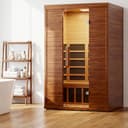
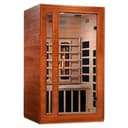
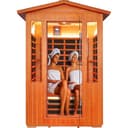
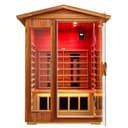
Start with the circuit, because it is the one thing you cannot change after the fact. An indoor infrared two-seater like the EASYHAWK states 1,500W at 120V, which computes to 12.5A — close enough to a standard outlet’s 15A continuous limit that it wants its own 20A receptacle, but no 240V run and no electrician. A traditional 6kW barrel draws 25A at 240V and wants a 35A dedicated circuit, which on a smaller service can mean a panel upgrade that costs more than the sauna. Which saunas run without an electrician is worth reading first, because it quietly halves your shortlist.
Then decide infrared or traditional, because it decides the experience.Infrared is a milder, dry radiant heat with no steam — pleasant, low-fuss, and the reason most indoor two-person cabins exist. Traditional is hot air and stones you can throw water on for löyly, which is what most people picture when they say “sauna.” The evidence cannot currently tell you one is healthier than the other, so choose on the experience you want and the circuit you have, not on a health claim. We compare the two side by side.
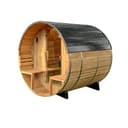
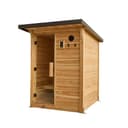
Then indoor or outdoor, because it is a siting decision as much as a heat one.An indoor cabin needs a corner, a nearby outlet and a little ventilation. An outdoor cabin — infrared or barrel — needs a level pad, weatherproofing and, usually, an electrical run out to it. The compact outdoor infrared units here (the OUTEXER and KUNSANA) suit a small deck; the cedar barrels want genuine yard and a foundation. The indoor-versus-outdoor trade-offs are the same whether you seat two or six.
Then read the seat count as capacity, not comfort.A “two person” cabin means two people seated fairly close, not two people lying down; a “two-to-four person” barrel seats two in real comfort and four at a squeeze. Take the number as the ceiling, not the promise. If you can, plan around published exterior dimensions — and note how few listings in this category state them, which is itself the finding.
Finally, weigh the wood and the documentation together. Canadian hemlock and cedar are the two woods that show up most on the better cabins, and a full-spectrum heater with named wavelengths is a real hardware choice — but none of that is a proven health upgrade, and the wavelength and “low EMF” claims on these listings are the manufacturer’s, not ours. Where a listing is silent on wattage, wood or dimensions, treat that silence as a cost you have not priced yet.
True two-seaters versus the “2-4 person” cedar builds
Two of the six here — the Backyard Discovery Paxton barrel and Henley cabin — are marketed as “2-4 person,” and their spec tables show that marketed maximum of four seats. We include them on a two-person page on purpose: a couple who wants a genuine steam sauna is better served by a compact cedar structure that seats two with room to stretch out than by a cramped two-seat box, and these come from an established brand with a real track record. The rest — the EASYHAWK and Dynamic Cordoba indoors, the OUTEXER and KUNSANA outdoors — are true two-seaters. Read those two as “two in comfort, four if everyone is friendly,” and the trade you are making is size and steam for a 240V circuit and a foundation — a circuit the Henley at least states outright, at 240V/50A.
The pattern across all six is the one that runs through this whole category: the listings are generous about wood and seat count and evasive about watts. The indoor infrared cabins are the honest end — the EASYHAWK states 1,500W and 120V outright — while two of the outdoor units publish no wattage, voltage or dimensions at all. That is why the spec tables carry “Not published” rather than a guess, and why the two picks that tell you the most are ranked above the two that tell you the least.