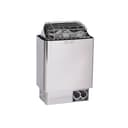
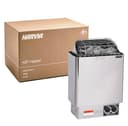
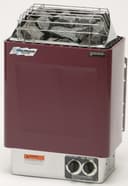
The KIP is the heater most residential Finnish saunas in the US end up with, and the 6kW-or-8kW question is the one real decision inside that choice. It is usually presented as a room-size question, which is half right. Room volume tells you the minimum power. What decides the actual cost of the decision is the circuit, and almost nobody prices that before buying the heater.
Here is the arithmetic, computed from each heater’s own published figures. A sauna heater runs for hours at a time, which makes it a continuous load, and the National Electrical Code sizes continuous loads at 125% of the current they actually draw. The 6kW at 240V draws 25.0A, needs 31.3A of continuous capacity and lands on a 35A breaker. The 8kW at 240V draws 33.3A, needs 41.7A and lands on a 45A breaker. Neither heater publishes an amperage of its own — not one of the heaters we compare does — which is exactly why we compute rather than quote, using the same arithmetic we show on our electrical pages.
So the comparison runs on four axes, in this order: the room volume each heater is rated or sized for; the circuit each one computes to, because that is where the money is; the control and install differences, which are smaller than they look; and running cost, which is smaller still. Price comes last, and only after you know which of the three listings on this page is actually the cheapest route to the heater you want.
We have not tested either heater; we own neither. Here is exactly what we do instead. Every specification below was read from the seller’s own Amazon listing on the date printed on each card, and prices on this page are live rather than typed into the text.
Sizing it properly, in four steps
1. Measure the room in cubic feet, not square feet. Length times width times height, in feet. A sauna heater is heating a volume of air, and the ceiling height is the dimension people forget: an otherwise small room with a tall ceiling can need the next heater up. Our heater sizing guide walks the whole method, and the calculator does the arithmetic with the penalties applied.
2. Add the penalties for glass and for anything uninsulated. A glass door or window is commonly counted as roughly the extra load of an added 45 cubic feet of room, and uninsulated surfaces add something like a quarter to the requirement. This is where a nominally 6kW room becomes an 8kW room, and it is the most common reason an owner finds their heater never quite gets there. Sauna insulation is the cheapest way to move the answer back down.
3. Compare against what the manufacturers publish, not against a blog. Harvia publishes 425cubic feet for the 8kW. For the 6kW, Harvia publishes nothing, so the honest reference points are other manufacturers’ own 6kW ratings: Mxmoonant rates its 6kW at 300 cubic feet, and VEVOR publishes a fit range of 176.5-317.8 cubic feet for its own. That is the corroboration behind the 50 cubic feet per kilowatt rule of thumb, and it is a rule of thumb rather than a code requirement every time we use it.
4. Then take the computed breaker figure to an electrician. Before you buy. The difference between a 35A and a 45A run is a question about your panel’s spare capacity and the distance to the sauna, and it is far cheaper to discover at the quoting stage than after a crate arrives. Does a sauna need a dedicated circuit and does a sauna need a disconnect are the two things the electrician will ask you about, and whether you need a permit is the third.