What a sauna costs per session
Two numbers added together: electricity, which is small and computable, and a slice of what you paid, which is the larger half and gets smaller every time you use it.
Last verified · Ice & Cedar editorial
The verdict
The electricity is a rounding error and the hardware is the real cost per session. A 3 kW traditional cabin run for an hour at a 60% duty cycle costs about $0.33 in electricity at the US average rate; an infrared cabin at roughly 1.2 kW costs about $0.13. Against that, the purchase price divided across 780 sessions — 3 a week for 5years — is almost always the bigger line. That is the figure to put next to your local studio’s drop-in rate, and the variable that moves it most is how often you actually go, not which unit you buy.
“Cost per session” is how people actually compare a home sauna to a studio, and almost every published answer to it is half an answer. Pages that quote electricity make a home sauna sound nearly free; pages that quote the purchase price make it sound unaffordable. Both are quoting one term of a two-term sum.
A session costs the electricity it consumes, plus a slice of what the unit cost divided by how many sessions you will get out of it. The first term is small and computable from published wattage. The second term is larger, and it is the one that falls every time you use the thing — which is the real financial argument for owning rather than renting, and also the real risk, because a unit used twice has the highest cost-per-session of any sauna ever built.
This page computes both terms for four formats, with every assumption stated in the open rather than folded into a single authoritative-looking figure. The electricity comes from each unit’s own published wattage; the hardware slice comes from the live price when the page is served, divided by a session count you can change in your head. One of the four formats has no computable electricity cost at all, and we show that as a blank rather than filling it in.
Cost per session, both halves, four formats
Electricity is computed from each unit’s own published wattage on the assumptions stated below. The hardware column is today’s live price divided by 780 sessions — 3 a week for 5 years. Prices read October 10, 2026; change the sessions or the years and the hardware column moves proportionally.
| Format | Rated power | Electricity | Hardware | Total per session |
|---|---|---|---|---|
| Traditional steam cabin | 3,000 W | 33c | $3.46 | $3.79 |
| Infrared cabin | 1,178 W | 13c | $1.87 | $2.00 |
| Portable steam tent | 1,200 W | 13c | $0.13 | $0.26 |
| Infrared blanket | Not published | Not computable | $0.51 | Incomplete |
Prices as of October 10, 2026, read live. #ad How we’re funded
The shape of that table is the whole point: the hardware column dwarfs the electricity column. Heat therapy at home is not expensive to run; it is expensive to buy, and then it gets cheaper every time you use it. Anybody telling you a home sauna costs pennies a session is quoting the electricity and ignoring the capital. Anybody telling you it is unaffordable is quoting the purchase price and ignoring that it does not expire.
The four assumptions, stated
Session length: 60 minutes.Covering heat-up and use, which is the honest unit — the heater is on before you get in. A thirty-minute session roughly halves the electricity column and does nothing to the hardware column.
Duty cycle: 60%. The single most important assumption and the one most often hidden. A heater draws rated power while it climbs to temperature and then cycles to hold it, so it is not energised for the full hour. We assume it is on about 60% of the time, which matches the model on our cost-to-run page so the two cannot disagree. A better-insulated room cycles less; a cold garage cycles more.
Use: 3 sessions a week for 5 years — 780 sessions. This is the number that decides the hardware column, and it is a forecast about you rather than a fact about the product. Halve it and the hardware cost per session doubles. It is deliberately not generous: three times a week is a real habit rather than an aspirational one.
Electricity: 18.31 cents per kWh. The US residential average, and therefore wrong for almost everyone — the same source has individual states more than thirty cents apart. If your rate is double the average, double the electricity column; it is still the smaller term.
And one thing deliberately excluded: installation. A 240V stove cabin needs a dedicated circuit, and that quote belongs in the hardware column for anyone comparing formats honestly. Add it and divide by the same session count. Sauna electrical requirements covers what you are actually asking an electrician for, and what a home sauna really costs covers the whole capital picture.
One unit per format
Ranked on published specifications. Select a row to jump to the full write-up. We have not tested these units — here is exactly what we do instead.
| # | Product | Format | Rated kW | Power/session | Best for | Price |
|---|---|---|---|---|---|---|
| 1 | 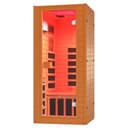 RESTISLAND Full Spectrum Infrared Sauna, 1 Person, 1178W The most completely specified cabin here: 1,178W at 120V, full-spectrum with named 660/850nm red-light wavelengths, and actual published dimensions. Everything you need to plan the corner it goes in. | Infrared cabin | 1.178 kW | $0.13 | Cheapest real cabin per session | $1,459.99 · View on Amazon Price as of October 10, 2026. #ad How we’re funded |
| 2 | 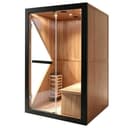 HOSAUNA HY5 2-Person Traditional Steam Sauna, 3 kW The most completely specified indoor cabin here and the only one that publishes a wood moisture content, a bench width and a seated weight limit. It is also real steam in a room inside your house, which is a ventilation decision as much as a purchase. | Traditional steam cabin | 3 kW | $0.33 | Traditional heat, highest draw | $2,699.00 · View on Amazon Price as of October 10, 2026. #ad How we’re funded |
| 3 | 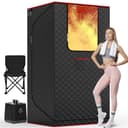 Manastin Upgraded Portable Steam Sauna, 3L/1200W The best-documented tent here: it publishes its assembled dimensions, a 130°F target, 15 heat levels and a 99-minute timer, plus a 304 stainless steel steam tank with an anti-dry-burn cutoff. Most tents in this category publish two of those; this one publishes all of them. | Portable steam tent | 1.2 kW | $0.13 | Lowest total per session | |
| 4 |  LifePro RejuvaWrap Infrared Sauna Blanket The most completely documented listing in the category: temperature range, heat settings, timer, blanket size and warm-up time are all published. Nothing else here states four of those, let alone five. | Infrared blanket | Not published | Not computable | Electricity not computable | $399.99 · View on Amazon Price as of October 10, 2026. #ad How we’re funded |
One representative unit per format, each from the roundup it already lives in — chosen because its listing publishes the wattage the arithmetic needs, not because it is the cheapest. The blanket is included precisely because its listing does not.
How to compare this against a studio, properly
We are not going to print a studio price, because we have not verified one. Drop-in rates vary by city, by operator and by whether the session is sauna, contrast or a package, and quoting a national figure we have not read would be making something up. You already have the number that matters: the rate at the place you would otherwise go.
So do this.Take the total-per-session figure from the table for the format you are considering. Subtract it from your local drop-in rate. Divide the unit’s purchase price by that difference. That is the number of sessions at which owning has cost you less than going. Then compare that number against 780— the sessions a 5-year life at 3a week actually delivers — and you have your answer.
Then weigh the thing the arithmetic cannot capture, because it is the part that decides it. A studio session costs you a drive, a booking and a decision; a cabin in your garage costs you a walk. The reason home units win for most people is not the money, it is that the friction is low enough that the sessions actually happen. The reason they sometimes lose badly is the same mechanism in reverse: a unit in a spare room you never go into gets used four times. Is a home sauna worth it takes that question on directly, and how often you should use a sauna is the honest input to the session count.
And if the capital is the obstacle rather than the running cost, change the format rather than the plan. The hardware column is the term that varies by an order of magnitude across formats while the electricity column barely moves. A fold-away tent or a blanket has a total-per-session figure a fraction of a cabin’s, for a session that is genuinely less good — which is a trade worth making while you find out whether the habit sticks. Best saunas under $1,000 is where that bracket lives.
Frequently asked questions
How much does a sauna session cost at home?
Two numbers added together, and the second is the big one. The electricity is small and computable: a 3 kW traditional cabin for an hour at a 60% duty cycle is about 1.8 kWh, which at 18.31 cents per kWh works out around $0.33 a session. An infrared cabin at about 1.2 kW is roughly $0.13. The hardware is the larger half: whatever you paid, divided by how many sessions you will actually get out of it. Our table above does both halves at today's live prices over 780 sessions.
Is a home sauna cheaper than a studio per session?
Almost certainly, eventually, and we are not going to quote you a studio price - they vary by city and by operator and we have not verified one, so inventing a figure would be fabrication. Here is the method instead: take your local studio's drop-in rate, and divide it into the total-per-session figure in our table. That gives you the number of sessions at which the home unit has paid for itself. Then ask the honest question, which is whether you will actually do that many. A unit used twice is the most expensive sauna in the world per session.
What does an infrared sauna cost per session?
On electricity alone, very little - around $0.13 for an hour on the published wattage of the most completely specified cabin we compare, at the national average rate. Add the hardware slice and the number is dominated by the purchase price divided by your session count. That is why "infrared is cheap to run" is true and not very useful on its own: the running cost was never the obstacle. Our cost-to-run page for infrared works the electricity half in more detail and lets you substitute your own rate.
Why can't you compute the cost per session for a sauna blanket?
Because not one blanket in the category publishes a rated wattage, and we will not invent one. This is a heating appliance whose entire function is converting electricity to heat, and the specification that would let anyone compute its running cost is absent across the board. Any site quoting you a precise per-session figure for a blanket has picked a wattage to get there. What we can say honestly is that the draw is low - it heats you rather than a room - and that the hardware slice is the dominant cost, which the table above shows with the electricity column left blank.
What assumptions are these figures built on?
Four, all stated rather than buried. A 60-minute session, covering heat-up and use. A 60% duty cycle, because a heater pulls rated power to reach temperature and then cycles to hold it - it does not draw full power for an hour. 3 sessions a week for 5 years, which is 780 sessions, for the hardware slice. And 18.31 cents per kWh, the US residential average, which is wrong for almost everybody - the same source puts individual states more than thirty cents apart. Change any of the four and the arithmetic moves; the point is that you can see which number to change.
Does the cost per session include installation?
No, and for a traditional cabin that is a real omission you should add yourself. A 240V stove cabin needs a dedicated circuit, and depending on your panel's spare capacity and the distance to the sauna that quote can be a meaningful fraction of the cabin's price. Add it to the hardware column and divide by the same session count. Infrared cabins, tents and blankets mostly plug in, which is the honest reason their total per session is lower than a stove cabin's by more than the wattage difference suggests.
What about maintenance and consumables?
Smaller than people expect on the heat side, which is the genuine advantage heat has over cold. A sauna has no water chemistry, no filter cartridges and no chiller; a traditional cabin's stones should be restacked and eventually replaced, and a wooden interior wants cleaning and occasional re-treatment. None of that is a per-session cost in any meaningful sense. The cold side of a recovery setup is the opposite, and our cold plunge running-cost page covers why.
How many sessions until it pays for itself?
That is the right question and it has your numbers in it rather than ours. Take the live total-per-session figure from the table, take your local studio's drop-in rate, and divide. The reason we present it this way rather than printing a break-even month is that the two variables that move it most are both yours: what a session costs near you, and how often you will really go. For what it is worth, the cheapest honest answer to "is this worth it" is usually not financial - it is that a sauna twenty feet from your bed gets used and one across town does not.
Related
- What a sauna costs to run — the monthly version, by heater size
- What an infrared sauna costs to run
- What a sauna blanket costs to run — and why it is modelled
- What a home sauna really costs, install included
- Is a home sauna worth it? — the non-financial half
- How often should you use a sauna? — the session count input
- What a cold plunge costs to run — the opposite maintenance picture
- What a contrast setup costs — both halves together
- Best saunas under $1,000 — if the capital is the obstacle
- Sauna vs steam room — the other thing studios sell
Sources
- Seller listings for the four representative units (Amazon detail pages) — Rated wattage for the three computable formats was read from each unit's own listing on the date shown on its card in our roundups, where each listing is linked. No blanket in the category publishes a rated wattage, so no electricity figure is given for that format. Purchase prices are not stored anywhere on this site: the hardware column is read from the live price layer at request time and divided by 780 sessions. No studio or gym drop-in price is quoted on this page, because we have not verified one. (accessed 2026-10-11)
- U.S. Energy Information Administration — Electric Power Monthly, Table 5.6.A — US average residential price, July 2026 (released 2026-09-24). Your utility rate is the number that matters — override the default. (accessed 2026-10-09)