ICE & CEDAR

The best saunas for a garage gym, ranked on the circuit you already have

A garage is the easiest room in the house to put a sauna in and the hardest one to power. Of the five cabins here, one publish 120V and three publish 240V - and a 20A garage circuit carries 16A continuously, not 20.

Last verified · Ice & Cedar editorial

The verdict

If you can get a 240V circuit to the bay, the HOSAUNA HY5 2-person steam cabin is the pick, and a garage is the one room where it is an easier install than an infrared box: the concrete slab and the roll-up door absorb the weight and the steam that would be a problem in a bedroom, and it publishes an 84-month warranty and a 195°F maximum when most of this category publishes neither. If the panel is the binding constraint, the Duthss cedar cubeis the best shape for a bay you still want to park in — flat walls, published dimensions — and the Albott 4-person outdoor infrared cabin computes to the smallest circuit on the page while still seating four. If you need the garage back between sessions, the Sauna Pod is the only pick that packs away and asks nothing of your panel. Read the computed circuit column before the price.

Putting a sauna in a garage inverts the usual problem. In a finished room the hard parts are moisture and floor load: a steam cabin is a humidity appliance in a space with paint and carpet, and a loaded cabin concentrates several hundred pounds into under twenty square feet of joist. A garage answers both of those before you ask. It has a slab, a drain or a door you can sweep water out of, wide delivery access, and no finish you are protecting.

What a garage does not have is spare electrical capacity, and that is the constraint this page is built on. A garage general-purpose circuit is almost always 20A, and it is almost never empty — the door opener, the second fridge and the chest freezer are usually already on it. A sauna heater runs for hours at a time, which makes it a continuous load, and the National Electrical Code sizes continuous loads at 125% of the current they actually draw. That means a 20A circuit carries 16A of continuous load, not 20. Every amp and breaker figure below is computed from each unit’s own published watts and volts using the same arithmetic we show on our electrical pages, and three of the five cabins here publish an amperage of their own to check it against.

So this page ranks on five criteria, in this order: what the bay has to supply electrically, because that is what makes a cabin possible or impossible where you want it; the shape, because a flat-walled cabin gives the parking space back and a barrel does not; whether the unit tolerates an unheated start, which is a siting question rather than a performance one; how much the listing publishes at all, since the blanks predict what you will discover after delivery; and only then price.

One scope note so you can tell this page from its neighbours. Our indoor roundup takes a finished room as the gate and our outdoor roundup takes weather as the gate. A garage is neither: it is sheltered but unconditioned, which is why cabins from both of those pages compete here, and why a cabin rated for a patio is a perfectly sensible thing to put in a bay. If you have not settled the room question yet, can you put a sauna in a garage works through the floor, the ceiling and the clearances first.

We have not tested any of these units; we own none of them. Here is exactly what we do instead. Every specification below was read from the seller’s own Amazon listing on the date printed on each card, and prices on this page are live rather than typed into the text.

Quick picks

Ranked on published specifications. Select a row to jump to the full write-up. We have not tested these units — here is exactly what we do instead.

#ProductHeatVoltsCircuitBest forPrice
1
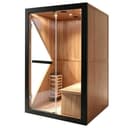
HOSAUNA HY5 2-Person Traditional Steam Sauna, 3 kW

HOSAUNA HY5 2-Person Traditional Steam Sauna, 3 kW

The most completely specified indoor cabin here and the only one that publishes a wood moisture content, a bench width and a seated weight limit. It is also real steam in a room inside your house, which is a ventilation decision as much as a purchase.

Stove240V20ABest overall
$2,699.00 · View on Amazon

Price as of October 10, 2026. #ad How we’re funded

2
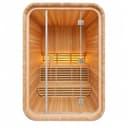
Duthss 2-Person Outdoor Cube Sauna, Red Cedar, 4.5kW

Duthss 2-Person Outdoor Cube Sauna, Red Cedar, 4.5kW

A cube rather than a barrel, which means full headroom and a flat wall against a fence — and the most completely specified structure in this survey: dimensions, heater, temperature range, weight, certifications and support terms are all on the listing.

Stove240V25ABest against a wall
$4,299.99 · View on Amazon

Price as of October 10, 2026. #ad How we’re funded

3
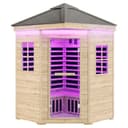
Albott Outdoor Infrared Sauna 4 Person, 2850W

Albott Outdoor Infrared Sauna 4 Person, 2850W

The only unit in this entire comparison that publishes its amperage: 2850W, 240V, 20A. Everyone else makes you do the math.

Infrared240V15ASmallest circuit for four
$2,999.99 · View on Amazon

$3,499.9914% off

Price as of October 10, 2026. #ad How we’re funded

4
SALUSHEAT Full Spectrum Outdoor Sauna, 3 Person, 1950W

SALUSHEAT Full Spectrum Outdoor Sauna, 3 Person, 1950W

The most spec-forward full-spectrum cabin here: it states 1,950W and a 20A circuit, adds red-light therapy and reclining seats, and seats three. The one number it withholds is the voltage.

InfraredNot publishedNot publishedBest full-spectrum
$2,578.99 · View on Amazon

Price as of October 10, 2026. #ad How we’re funded

5
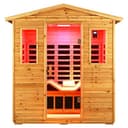
OUTEXER 2-3 Person Corner Infrared Sauna, 2100W

OUTEXER 2-3 Person Corner Infrared Sauna, 2100W

The only cabin on this page that publishes all four install numbers — wattage, voltage, amperage and exterior dimensions — which is also how you discover that its own 20A claim does not survive the code arithmetic. Ranked first for telling you enough to catch it.

Infrared120V25ABest corner fit
$1,999.00 · View on Amazon

Price as of October 10, 2026. #ad How we’re funded

6
The Pod Company The Sauna Pod (Portable Dry Sauna, 1500W)

The Pod Company The Sauna Pod (Portable Dry Sauna, 1500W)

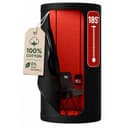
The one genuinely different machine on the page. Instead of a steam generator it uses a 1,500W hot-air heater that reaches 185°F — a real dry-sauna temperature — inside wax-treated cotton canvas rather than coated plastic fabric. It costs several times what the steam tents do, and the reasons are on the spec sheet.

Dry airPlug-inHouseholdBest plug-in
$474.03 · View on Amazon

$596.9921% off

Price as of October 10, 2026. #ad How we’re funded

#1Best overall

HOSAUNA HY5 2-Person Traditional Steam Sauna, 3 kW

The most completely specified indoor cabin here and the only one that publishes a wood moisture content, a bench width and a seated weight limit. It is also real steam in a room inside your house, which is a ventilation decision as much as a purchase.

Strengths

  • Publishes 195°F maximum and a 3,000W stove with volcanic stones — a traditional loyly cabin, not a dry box
  • Publishes its wood species (Okoume) AND a controlled 8-15% moisture content, which nothing else here states
  • Publishes a 43.3 in bench width and a 265 lb seated support figure
  • Exterior dimensions published at 47.2 x 47.2 x 74.8 in, so you can check it against a doorway
  • 7-year warranty stated — by far the longest term on this page
  • Snap-lock modular panels the listing says two adults assemble without tools

Trade-offs

  • 220-240V: this is not a cabin you plug into a bedroom outlet, and the listing says so
  • Real steam in an interior room needs ventilation and a floor that tolerates water — neither is in the box
  • Publishes no amperage, so the circuit has to be computed from the stove's rated watts
  • 74.8 in tall before you add clearance, which rules out most basements with ductwork
  • No heat-up time published, unlike the traditional cabin below it
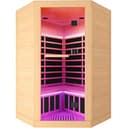
Heat typeTraditional stove and stones
Seats (as published)2
Rated power3,000 W (3 kW)
Voltage240V
Current at rated power (computed)12.5A
Circuit required, NEC 125% (computed)20A
Amperage (as published)Not published
Maximum temperature195°F
Exterior size (as published)47.2" x 47.2" x 74.8"
WoodOkoume, 8-15% moisture content
Warranty84 months

Specifications as published by the manufacturer listing, read on October 9, 2026. Blank fields are specs the manufacturer does not publish.

#2Best against a wall

Duthss 2-Person Outdoor Cube Sauna, Red Cedar, 4.5kW

A cube rather than a barrel, which means full headroom and a flat wall against a fence — and the most completely specified structure in this survey: dimensions, heater, temperature range, weight, certifications and support terms are all on the listing.

Strengths

  • Cube geometry gives full headroom and sits flat against a wall
  • Publishes exterior dimensions (54 x 56 x 80 in), a TOULE 4.5kW/220V heater, a 32-195°F range and a 975 lb shipping weight
  • Approximately 2-inch Canadian red cedar panels and a two-tier bench — a heavier wall section than the barrels here
  • States its support terms: 2 years on the heater, 5 years on the wood structure
  • Ships from US warehouse stock in a reinforced crate, with CE and ETL listed among its certifications

Trade-offs

  • A genuine two-seater — the 4-6 barrels here cost less and seat more
  • Priced above the premium cedar barrels despite being the smallest traditional unit here
  • Amperage is not published, so the circuit has to be computed from the 4.5kW rating rather than read
  • Usually ships in two to three weeks, not days
Heat typeTraditional stove and stones
Seats (as published)2
Rated power4,500 W (4.5 kW)
Voltage240V
Current at rated power (computed)18.8A
Circuit required, NEC 125% (computed)25A
Amperage (as published)Not published
Maximum temperature195°F
Exterior size (as published)54" x 56" x 80"
WoodCanadian red cedar
Warranty24 months

Specifications as published by the manufacturer listing, read on September 18, 2026. Blank fields are specs the manufacturer does not publish.

#3Smallest circuit for four

Albott Outdoor Infrared Sauna 4 Person, 2850W

The only unit in this entire comparison that publishes its amperage: 2850W, 240V, 20A. Everyone else makes you do the math.

Strengths

  • Publishes 2850W / 240V / 20A — the ONLY listing surveyed that states amperage
  • Infrared draws far less power than a 6kW traditional heater
  • Finnish spruce, asphalt shingle roof, 12 carbon panels

Trade-offs

  • Infrared is a different experience from a traditional steam sauna — it is not a substitute
  • Interior volume is not published
Heat typeFar infrared panels
Seats (as published)4
Rated power2,850 W (2.85 kW)
Voltage240V
Current at rated power (computed)11.9A
Circuit required, NEC 125% (computed)15A
Amperage (as published)20A
Maximum temperatureNot published
Exterior size (as published)Not published
WoodFinnish spruce
WarrantyNot published

Specifications as published by the manufacturer listing, read on July 16, 2026. Blank fields are specs the manufacturer does not publish.

#4Best full-spectrum

SALUSHEAT Full Spectrum Outdoor Sauna, 3 Person, 1950W

The most spec-forward full-spectrum cabin here: it states 1,950W and a 20A circuit, adds red-light therapy and reclining seats, and seats three. The one number it withholds is the voltage.

Strengths

  • Publishes a 1,950W rated draw and a 20A circuit — most outdoor listings state neither
  • Full-spectrum panels with red-light therapy and reclining seats
  • Seats three, a middle ground between the two- and four-person cabins

Trade-offs

  • Voltage is not published, so the final circuit still needs confirming with the seller
  • The wood is listed only as 'old fir', a plainer softwood than cedar or hemlock
  • The full-spectrum and red-light health claims are the manufacturer's, not ours
Heat typeFar infrared panels
Seats (as published)3
Rated power1,950 W (1.95 kW)
VoltageNot published
Current at rated power (computed)Not published
Circuit required, NEC 125% (computed)Not published
Amperage (as published)20A
Maximum temperatureNot published
Exterior size (as published)Not published
WoodOld fir
WarrantyNot published

Specifications as published by the manufacturer listing, read on July 29, 2026. Blank fields are specs the manufacturer does not publish.

#5Best corner fit

OUTEXER 2-3 Person Corner Infrared Sauna, 2100W

The only cabin on this page that publishes all four install numbers — wattage, voltage, amperage and exterior dimensions — which is also how you discover that its own 20A claim does not survive the code arithmetic. Ranked first for telling you enough to catch it.

Strengths

  • Publishes 2,100W, 120V, 20A and a 47.2 x 47.2 x 74.8 in cabinet — no other listing here states all four
  • Names Canadian hemlock rather than leaving the wood as 'wood'
  • Square corner footprint, so it loses a corner of a room rather than a wall

Trade-offs

  • 2,100W at 120V is 17.5A continuous, and the NEC 125% rule puts that past what a 20A branch circuit may carry — despite the title's '20A'
  • No maximum temperature published, so there is no way to compare its heat to a traditional room
  • No warranty term published
  • 'Low-EMF' is used without a figure, unlike the 0-5 mG cabin below
Heat typeFar infrared panels
Seats (as published)3
Rated power2,100 W (2.1 kW)
Voltage120V
Current at rated power (computed)17.5A
Circuit required, NEC 125% (computed)25A
Amperage (as published)20A
Maximum temperatureNot published
Exterior size (as published)47.2" x 47.2" x 74.8"
WoodCanadian hemlock
WarrantyNot published

Specifications as published by the manufacturer listing, read on October 2, 2026. Blank fields are specs the manufacturer does not publish.

#6Best plug-in

The Pod Company The Sauna Pod (Portable Dry Sauna, 1500W)

The one genuinely different machine on the page. Instead of a steam generator it uses a 1,500W hot-air heater that reaches 185°F — a real dry-sauna temperature — inside wax-treated cotton canvas rather than coated plastic fabric. It costs several times what the steam tents do, and the reasons are on the spec sheet.

Strengths

  • Hot-air, not steam: a 1,500W heater reaches 185°F — the only unit here that hits a real dry-sauna temperature
  • Dual-layer 100% natural cotton canvas, wax-treated for fire and water resistance, rather than coated plastic fabric
  • Fits users up to 6'7", and includes red LED lighting and a tall stainless-framed chair
  • From an established recovery brand — the same company behind the Ice Pod cold plunge

Trade-offs

  • Several times the price of the steam tents on this page
  • Dry heat only — no steam, if humidity is what you are after
  • One person only, and it publishes no assembled dimensions
  • The recovery and detox benefits it lists are claims, not measurements
Heat typeDry hot air (no steam generator)
Seats (as published)1
Rated power1,500 W
VoltageNot published (standard household plug)
Maximum temperature185°F
Assembled size (as published)Not published
Fits user up to79 in
Shell materialDual-layer 100% natural cotton canvas, wax-treated (fire- and water-resistant)
Packs away between sessionsYes

Specifications as published by the manufacturer listing, read on July 26, 2026. Blank fields are specs the manufacturer does not publish.

How to choose a sauna for a garage

Start with the panel, not the cabin, because it is the only criterion that can rule a unit out entirely. Walk to the garage and find out what is actually there. Most garages have one 20A general-purpose circuit and, if you are lucky, a 240V outlet left over from a dryer, a welder or an EV charger. On the continuous-load rule that 20A circuit gives you 16A, and whatever is already plugged into it comes off that number first. Of the four cabins here whose circuit can be computed from published figures, two compute past what a 20A circuit carries continuously. 240V versus 120V saunas explains what each answer commits you to, and which saunas plug into a normal outlet works through the whole rule.

Then choose the shape, because in a garage the shape is what you pay for in square feet. A garage is a rectangle with a car-shaped hole in it, and the usable leftovers are the back wall and the corners. A cube or a corner cabin occupies exactly that leftover; a barrel wastes the wedge on either side of its curve, which is why barrels are a yard product and not a bay product. three of the five cabins here publish exterior dimensions, and those are the only ones you can check against a tape measure before you buy. Barrel versus cabin covers the geometry properly.

Then decide on the heat, knowing the garage changes the usual answer. Indoors we normally steer people to infrared, because it makes no steam and often runs on a household circuit. A garage removes most of the objection to a traditional stove: concrete does not mind water, and the door is a vent. That makes a stove cabin genuinely viable here, with real sauna temperatures and water you can throw on stones — at the price of a 240V circuit and an electrician. Infrared versus traditional is the long version, and sauna ventilation covers what the cabin needs separately from what the room needs.

Then think about the cold start, and ignore anything specific you read about it. In an unheated garage the cabin, the benches and the stones all begin at ambient, so the first part of every winter session is spent getting the box itself up to temperature. That is a real cost in minutes and a marginal one in electricity, because the heater is working against the cabin’s own thermal mass rather than against the garage. Not one listing in this category publishes a warm-up time at a stated ambient temperature, so a page quoting you minutes for a 40°F garage is quoting an invention. How long a sauna takes to heat sets out what can honestly be said, and running a sauna in winter covers the cold-weather half.

Then count what the listing publishes. Across these five cabins: four publish a voltage, three publish an amperage, three publish exterior dimensions and two publish a maximum temperature. The one blank that matters most in a garage is the dimension, because a cabin you cannot measure in advance is a cabin that may not leave room for the car.

Then, and only then, compare prices. The spread here runs from a fold-away canvas pod to a cedar cube that costs eight times as much, and they are plainly different products rather than different grades of one. The ranking above does not follow the price order: the cabin publishing the most and the cabin publishing an amperage both rank above units that cost more and say less. If budget is the binding constraint, our best saunas under $1,000 page covers everything the panel will not stop you from buying, and what a home sauna really costs adds the install and the running cost that no listing includes.

The circuit arithmetic, unit by unit

This is the part the listings hand back to you, so here it is worked through. The rule is 125%: a load that runs for three hours or more is continuous, and its circuit is sized at 125% of the current it actually draws. A sauna session is an hour; a heater reaching and then holding temperature in a cold bay is longer than that, every time.

UnitPublishedDrawsNeeds (125%)Circuit
HOSAUNA 2-seat3,000 W / 240V12.5A15.6A20A
Duthss 2-seat4,500 W / 240V18.8A23.4A25A
Albott 4-seat2,850 W / 240V11.9A14.8A15A
SALUSHEAT 3-seat1,950 W———
OUTEXER 3-seat2,100 W / 120V17.5A21.9A25A
The Pod Company fold-away pod1,500 W———

Two things fall out of that table. The first is that the 240V units are not a plug-in decision at any point — they are wired appliances, and the only question is who runs the circuit and what it costs. The second is that a dash in the last three columns is not a small gap: it is a unit that publishes watts but no voltage, or neither, and we do not fill those in by assuming a category default. one of the five cabins here have no computed circuit for exactly that reason. If one of those is the cabin you want, ask the seller for the voltage before you ask an electrician for a quote.

The fold-away pod is the honest outlier. It is a 1,500 W hot-air heater with a standard household plug, which on the same rule needs about 15.6A of continuous capacity at 120V — inside a 20A circuit’s allowance, but not inside a 15A one, and not if the freezer shares the run. It is the only pick here that asks nothing of your panel beyond an outlet that is genuinely free.

What a garage gives you that no other room does

A floor that does not care. A loaded stove cabin concentrates several hundred pounds into a small footprint, and on a first-floor joist span that is a question for somebody qualified. On a slab it is nothing at all. The same slab means spilled water, melted snow and condensation are a mop rather than a repair, which is the whole reason the steam cabin ranks first on this page and mid-table on our indoor one.

Delivery access. These arrive as crated flat panels, and the heavy ones are a two-person carry per panel. A garage is the one room you can reverse a truck up to. Nothing on this page goes up a staircase comfortably, and the cedar cube does not go up one at all.

A vent you already own.A roll-up door cracked six inches is more ventilation than most finished rooms can offer, which matters for a stove cabin and matters less for infrared. It also means the heat a cabin leaks is not heat your air conditioning has to remove again — the quiet argument for siting heat therapy outside the conditioned envelope, and the reason what an infrared cabin costs to run is a floor rather than a total indoors.

And one thing it takes away: the room is already occupied. A garage holds a car, a rack, shelving and a ladder, and a sauna has to fit the leftovers with clearance around it. That is the argument for a flat wall over a curve, for a corner over a wall, and — if the bay must keep its car — for something that folds. Fitting a sauna in a small space covers the clearances, and a cold plunge in the same garage is the obvious next thing to plan around rather than discover.

Frequently asked questions

Can you put a sauna in a garage?

Yes, and a garage is the single most forgiving place in a house to put one. The two constraints that make an indoor install awkward - a floor that must take several hundred pounds plus two adults, and steam that has to go somewhere other than into your paint - are both non-issues on a concrete slab in a space that already tolerates damp. What a garage does not usually have is spare electrical capacity, which is why this page ranks on the circuit first and the cabin second. Our full checklist for the room itself covers the floor, the clearances and the ceiling height under a door track.

Will a sauna run on the outlet already in my garage?

Sometimes, and the arithmetic is worth doing before you buy rather than after. A garage general-purpose circuit is usually 20A, and a sauna heater runs for hours, which makes it a continuous load the code sizes at 125% of its actual current - so a 20A circuit carries 16A continuously, not 20. Of the five cabins here, one publish 120V and three publish 240V. The 240V units are not an outlet decision at any point: they are wired, and the question is only who runs the circuit. Remember too that the garage circuit is rarely empty - the door opener, the freezer and the chest fridge are usually already on it.

Does a cold garage stop a sauna from working?

No, but it changes the warm-up and it changes nothing else. A sauna heater is sized to lift the air inside the cabin, and it does not care much what is on the other side of the panel - the cabin is insulated, and the heater reaches its set point either way. What a 40°F garage costs you is time at the front of each session, because the cabin, the benches and the stones all start colder. The published maximums here run 185-195°F, and two of the five cabins publish a maximum at all. Not one listing in this category rates its warm-up time at a stated ambient temperature, so any specific minutes figure you read about a cold garage was invented by somebody.

Traditional or infrared for a garage gym?

In a garage the usual argument flips. Indoors, infrared wins on install because it makes no steam and often runs on a household circuit. In a garage, the moisture objection to a traditional stove mostly disappears - concrete and a roll-up door do not mind - so the stove cabin becomes genuinely viable, and it is the only option that gets you real sauna temperatures and water on stones. The counterweight is electrical: the stove cabins here are 240V appliances and the infrared cabins are mostly not. Decide on what your panel can give you, then on the kind of heat you want.

What about the car?

Two practical points the listings skip. Geometry first: a cabin with flat walls parks against a wall or into a corner and gives the bay back, where a barrel's curve wastes the space either side of it - which is why the cube and the corner cabin rank where they do here. Then clearance: a garage is where the ladder, the bikes and the shelving already live, and a sauna needs space around it as well as under it. If the garage has to keep working as a garage, the fold-away pick at the bottom of this page is the one that disappears between sessions.

Do any of these publish an amperage figure?

three of the five cabins do, which is unusually good for this category - and one of those three figures does not survive the arithmetic, which is the best argument on this page for computing rather than quoting. The corner infrared cabin states 20A, but its own 2,100 W at 120V draws 17.5A and therefore needs 21.9A of continuous capacity under the code's rule. Every amp and breaker number here is computed from each cabin's own published watts and volts: four of these cabins publish both, so the circuit can be derived and shown rather than asserted. Where a cabin publishes watts but no voltage, the circuit column says "Not published" - we will not infer a voltage from a product category. Give the computed figure to an electrician as a starting point and let them confirm it against your panel.

Is a garage sauna worth it next to a gym membership?

That depends on how often you would actually use it, and the honest version of the arithmetic is on our cost pages rather than in a sentence here. What is specific to a garage gym is the adjacency: the reason people put a sauna next to the rack rather than in a spare bedroom is that the session happens immediately after the training, with no second trip and no second decision. That is a behavioural argument rather than a physiological one, and it is the one we would make. Whether heat immediately after lifting is what you want is a separate question, and we cover it on its own page.

Why don't you score these out of ten?

Because a score implies a measurement and we have measured nothing - we own none of these cabins and we have not run one in a cold garage. Every figure above was read from the seller's own listing on the date printed on each card, and every blank is a spec the seller does not publish. The blanks matter here: three of the five cabins publish exterior dimensions, which is the figure that decides whether the bay still fits a car afterwards. We rank in prose you can argue with and show the computed arithmetic underneath it.

Related

Sources