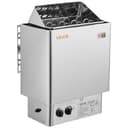
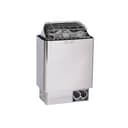
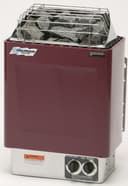
We already rank this pool twice. Best sauna heaters ranks it on published room volume and the circuit each unit needs, and HUUM against Harvia settles a brand question. Neither asks what a kilowatt costs. This page does, and the answer reorders the field more violently than it does in any other category we cover.
The reason is that a sauna heater is an unusually honest product. It is a resistive element in a box of stones, it converts essentially all of its input to heat, and a kilowatt from a two-hundred-dollar heater is the same kilowatt as a kilowatt from a three-thousand-dollar one. There is no efficiency rating to hide behind, because there is no meaningful efficiency difference to rate. So when the cost of a published cubic foot of heated room varies by roughly an order of magnitude across one page, that variation is buying something other than heat — documentation, a warranty, a parts supply, a stainless body, a dealer. Those are all worth money. They are just worth deciding on deliberately.
We own none of these heaters and have fired none of them. What we do instead is read what each manufacturer put in writing, divide the live price by the room volume they publish, compute the circuit from their own watts, and leave a dash where they publish nothing. Prices move daily and are read when the page is served, so the ranking in prose is argued and the numbers in the table are not authored at all.
How we ranked them
- Cost per published cubic foot — the gate. Computed at request time from the live price and the maximum room volume the manufacturer publishes. eight of nine picks publish a volume to divide by.
- Watts per published cubic foot — the cross-check. Cost per cubic foot rewards whoever quotes the biggest room, and nobody audits a room claim. Dividing a heater’s own watts by its own volume catches the generous ones: two of eightrated picks meet or beat the category’s 20 W rule of thumb and six are thinner than it.
- Cost per kilowatt. The cleanest like-for-like comparison, because a kilowatt is a defined quantity rather than a marketing claim. It is in the table as a column rather than as the ranking, because cubic feet are what you are actually buying.
- What the listing publishes at all.A room range beats a room ceiling, a ceiling beats nothing, and a heater that publishes no volume cannot be value-ranked on this page’s own terms. four of nine publish a full range.
- What you give up. Warranty, published amperage, stone capacity, a service record. These blanks are named on every card, and they do not all cluster where price would predict.
No scores, and no price typed into a write-up. Every figure above was read from the seller’s own listing on the date printed on each card; every blank is a spec the seller does not publish; every circuit number is computed by us from their watts.
The cross-check that changes the answer
Rank anything on cost per unit of claimed capacity and you create an incentive to claim more capacity. In this category that incentive is unpoliced: no manufacturer publishes how its room rating was arrived at, and no independent body checks it. So before trusting a cost-per-cubic-foot figure, it is worth asking whether the cubic feet are real.
The check is simple and uses no price at all: divide the published watts by the published maximum volume. Our sizing calculator works from 50 cubic feet per kilowatt, which is the industry rule of thumb and comes to 20 watts per cubic foot. A heater rated below that line is claiming to heat more room per kilowatt than the rule of thumb allows.
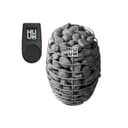
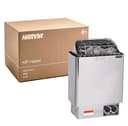
Measured that way, six of the eight rated heaters here sit below the line, and the thinnest claim on the page — 17.0 W per cubic foot, on the HUUM Drop 9 kW with UKU Local Control — belongs to one of the most expensive heaters in our registry. The most conservative rating here is 21.2 W per cubic foot, on the Mxmoonant 9kW 220V Digital Sauna Heater, one of the cheapest units on the page. That is the opposite of the story price would tell you, and we are not going to dress it up as a verdict: a thin rating is not automatically wrong. A tightly built room with real insulation, a small glass area and no cold slab underneath genuinely needs fewer watts per cubic foot than a thrown-together garage cabin does. What the figure does tell you is whose rating assumes a good room— and if your room is not that room, the generous rating is the one that will disappoint you.
The practical rule we would use: size from 20 W per cubic foot, then treat any heater rated thinner than that as rated for a better-insulated room than yours until you have actually insulated it. The reverse is also worth saying plainly: a conservatively rated budget heater is not underpowered, it is honestly rated, and that is a reason to prefer it rather than a reason to step up a size.
Why the saving survives the install
On most pages we write, a cheap unit claws its money back later. Not here, and this is the single strongest argument for buying value in this category.
The circuit is priced by kilowatts. A 6 kW heater at 240V draws 25.0A, which the code’s continuous-load rule turns into 31.3A and a 35A breaker. An 8 kW lands on 45A, a 9 kW on 50A. Nothing in that arithmetic knows what the heater cost. Two 6 kW heaters an order of magnitude apart in price need the same breaker, the same conductor and the same disconnect, so the electrician’s invoice is a constant you can take out of the comparison entirely. It is also why none of these heaters is a plug-in appliance — nothing in this class runs off a normal outlet.
Running cost is priced by kilowatts too. At 18.31 cents per kWh, 3 one-hour sessions a week comes to roughly $7 a month on a 6 kW and about $11 on a 9 kW, at a stated 50% duty cycle that is our assumption rather than anybody’s published figure. Our cost-to-run page takes your own tariff and habit as inputs. The consequence for this page is the one place where value thinking goes wrong: buying a bigger heater than your cubic feet need costs you money every single session forever, so size it properly before you shop on price.
What the premium actually buys
It is worth being precise about this, because “you get what you pay for” is doing a lot of unexamined work in this category.
At the HUUM end, it buys documentation.The Drop bundles are the only heaters in our entire registry that publish an amperage, a breaker size and a wire gauge — three of these nine picks publish an amperage at all and every one of them is a Drop. If you are collecting quotes and checking a panel, that is information with a cash value. Our Drop review goes through it line by line, including the awkward detail that the pricier WiFi bundle states a shorter warranty than the cheaper Local one. Per cubic foot, though, the Drop line is the most expensive heat on this page, and that is the honest framing: you are buying a spec sheet and a stainless exposed-stone body, not more sauna.
At the Harvia end, it buys continuity. Elements, stones, controllers and thermostats you can still buy in a decade, a dealer who has seen your problem before, and a heater most sauna builders have installed. None of that is in a spec column and all of it is real. What the Harvia listings here do not buy you is disclosure: no amperage, no stone capacity, no warranty term, and on the 6 kW KIP no room volume at all. Our brand page is the right place to weigh a track record, because it is the one thing this page’s arithmetic cannot see.
At the budget end, you give up the paperwork. three of these ninelistings state a warranty and none of the cheap ones does. Nor does any of them publish an amperage, so the circuit rows on their cards are our arithmetic rather than their claim. If a heater fails in year three you are buying another heater — which, at the per-cubic-foot figures in the table, is a risk the numbers can genuinely absorb. That is a calculation, not a reassurance, and it is yours to make.
Who should ignore this page
If you are buying a complete cabin rather than a heater, the outdoor value ranking asks the same question of whole saunas, and most kits ship their own 6 kW stove anyway — kit against custom build is the decision upstream of this one. If you have no 240V circuit and no appetite for one, the value question is not which electric heater but whether to burn wood instead: best wood-burning sauna heaters covers that pool, and electric against wood weighs it properly. A wood stove’s install cost is a flue rather than an electrician, which changes the arithmetic on this page completely.