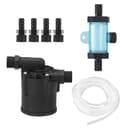
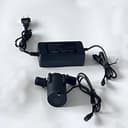
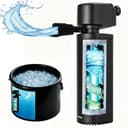
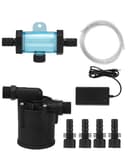
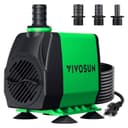
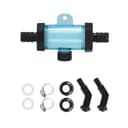
Two completely different products answer the search term “cold plunge filter”, and buying the wrong one is the single most common mistake in this category.
The first is an all-in-one: a submersible box that drops in the tub and circulates, strains and sometimes sanitizes the water. If your plunge has no chiller — an ice bath, a stock tank, an inflatable pod — that box is your entire water-care system and nothing else on this page replaces it. The second is a loop: a pump, an inline strainer and hoses that carry water out to a chiller and back. If your plunge has a chiller, the chiller is already circulating; what you need is plumbing and a hair trap, not another pump.
Both are ranked here, labeled, and kept apart in the argument. The axis they share is documentation: does the listing publish flow, lift and power? 6 of 7 publish a flow rate, 5 publish a wattage, and 2 publish a lift figure. Not one of the 7 publishes a micron rating for its filter media, which is why that row reads the same on every card below.
How we ranked them
- Published flow, in GPH.The headline number, and the easiest one to publish — so a listing that omits it has told you something. 6 of 7 state one.
- Published lift, in feet. The spec that decides whether an external pump works in your layout, and the one this category almost universally hides. 2 of 7 publish it. That is the finding of this page.
- Published power, in watts.These run continuously. A 44 W all-in-one and an 80 W pump are different line items on a bill you are already paying to chill water. 5 of 7 publish a figure.
- What it actually replaces. An all-in-one that is the whole system for an unchilled tub is worth more than a bare pump that is one component of a loop, at the same price.
- Everything else in writing. Rated tub volume, certification, ingress rating, warranty, and what is actually in the box. Two of these are complete kits and the rest are parts.
No micron ratings appear anywhere on this page because no listing publishes one. We are not going to assign a number to a mesh we have not measured, and we own none of these — how we review explains what we do instead.
Lift is the spec that decides your layout
Flow rate gets printed on every box. Lift— the vertical height a pump can push water to, sometimes called head — gets printed on almost none of them, and it is the one that determines whether your setup physically works.
Here is why it matters. A chiller sitting on the ground next to a tub needs almost no lift: water flows out of the tub, through the chiller and back. A chiller sitting on a shelf, a bench, a deck above the tub, or on the other side of a step needs the pump to raise the whole column. And an externalpump — one that lives outside the water rather than submerged in it — has to first pull water up out of the tub before it can push it anywhere, which is why two of the kits here carry an explicit warning in their own listing that the pump must sit below the water line to prime at all.
One product on this page publishes a 25 m (roughly 82 ft) maximum lift, which is enormous and makes it the only safe choice when the chiller is not at floor level. One pond pump publishes 10 ft, which is plenty for any realistic plunge layout. The other five publish nothing, which means that if your geometry is anything other than everything-on-the-same-slab you are buying on hope. Note too that maximum lift and maximum flow are never achieved at the same time: a pump at the top of its head delivers almost nothing. Nobody in this category publishes a pump curve either.
Submerged pumps put their heat back in your water
This is small, real, and never mentioned on a listing. A submersible pump converts essentially all of its electrical draw into heat, and a submersible pump in a plunge dumps that heat into the water. A 50 W pump running continuously is 50 W of heat your chiller now has to remove, on top of everything arriving through the walls and the surface.
In absolute terms it is a rounding error next to an uninsulated lid. But it is a rounding error you pay for twice — once to run the pump and once to remove what the pump added — and it is free to avoid if your layout allows an external pump. On an unchilled tub it does not matter at all, because there is no refrigeration bill to inflate; on a chilled tub, prefer external if you can prime it. The bigger wins are still a cover and insulation, as the cost-to-run arithmetic shows.
UV, ozone and what a filter cannot do
Two products here add an ultraviolet lamp to the filter housing, and one chiller-side option in our water-care survey adds ozone instead. All three are sanitizing steps, and all three are supplements rather than replacements for chemistry. The UV page takes that half further and adds the bare submersible lamps to the comparison — including the fact that not one listing in the category publishes a UV dose.
The distinction is worth holding onto. A filter is mechanical: it traps what is physically in the water as the water passes through it. UV is point-of-contact: it deactivates what passes directly in front of the lamp and does nothing to water sitting in the far corner of the tub. A chemical sanitizer carries a residual— it keeps working everywhere in the volume, all the time, which is the thing neither filtration nor UV can do. That is why the honest answer to “can I skip chemicals if I buy a UV filter” is no, and why the treatment roundup is the companion to this page rather than an alternative to it.
What to buy for your actual setup
No chiller, water sits for days.An all-in-one submersible. It is the only product class here that gives you circulation, straining and a sanitizing step from one purchase and one outlet. Check the published tub range against your own volume — two of the units here state one.
Chiller already plumbed, hair in the water.An inline strainer on the suction side. It is the cheapest item on this page and it protects the single most expensive thing in your setup: the chiller's impeller and heat exchanger.
Chiller with no pump, or a tub with no ports. A complete loop kit, because the adapters are the part people forget. A stock tank has no bulkhead fitting at all, so the hoses go over the rim and the pump has to prime itself.
Chiller above the water line. The one pump here that publishes a lift figure, plus an inline filter in front of it. Nothing else on this page can tell you in advance that it will work.
Who should skip this page
If your chiller already ships with a pump and an internal filter — and most of the units in our chiller survey do — you do not need anything here except possibly the inline strainer. Check what is in the box before you buy a second pump.
And if the water in your tub is the problem rather than the debris in it, this is the wrong page: cloudy, smelly or slimy water is a chemistry failure, not a filtration one. Do you need a filter on a cold plunge works through which problem you actually have, and the maintenance guide covers the routine that keeps both under control.