ICE & CEDAR

The best cold plunge water treatment, compared on what sellers publish

Of the four treatment bottles compared here, one tells you what is in it. That single fact decides most of this ranking - because a chemistry nobody will name is one you cannot dose, test or verify.

Last verified · Ice & Cedar editorial

Water care is the recurring cost of owning a cold plunge, and it is the part of the purchase nobody researches until the water goes cloudy. It is also the corner of this category with the thinnest documentation we have found anywhere on this site — thinner than sauna blankets, which is not a sentence we expected to write.

Here is the finding, counted from the eight products below rather than asserted. Of the four treatment bottles, one names an active ingredient and one publishes a concentration — and it is the same product, an ordinary food-grade hydrogen peroxide that is not sold as a cold plunge product at all. The three bottles marketed specifically at plunge owners describe their contents as “formulated with effective ingredients,” “professional-grade” and “without harsh chemicals.” Just three of the four publish a dose you can actually follow, and only one of the eight products here carries any third-party certification.

So this page ranks on four criteria, in this order: whether the seller publishes what treats the water; whether it publishes a strength and a dose you can compute from; whether the claim is a verifiable measurement or an adjective; and only then price. That order is the argument, not a preamble to one — on a product you put in water you sit in, an unnamed formula at any price is a worse buy than a named one.

The inversion worth noticing before you scroll: the equipment in this category documents itself far better than the chemistry does. Exactly one of these eightproducts publishes a power figure, and it is the filter — which is why it is the only item on this page whose running cost we can compute, and part of why it ranks first.

We have not tested any of these products; we own none of them. Here is exactly what we do instead. Every specification below was read from the seller’s own Amazon listing on the date printed on each card, every product was in stock when it was read, and every price is live.

Quick picks

Ranked on published specifications. Select a row to jump to the full write-up. We have not tested these units — here is exactly what we do instead.

#ProductBest forPrice
1
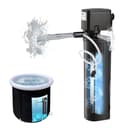
COOSPIDER 600 GPH Submersible Pool Filter with UV Light

COOSPIDER 600 GPH Submersible Pool Filter with UV Light

The best-documented product on this page by a distance, and the only one that publishes a wattage — which makes it the only one whose running cost can actually be computed.

Best overall
$57.19 · View on Amazon

$60.495% off

Price as of July 24, 2026. #ad How we’re funded

2
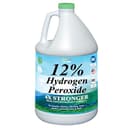
Nature's Freedom 12% Food Grade Hydrogen Peroxide (1 Gallon)

Nature's Freedom 12% Food Grade Hydrogen Peroxide (1 Gallon)

The only product here that states exactly what is in the bottle and at what strength, and the only one carrying a recreational-water certification. It is also the only one that leaves the dosing entirely to you.

Best documented chemistry
$26.99 · View on Amazon

Price as of July 24, 2026. #ad How we’re funded

3
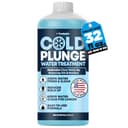
MAV AquaDoc Cold Plunge Water Treatment (32 oz)

MAV AquaDoc Cold Plunge Water Treatment (32 oz)

The clearest weekly dose in the category — one ounce per hundred gallons — which is the only reason a cost per week can be worked out at all. What is in the ounce is not published.

Best weekly routine
$21.99 · View on Amazon

Price as of July 24, 2026. #ad How we’re funded

4
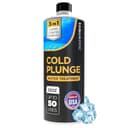
Durabasics 3-in-1 Cold Plunge Water Treatment (32 oz)

Durabasics 3-in-1 Cold Plunge Water Treatment (32 oz)

The most complete dosing instructions of the four bottles here — initial dose, maintenance dose and rates for larger tanks. It is also the one whose own arithmetic does not support its own headline.

Best for larger tubs
$21.99 · View on Amazon

Price as of July 24, 2026. #ad How we’re funded

5
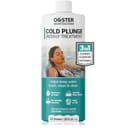
Bio Ouster 3-in-1 Weekly Cold Plunge Water Treatment (32 oz)

Bio Ouster 3-in-1 Weekly Cold Plunge Water Treatment (32 oz)

The only bottle here that addresses the tubs most people actually own — the ones with no pump and no filter — and says so plainly. It is also the most expensive way to buy an unnamed formula.

Best for unfiltered tubs
$29.97 · View on Amazon

Price as of July 24, 2026. #ad How we’re funded

6
Plunge Crafters Ambohr SPA-124 Ozone Generator

Plunge Crafters Ambohr SPA-124 Ozone Generator

The chemical-free route, and the listing is unusually straight about what it does not include: a venturi is required to get ozone into the water, and it is sold separately.

Best chemical-free
$76.95 · View on Amazon

Price as of July 24, 2026. #ad How we’re funded

7
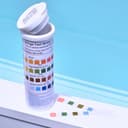
Caplide 4-in-1 Cold Plunge Test Strips (30 count)

Caplide 4-in-1 Cold Plunge Test Strips (30 count)

The cheapest item on this page and the only one that tells you whether anything else on it is working. Four readings off one strip, including the peroxide number nothing else measures.

Best all-round test kit
$19.99 · View on Amazon

Price as of July 24, 2026. #ad How we’re funded

8
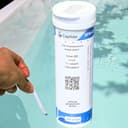
Caplide Hydrogen Peroxide Test Strips, 0–100 ppm (100 count)

Caplide Hydrogen Peroxide Test Strips, 0–100 ppm (100 count)

If peroxide is your chemistry, this is the better of the two strip packs: the same 0–100 ppm range at the same price, with more than three times as many strips.

Best value for peroxide
$19.99 · View on Amazon

Price as of July 24, 2026. #ad How we’re funded

#1Best overall

COOSPIDER 600 GPH Submersible Pool Filter with UV Light

The best-documented product on this page by a distance, and the only one that publishes a wattage — which makes it the only one whose running cost can actually be computed.

Strengths

  • Publishes both power figures: a 35 W, 600 GPH pump and a 9 W 254 nm UV lamp
  • Publishes a working range of 75 to 1,000 gallons, so you can check it against your own tub
  • Publishes an IPX8 ingress rating and a stated 8.2 ft submersion depth
  • Pump and UV lamp switch independently, and the pleated filter is reusable rather than a consumable
  • One-year warranty stated — the only warranty term published anywhere on this page

Trade-offs

  • Filtration removes particulate; it is not a sanitizer, and the listing does not claim to be one
  • A 44 W device left running continuously is a small but real addition to your power bill
  • The UV lamp is a wear item with no published replacement interval and no published lamp price
  • Sold as a pool and aquarium filter with cold plunge as one of several listed uses, so fitting it to your tub is on you
TypeSubmersible filter with UV clarifier
How it treats the waterPhysical filtration plus a 254 nm ultraviolet lamp — no chemistry
Rated power (as published)35 W pump + 9 W UV lamp
Flow rate600 GPH
Ozone outputNot published
Rated for75–1,000 gallons
CertificationNot published
Warranty12 months

Specifications as published by the manufacturer listing, read on July 24, 2026. Blank fields are specs the manufacturer does not publish.

#2Best documented chemistry

Nature's Freedom 12% Food Grade Hydrogen Peroxide (1 Gallon)

The only product here that states exactly what is in the bottle and at what strength, and the only one carrying a recreational-water certification. It is also the only one that leaves the dosing entirely to you.

Strengths

  • Publishes the full contents: food-grade hydrogen peroxide and purified deionized water, with no stabilizers or additives
  • Publishes a concentration — 12% — which is the number any dose has to be computed from
  • States NSF certification to NSF/ANSI/CAN 50, the pool, spa, hot tub and recreational water treatment standard, and to NSF/ANSI/CAN 60
  • A gallon at 12% dilutes to four gallons of standard 3% solution, so the cost per treated gallon is the lowest on this page

Trade-offs

  • Publishes no cold plunge dose anywhere — the listed uses are cleaning, laundry and gardening, and the plunge arithmetic is left entirely to you
  • A 12% concentrate needs more careful handling and storage than a ready-mixed bottle; the listing's own vent-cap note is the hint
  • Peroxide is the one chemistry here that genuinely has to be tested to be dosed, and no test strips are included
  • Nothing on the listing is written for cold plunge owners, so there is no product support to fall back on
TypeOxidizer (liquid concentrate)
Active ingredientFood-grade hydrogen peroxide (H2O2) and purified deionized water; no stabilizers or additives
Concentration12%
Pack size1 gallon (128 fl oz)
Dose (as published)Not published
Doses per packNot published
CertificationNSF/ANSI/CAN 50 and NSF/ANSI/CAN 60
WarrantyNot published

Specifications as published by the manufacturer listing, read on July 24, 2026. Blank fields are specs the manufacturer does not publish.

#3Best weekly routine

MAV AquaDoc Cold Plunge Water Treatment (32 oz)

The clearest weekly dose in the category — one ounce per hundred gallons — which is the only reason a cost per week can be worked out at all. What is in the ounce is not published.

Strengths

  • Publishes a single unambiguous dose: 1 oz per 100 gallons weekly, at the same rate for the initial circulation
  • That dose makes cost per treatment computable — 32 weekly doses in the bottle for a 100-gallon tub
  • Written for cold plunges and ice baths specifically rather than adapted from pool copy
  • Made in the USA, stated on the listing

Trade-offs

  • Names no active ingredient — “formulated with effective ingredients” is the entire disclosure
  • No concentration published, so there is nothing to test against and no residual to hold
  • Its claims are worded as helping reduce odors and buildup, not as disinfection — read them literally
  • No third-party certification published
TypeWeekly all-in-one treatment (liquid)
Active ingredientNot published
ConcentrationNot published
Pack size32 fl oz
Dose (as published)1 oz per 100 gallons weekly; same rate circulated on first use
Doses per pack32
CertificationNot published
WarrantyNot published

Specifications as published by the manufacturer listing, read on July 24, 2026. Blank fields are specs the manufacturer does not publish.

#4Best for larger tubs

Durabasics 3-in-1 Cold Plunge Water Treatment (32 oz)

The most complete dosing instructions of the four bottles here — initial dose, maintenance dose and rates for larger tanks. It is also the one whose own arithmetic does not support its own headline.

Strengths

  • Publishes a full schedule: 16 oz per 100 gallons on the first fill, then 2 oz per 100 gallons every two weeks
  • Publishes rates for larger volumes — 4 oz for 200 gallons, 6 oz for 300 gallons — which nothing else here does
  • Maintenance is fortnightly rather than weekly, so the routine is lighter
  • States compatibility with acrylic, portable, inflatable, barrel and pod tubs

Trade-offs

  • The “32-week supply” in the title does not survive its own dosing: a 16 oz first dose leaves 16 oz, and 2 oz every two weeks is 16 more weeks, not 32
  • Names no active ingredient; “without harsh chemicals” is a claim, not a formulation
  • The heavy 16 oz initial dose means half the bottle is gone on day one
  • No concentration and no third-party certification published
TypeFortnightly all-in-one treatment (liquid)
Active ingredientNot published
ConcentrationNot published
Pack size32 fl oz
Dose (as published)16 oz per 100 gallons on first fill, then 2 oz per 100 gallons every two weeks (4 oz for 200 gal, 6 oz for 300 gal)
Doses per packNot published
CertificationNot published
WarrantyNot published

Specifications as published by the manufacturer listing, read on July 24, 2026. Blank fields are specs the manufacturer does not publish.

#5Best for unfiltered tubs

Bio Ouster 3-in-1 Weekly Cold Plunge Water Treatment (32 oz)

The only bottle here that addresses the tubs most people actually own — the ones with no pump and no filter — and says so plainly. It is also the most expensive way to buy an unnamed formula.

Strengths

  • States explicitly that it works on filtered and non-filtered setups — the only listing here that addresses unfiltered tubs
  • Publishes a dose count: up to 32 doses from the 32 oz bottle
  • States that it is septic-system safe, which matters when you drain 100 gallons at home
  • Covers acrylic, portable, inflatable, barrel and pod tubs

Trade-offs

  • The most expensive of the three cold-plunge-branded bottles here, for no published difference in chemistry
  • Names no active ingredient — “professional-grade” and “maximum strength” are not specifications
  • Gives a dose count but no per-gallon rate, so it cannot be scaled to a larger tub with any confidence
  • No concentration and no third-party certification published
TypeWeekly all-in-one treatment (liquid)
Active ingredientNot published
ConcentrationNot published
Pack size32 fl oz
Dose (as published)Up to 32 weekly doses per bottle; no per-gallon rate published
Doses per pack32
CertificationNot published
WarrantyNot published

Specifications as published by the manufacturer listing, read on July 24, 2026. Blank fields are specs the manufacturer does not publish.

#6Best chemical-free

Plunge Crafters Ambohr SPA-124 Ozone Generator

The chemical-free route, and the listing is unusually straight about what it does not include: a venturi is required to get ozone into the water, and it is sold separately.

Strengths

  • Publishes an output rate — 100 mg/h — which is the spec that separates one ozone generator from another
  • States plainly that a venturi is required to draw the ozone into the water, and that it is not included
  • Recommends running alongside a filter rather than instead of one
  • Ships with the check valve and PVC hose, which are the parts people forget to order

Trade-offs

  • The venturi is a second purchase the listing does not price, so the real cost is higher than the number on the page
  • Ozone is a respiratory irritant — you cannot be in the water while it runs, and listings in this category say to wait after it stops
  • No wattage, no timer and no warranty term published
  • Installation assumes plumbing that a simple stock-tank or inflatable tub does not have
TypeOzone generator (injected)
How it treats the waterOzone (O3) generated on demand — no stored chemistry
Rated power (as published)Not published
Flow rateNot published
Ozone output100 mg/h
Rated forNot published
CertificationNot published
WarrantyNot published

Specifications as published by the manufacturer listing, read on July 24, 2026. Blank fields are specs the manufacturer does not publish.

#7Best all-round test kit

Caplide 4-in-1 Cold Plunge Test Strips (30 count)

The cheapest item on this page and the only one that tells you whether anything else on it is working. Four readings off one strip, including the peroxide number nothing else measures.

Strengths

  • Reads four parameters from a single strip: pH, total alkalinity, hardness and hydrogen peroxide
  • Publishes the peroxide range it covers — 0 to 100 ppm
  • Includes colour-matching charts for all four readings
  • Costs less than one bottle of treatment, and turns dosing from a guess into a measurement

Trade-offs

  • 30 strips — a third of what the peroxide-only pack in the same range gives you at the same price
  • No accuracy tolerance published for any of the four pads, so treat readings as indicative
  • Does not read free chlorine or bromine, so it is the wrong strip if you sanitize with either
  • Cannot tell you anything at all about a treatment whose active ingredient is unpublished — which is three of the four bottles here
TypeTest strips
MeasurespH, total alkalinity, hardness, hydrogen peroxide
Published rangeHydrogen peroxide 0–100 ppm
Pack size30 strips
Accuracy toleranceNot published
CertificationNot published
WarrantyNot published

Specifications as published by the manufacturer listing, read on July 24, 2026. Blank fields are specs the manufacturer does not publish.

#8Best value for peroxide

Caplide Hydrogen Peroxide Test Strips, 0–100 ppm (100 count)

If peroxide is your chemistry, this is the better of the two strip packs: the same 0–100 ppm range at the same price, with more than three times as many strips.

Strengths

  • 100 strips at the same price as the 30-strip 4-in-1 pack
  • Publishes the range — 0 to 100 ppm — and reads in ppm or mg/L
  • Listing includes a dosing calculator, which is exactly what a peroxide bottle leaves out
  • Enough strips to test before every session for months, which is the only way a residual means anything

Trade-offs

  • Reads peroxide only — no pH, no alkalinity, no hardness
  • Useless if you sanitize with anything else, including every unnamed 3-in-1 formula on this page
  • No accuracy tolerance published
  • Colour-block reading is inherently coarse next to a photometer
TypeTest strips
MeasuresHydrogen peroxide only
Published range0–100 ppm
Pack size100 strips
Accuracy toleranceNot published
CertificationNot published
WarrantyNot published

Specifications as published by the manufacturer listing, read on July 24, 2026. Blank fields are specs the manufacturer does not publish.

How to choose cold plunge water treatment

Start by working out which problem you have. Cloudy water and smelly water are different faults with different fixes, and the category sells them as one thing. Cloudiness is particulate — skin, oils, hair, sunscreen, dust — and it is removed physically or not at all. Odour and slime are biological, and they are a sanitation problem no filter cartridge will solve. A buyer who adds a treatment to a tub that needed a filter concludes the treatment does not work, and a buyer who adds a filter to a tub that needed a sanitizer concludes the same about the filter. Both are right about the product and wrong about the diagnosis.

Then ask what treats the water, and refuse to accept an adjective as the answer. This is the criterion that reorders the whole page. A named chemistry at a published strength can be dosed by arithmetic, checked with a twenty-dollar strip, and looked up if you want to know how it interacts with your chiller’s seals. An unnamed formula can do none of those things, and the price you pay for it is not correlated with anything you can inspect — the most expensive bottle here publishes exactly as little as the cheapest.

Then read the dose, and do the arithmetic yourself. Published dosing is where this category is genuinely uneven and where a careful reader finds real differences. One bottle here gives a single flat rate of an ounce per hundred gallons a week, which makes cost per treatment trivial to work out. Another publishes an initial dose, a maintenance dose and rates for 200 and 300 gallon tanks, which is the most useful set of instructions on the page — and whose own headline claim of a “32-week supply” does not survive that arithmetic, because a 16 oz first fill leaves 16 oz, and 2 oz every two weeks is 16 more weeks. A third publishes a dose count with no per-gallon rate at all, which cannot be scaled to a larger tub. We print all three as published and let you compare them.

Then check it against your tub’s volume, which is the number that turns any of this into money. A 100-gallon tub and a 300-gallon one are a three-fold difference in consumable spend for the identical routine, and capacity is the spec we argue is decisive in choosing the tub in the first place. If you have not measured yours, do that before you buy chemistry for it.

Then buy the strips, whatever else you buy. They are the cheapest item on this page and the only one that reports rather than claims. If you dose with peroxide, strips are not optional — a peroxide residual you have not measured is exactly as unverifiable as an unnamed formula, and you have paid for the ability to check. If you use a 3-in-1, strips will at least keep pH and hardness honest, which is the part that pits stainless and degrades seals.

Then, and only then, compare prices. The whole category sits between roughly twenty dollars and the price of a decent chiller cover, which makes it rounding error against the chiller and the tub. Nothing on this page is expensive enough to be worth buying badly.

What these products can, and can’t, claim

Read the claim wording on the four bottles closely and a pattern appears: they say they help maintain clear water, help reduce odours and buildup, and supportfresher water. Those are clarity and odour claims, carefully worded. Not one of them claims to disinfect, and none of the three unnamed formulas carries a certification that would sit behind such a claim. That is not us catching anyone out — it is the sellers being precise, and it is worth reading them as precisely as they wrote it.

The practical consequence is the one thing we most want you to take from this page. A residual is a measured concentration of a known disinfectant, held at a controlled pH, and it is the basis of every public-health framework for water that people sit in. You cannot hold a residual of a chemical nobody will name. So if your tub is shared, used often, or run warmer than a plunge in summer, the product you want is a named chemistry you can test — not the bottle with the most confident label.

We are deliberately not printing a target parts-per-million or a pH band. Those figures come from public-health and state regulatory documents, and we could not retrieve the primary text to verify one. That is the same rule we apply to electrical code we cannot verify: state the principle, cite the authority, and refuse to split the difference with a number that merely looks authoritative. Your local health authority and your equipment manufacturer are the two documents that outrank this page.

One more limitation, stated plainly because the listings do not. None of these eight products publishes a compatibility statement for any named chiller, and chillers push water through heat exchangers, pumps and seals with their own chemical tolerances. Your chiller’s manual is the document with your warranty attached to it. Read it first.

What water care actually costs to run

This is normally the section where we compute running cost from rated power, and on this page we can do it exactly once, because exactly one of these eight products publishes a wattage. The filter states a 35 W pump and a 9 W ultraviolet lamp — 44 W together, both figures published rather than inferred.

Run continuously, that is 32.1 kWh a month, or about $6.05 at the 18.83 cents per kWh US residential average. Run eight hours a day it is roughly $2.02. Both numbers are arithmetic on a published figure at a stated rate, and your own utility rate is the one that matters — the same spread we flag on what a cold plunge costs to run applies here.

The consumable side is arithmetic you can do from the dose. A bottle promising 32 weekly doses covers about eight months on a 100-gallon tub, which puts the chemistry somewhere near the price of a couple of coffees a month — genuinely trivial against the chiller running beside it. That is the real reason to buy on documentation rather than price: the money saved by choosing the cheapest unnamed bottle over the best-documented one is a few dollars a year.

The one figure we will not estimate is how much a treatment extends the interval between water changes. Every listing here implies it and none of them quantifies it, and the honest answer depends on your bather load, your cover, your filtration and your water temperature. We would rather leave a blank than fill it with a number that would look researched.

Frequently asked questions

What actually goes wrong with cold plunge water?

Two different things, and they need two different products. The first is particulate - skin cells, hair, body oils, sunscreen, dust and leaves - which is a filtration problem and no chemical removes it. The second is biological growth, which is a sanitation problem and no filter solves it. Cold water slows growth down, which is why a plunge stays usable far longer than a hot tub would, but it does not stop it. If your water goes cloudy you have a filtration problem; if it goes slimy or smells, you have a sanitation problem. Buying the wrong one of the two is the most common mistake in this category.

Do the '3-in-1 weekly treatment' bottles say what is in them?

Not in this survey. Of the four bottles compared here, one names an active ingredient and one publishes a concentration - and it is the same product, a plain food-grade hydrogen peroxide that is not marketed as a cold plunge product at all. The three sold specifically for cold plunges describe themselves as "formulated with effective ingredients", "professional-grade" and "without harsh chemicals". None of those is a formulation. That matters practically rather than pedantically: you cannot compute a dose, test a residual or know whether two products conflict when neither will tell you what it contains.

How often do I need to change the water?

Nobody publishes an honest answer to this, ourselves included, because it depends on bathers per week, whether you shower first, whether the tub is covered, whether it is filtered and how cold you keep it. What we can say is what the products claim: the weekly and fortnightly treatments here are all sold on the promise of extending the interval between changes rather than eliminating it, and the ozone listing makes the same claim in the same words. Treat any product that implies you never need to drain as overselling. A cover keeps the debris out in the first place, which is the cheapest intervention of all.

Is hydrogen peroxide better than chlorine for a cold plunge?

It is more popular in this category, largely because it leaves no chlorine smell and breaks down into water and oxygen, and because chlorine's effectiveness is tied to pH in a way that trips people up. But 'more popular' is not 'proven better', and we are not going to tell you it is. What is true and checkable is that peroxide is the one chemistry on this page you can actually verify: it publishes a concentration, test strips for it are sold in the same aisle for about twenty dollars, and a residual you can measure is worth more than a claim you cannot. If you use it, test it - a peroxide dose you have not measured is exactly as unverifiable as an unnamed 3-in-1 formula.

Do I need a filter as well as a treatment?

They do different jobs, so mostly yes if your tub has no circulation at all. A submersible filter pulls hair and grit out of the water physically; a bottle of treatment does not, and the one product here that addresses unfiltered tubs says so precisely because most of these treatments assume circulation. The filter here is also the only product on the page that publishes a wattage, so it is the only one whose running cost can be computed: 44 W continuous works out at about $6.05 a month at 18.83 cents per kWh, or roughly $2.02 if you run it eight hours a day.

Is an ozone generator worth it?

It has the strongest argument of anything here for people who want nothing stored in the water, and the clearest hidden cost. Ozone is generated on demand and leaves no residue, and the generator on this page publishes an output rate, which most do not. But it needs a venturi to get the gas into the water and that is a separate purchase the listing does not price, it assumes plumbing a stock tank or inflatable tub does not have, and ozone is a respiratory irritant - you cannot be in the water while it runs, and listings in this category tell you to wait after it stops. It is a real option for a plumbed, chiller-fed setup and a poor one for a tub you fill with a hose.

What residual should I be maintaining?

We are not going to print a number. Target disinfectant residuals and pH ranges for bathing water are set by public-health authorities and state regulators, and we could not retrieve the primary text of those documents to verify a figure - so, exactly as we do with electrical code we cannot verify, we state the principle and refer you to the authority rather than splitting the difference with a plausible-looking guess. The principle is the part that survives: a residual is a measured number you hold at a controlled pH, which is why test strips are on this page at all, and which is why a treatment that names no ingredient cannot give you one.

Will any of this hurt my chiller?

Possibly, and none of these listings will tell you. Chillers push water through a heat exchanger, a pump and often a UV or ozone stage of their own, and manufacturers vary on what chemistry they will warrant. Not one of the eight products here publishes a compatibility statement for any named chiller. Before you dose a chilled tub, read your chiller's own manual - that document is the one with your warranty attached to it, and it outranks anything on this page.

Related

Sources

  • Seller listings for all eight products (Amazon detail pages)Every specification, dose, certification and power figure on this page was read from the eight listings themselves via the Amazon Creators API, and each card links its own source. All eight were in stock when read. (accessed 2026-07-24)
  • NSF — Pool and spa equipment certificationNSF/ANSI/CAN 50 is titled 'Equipment and Chemicals for Swimming Pools, Spas, Hot Tubs, and Other Recreational Water Facilities'. We quote the standard's designation and title only — NSF's own page could not be retrieved directly, and the designation is also printed verbatim on the certified product's listing. (accessed 2026-07-24)
  • CDC — Home pool and hot tub water treatment and testingThe public-health reference for disinfectant residual and pH in water people sit in. Linked as the authority; we print no target figure from it because we could not retrieve its primary text to verify one. (accessed 2026-07-24)
  • U.S. Energy Information Administration — Electric Power Monthly, Table 5.6.AUS average residential price, April 2026 (released 2026-06-25). Your utility rate is the number that matters — override the default. Source of the 18.83 cents/kWh used in the filter running-cost arithmetic above. (accessed 2026-07-16)