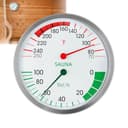
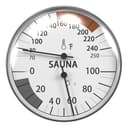
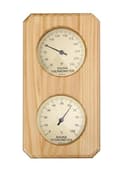
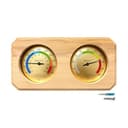
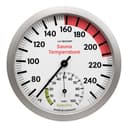
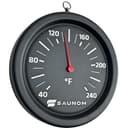
Start with what it measures, not what it is made of. A thermometer-hygrometer costs a few dollars more than a thermometer and doubles what you know. Humidity is the spec that separates a traditional sauna from a steam room at the same temperature, and it is the one your heater will never report. Buy temperature-only if you have a specific reason — the glass-free aluminum dial at the bottom of this page is a good one, because it removes the lens that fogs — and otherwise buy the pair.
Then check that the published range covers your room. A traditional sauna is typically run somewhere between 150 and 195°F, and the published ceilings on this page run from 212°F to 250°F. A 212°F ceiling is fine for an infrared cabin, which runs much cooler, but it leaves almost nothing above a hot traditional session — and a needle pinned at the end of its scale has stopped being a measurement. three of the nine gauges here publish no range whatsoever, which is a strange thing for an instrument to omit.
Then the accuracy tolerance, if you can find one. Only two of these listings state one: ±2°F on the cheapest gauge here and ±3.6°F on another. That is a real difference — the looser of the two is nearly twice the margin — but the honest comparison is against the seven that publish nothing, where you are trusting the word “precision” in a bullet point. Where two gauges are otherwise equal, the one that states a number is telling you it has been measured against something.
Then whether you can read it from where you sit. This is a genuinely practical criterion in a dim, steamy room several feet from the wall. Face size is the single best predictor and only two listings publish one, topping out at a 10-inch board. Beyond size, three things help: high-contrast numerals, color-coded zones marking the useful bands, and either a domed lens or no lens at all. Condensation on flat glass is the reason people end up squinting at a gauge they paid for.
Then recalibration. Analog gauges drift, and heat, steam and cooling cycles accelerate it. three of the nine gauges here publish a way for you to correct that yourself: a knob on the back, printed instructions in the box, or a stated manual adjustment. On the rest, a drifted reading is permanent. This is worth more than an extra half-degree of factory tolerance, because a gauge you can nudge back into agreement stays useful for years.
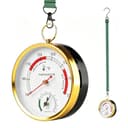
Then mounting, which decides whether you can use it at all. Most of these are wall fixtures with screws, which is right for a wooden cabin or barrel. An infrared cabin panel and a fabric sauna tent are both walls you should not drill, and that is exactly what the lanyard-mounted gauge here solves — it hangs at an adjustable height from any frame or hook. Check this before you check the price, because the wrong mounting turns a gauge you paid for into an ornament.
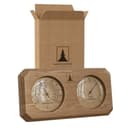
And only then price. The spread on this page is wide, and it does not track documentation at all. What price does buy is material and finish: cedar and pine boards that belong visually in a wooden room, aluminum and stainless that will not care about the steam, and in one case a named instrument company with a support line. Those are real reasons to spend more. Better numbers are not one of them, because the numbers largely are not published.