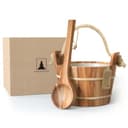
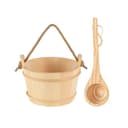
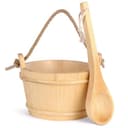
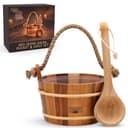
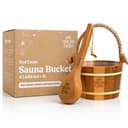
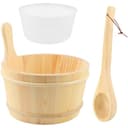
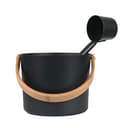
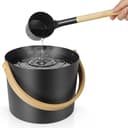
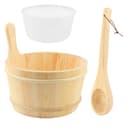
Start with whether the listing names its material. “Wooden sauna bucket” tells you the texture, not the wood. Cedar, pine and aspen all make a bucket; they differ in cost, scent and how the outside weathers, and a seller who will not say which one you are buying has told you something about the rest of the listing too. Two in-stock sets were excluded from this page on that criterion alone. On the metal side the equivalent is the alloy and the coating: “aluminum” with a black finish could be anodized or painted, and neither metal set here says which. That is a real difference in a room that runs at 180°F with water flying about.
Then the bucket capacity, which is a carrying decision as much as a refilling one. The spread here is narrow: 4 liters on every wood set and 7 on the metal ones. Water weighs 2.2 pounds a liter, so a 4-liter bucket is about 9 pounds of water and a 7-liter one about 15— we compute that on every card, because none of the listings does. Four liters is twenty throws at the Harvia maximum, which is more than a session for one person. Seven is for a sauna that several people use in a row, or for whoever would rather carry once.
Then the ladle capacity, the number this page exists to report. Only three of the nine sets publish it, and each of those states 100mL (3.4 oz). Against the 0.2-liter ceiling Harvia prints, that is a half-dose, which is a sensible place to be: two ladles for a big löyly, one for a small one, and no single throw that can splash back. Where the ladle capacity is not published, you find it out with a measuring jug when the box arrives — and if it turns out to hold more than 200 mL, do not fill it.
Then, for wood, the liner — and what it is made of. Every wood set here ships one, so “liner included” is not a differentiator. What separates them is whether the listing names the material (five of sevendo: recycled plastic on one, plain “plastic” on the others) and whether it says the liner comes out to be rinsed (three of seven). A liner that is “built-in” may be fine; it is also a bucket you cannot clean behind. Not one listing here calls its liner food-grade, and one calls it BPA-free without saying what it is.
Then the finish. This is the spec that decides what the bucket looks like after a winter of steam and drying, and three of ninelistings state one: a wax oil, a heat-resistant sauna oil, and — on one pine set — an explicit statement that nothing at all is applied. All three are answers. “Polished to perfection” and “premium natural finish” are not, and that is how the most expensive set here ends up with a blank in that row.
Then whether the listing agrees with itself. This category has a self-consistency problem that instruments do not. One set here states its capacity as 1.85 gallons in the title and 1.87 in the bullets. One says rope handle at the top and “curved smooth-finished handle” below. One bucket is sold under at least three brand names with identical published dimensions and weight. And the set we excluded on the first criterion names cedar and Finnish pine in the same title, then publishes a 4.5-liter liner capacity for a body whose own published dimensions (5.5 inches across, 9.5 tall) enclose about 3.7 liters. None of these is a reason not to buy; every one is a reason to trust the number you can check over the one you cannot.
And only then price. The spread on this page is wide, and documentation does not track it. What money buys is cedar rather than pine, a gift box, a brand with a matching stand-alone ladle you can reorder, and on the metal side a bigger bucket. Those are real reasons to spend more. A better-specified ladle is not one of them, because two pine sets well below the cedar price bracket publish as much about their ladles as the most expensive set does.